Get Full Government Meeting Transcripts, Videos, & Alerts Forever!
Get email alerts on the Police Use Of Force topic
No spam. Unsubscribe anytime.
Clark County holds public fact-finding review after officer-involved shooting that killed Felicia Guzman
Summary
A Clark County public fact-finding review presented a timeline, witness statements, body-worn camera imagery and forensic findings after officers shot and later searched but did not charge the suspect, Felicia Guzman, who died of multiple gunshot wounds.
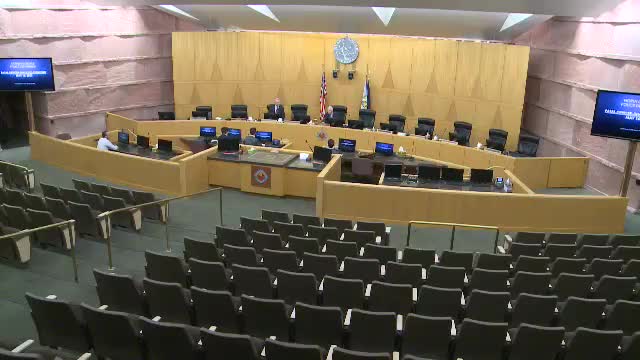
CLARK COUNTY, Nev. — Clark County held a public fact-finding review to present evidence and witness statements about the May 16, 2023, officer-involved shooting that left Felicia Guzman dead.
Presiding officer William Janssen opened the hearing stating that the Clark County District Attorney's Office had made a preliminary determination that no criminal prosecution of the officers involved would be filed and that Clark County Ordinance Chapter 2.12 requires a public review in such cases. Deputy District Attorney Parker Brooks presented the investigative record and called Detective Dave Smith of the North Las Vegas Police Department’s homicide unit as the primary witness.
The investigation timeline introduced at the hearing shows multiple 911 calls beginning at about 4:33 p.m. reporting an assault in which a woman allegedly cut a man. Dispatch logs and Detective Smith's testimony place an additional location-specific call at about 5:07 p.m.; officers Sergeant Salkoff and Officer Caitlin Ebert arrived on scene at about 5:13 p.m. Detective Smith said body-worn camera footage and a scene timeline show Felicia Guzman exited a home carrying a large knife at 5:23:21 p.m., advanced toward officers, and within six seconds the officers fired. Forensic and ballistics evidence presented at the review showed six shots were fired in the brief volley — three rounds fired by Sergeant Salkoff and three by Officer Ebert — and Guzman sustained four gunshot wounds. She was transported to University Medical Center and pronounced dead at 6:59 p.m., the review record shows.
Detective Smith described officers’ commands captured on body-worn camera, including orders to drop the knife and to sit in nearby chairs. The videos shown to the panel included still frames capturing Guzman holding the knife overhead as she advanced and images immediately after the volley showing her beginning to fall. The footage and witness statements led investigators to conclude Guzman did not immediately comply with repeated verbal commands, and officers stopped firing once Guzman was on the ground and no longer an apparent threat, Detective Smith testified.
Officer Ebert told investigators and, in testimony summarized at the hearing, said she believed Guzman was "coming for me." Detective Smith said Ebert then kicked the knife away, handcuffed Guzman and began medical aid; medical personnel arrived within minutes and transported Guzman to UMC. The autopsy, performed May 17 by Dr. Stephanie Yagi, listed cause of death as multiple gunshot wounds and toxicology showing ethanol (alcohol), hydromorphone and a fentanyl metabolite (4‑ANPP), which Detective Smith said could help explain some atypical behavior but that establishing a direct causal link to behavior was not within the scope of the fact-finding review.
The review included testimony about scene conditions and evidence handling: two spent cartridge cases and one casing found in a firearm chamber were microscopically matched to Sergeant Salkoff’s duty weapon; three cartridge cases recovered from the street were matched to Officer Ebert’s handgun. Investigators said some cartridge cases and the large silver knife were recovered in the road and driveway area; photographs shown in the hearing recorded their positions and where officers later found the knife after it was kicked away.
Panel questioning by ombudsman Josh Tomczak focused on whether less-lethal options could have been used. Detective Smith and other witnesses said less‑lethal tools typically require time and distance to deploy — for example, a beanbag shotgun stored in trunk equipment or a K-9 that would not be released off-leash against an armed suspect. K9 Officer Caleb Friedman testified he had been preparing to get his dog, Bolt, from his vehicle but the dog remained in the vehicle when the shooting occurred; Detective Smith said the six-second sequence from Guzman emerging from the house to the shooting removed the time and distance that might have allowed alternative tactics.
Detective Smith summarized witness interviews: an elderly man on oxygen who lived nearby (identified in the investigation as Witness 1) told investigators Guzman had been hearing voices and had used fentanyl and other drugs; a second witness in a nearby garage said Guzman earlier was seen lying in the street and banging her head. During the post-incident property search, investigators recovered drug paraphernalia and items that field tests indicated contained illicit drugs; investigators said they could not determine from the toxicology alone whether substances were administered as part of medical care or were present before transport.
No discipline or criminal charges were announced during the hearing; the purpose was to present the public record following the district attorney's preliminary determination. William Janssen reiterated at the end of the session that the proceeding is not a trial and that no formal legal determination of manner or cause of death would be returned by the review panel. The county posted the video and transcript of the proceedings on the Clark County website for public access, the presiding officer said.
Participants and witnesses at the hearing included the Clark County presiding officer, representatives of the Clark County District Attorney’s Office, North Las Vegas homicide investigators, the two officers involved — Sergeant Salkoff and Officer Caitlin Ebert — a K‑9 handler, physicians who performed the autopsy, and multiple civilian witnesses whose statements and body-worn-camera images were entered into the public record.
The public fact-finding review provided a consolidated presentation of the investigative timeline, forensic findings and witness statements but did not change the district attorney's preliminary decision not to seek criminal charges.