Get Full Government Meeting Transcripts, Videos, & Alerts Forever!
Get email alerts on the Detention Facility topic
No spam. Unsubscribe anytime.
Jacksonville council members discuss next steps after 40-page jail facilities report; estimate of $1 billion cited as high-level benchmark
Summary
Council member Will Layne, newly appointed liaison for the future of the county correctional facilities, and the chair of a prior special committee met in a special notice session to review a 40-page report and a large appendix on Jacksonville Sheriff’s Office detention facilities and to discuss stakeholder mapping, procurement options and a mental-health-focused facility design.
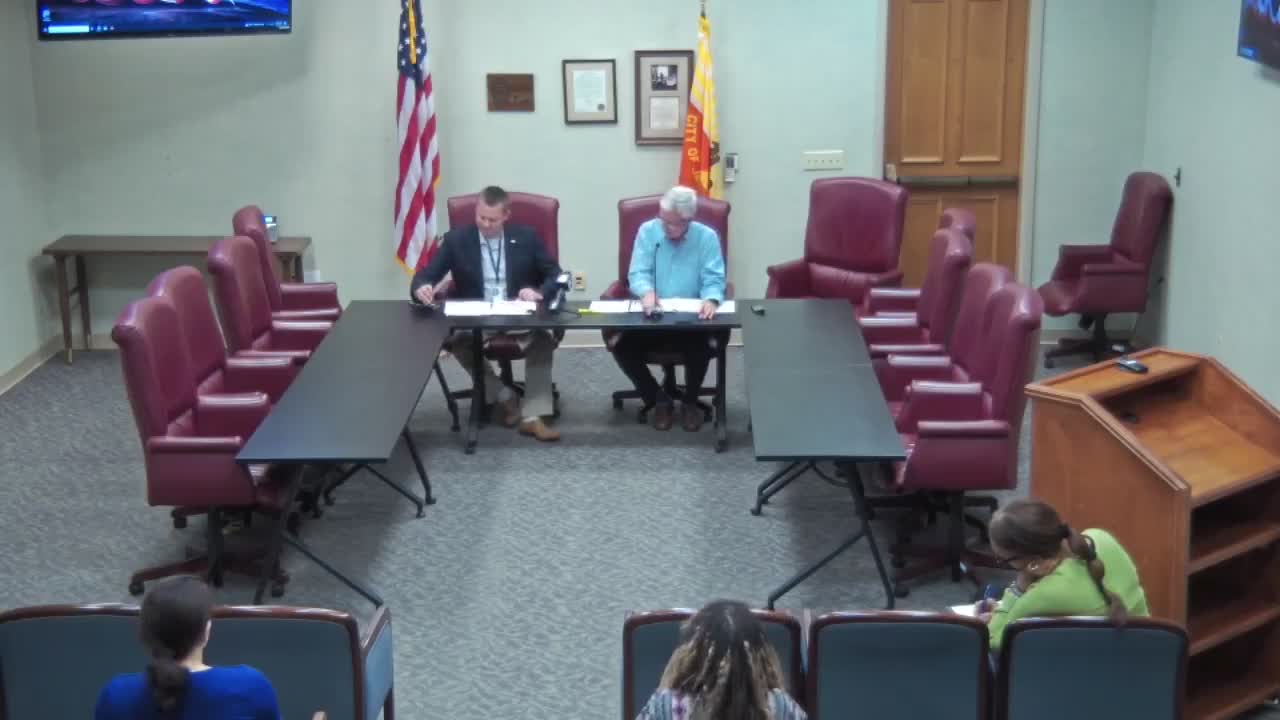
Council member Will Layne, newly appointed liaison for the future of the county correctional facilities, and a council member who chaired last year’s special committee on detention facilities met in a special notice session on Oct. 27, 2025, to review a 40-page facilities report and related appendices and to discuss next steps for evaluating a potential new detention center for Jacksonville.
The meeting focused on three immediate themes: identifying and mapping stakeholders who should be involved in planning, revisiting methodological options presented in the report and appendix, and ensuring facility design emphasizes behavioral and mental-health services. The chair of the special committee urged a deliberate review of multiple vendor presentations included in the report and suggested the city consider a staged procurement approach rather than accepting unsolicited proposals.
"I'm the newly appointed liaison for the future of the county correctional facilities," Will Layne said, describing his early-stage review of the materials and his intent to work with the sheriff’s office and the administration. "I appreciate Council President White appointing me that. And, I am still in the learning phase. ... I look forward to working with the sheriff's office and the administration and I think we've already heard some of the common themes right just to make sure that it's a transparent process that we have community input and then ultimately a financial structure that is, the best, most optimal solution for the city as well and, really most importantly, something that, fits the needs of our, professional corrections officers and all those out of JSO as well."
The committee chair (identified in the transcript as the report author) described the report and a 511-page addendum in the appendix and recommended that the new group begin with "asset mapping of partnerships" to identify stakeholders beyond JSO and public works — including the public defender's office, mental-health providers and community organizations such as Sulzbacher. The chair emphasized revisiting vendor and methodology presentations contained in the appendix and said, "there are options as to how we pursue this" including public–private partnership (P3) models presented by firms that appeared in the report.
On cost, the chair warned the council not to treat a single number as definitive but offered a high-level benchmark: "I think one question ... how much do you think a new jail is gonna cost us? To which my response was a billion dollars." The chair said that estimate came from benchmarking recently built or upgraded facilities around the country (examples cited in discussion included projects in Phoenix and Cleveland) and described it as a "back-of-the-envelope number" rather than a site-specific cost estimate.
The report and meeting discussion emphasized behavioral-health integration in any replacement or renovation. The chair noted that a substantial portion of the jail population has mental-health or behavioral-health needs, referencing the report's finding that "roughly 40 percent have mental health or behavioral health issues" and that "a good number is 60 percent, if not higher, but actually are on some form of medication while they are housed in our facility." Participants said designing a facility to provide on-site behavioral-health services could reduce outside medical costs and better support reentry, but details about staffing models (for example, whether services would be delivered by contracted providers such as UF Health or by other community providers) were not decided and remain part of the evaluation process.
Council members discussed immediate repairs to the existing facility. The committee previously identified urgent needs and the council reallocated about $9,000,000 to address short-term safety and operational issues — described in the meeting as "Band-Aid fixes" for fire pumps, elevators and deferred maintenance. The committee chair urged that the new planning process should not presume a site before the city determines programmatic needs: "we should not determine the where until we determine the what," the chair said.
Multiple vendor presentations are cited in the report’s appendix; the chair pointed to specific page ranges where methodology and design options are documented (examples referenced in the meeting: pages 69–93, 240–269, 334–355, 368–405 and a mental-health-focused presentation at 334–355). The chair recommended revisiting presentations from firms including HDR and the Architect Design Group and reviewing the Center for Public Safety and other interim reports to inform procurement strategy.
Council discussion also referenced alternative short-term facility solutions explored previously, including moving administrative functions to Riverside and the Police Memorial Building as an option for headquarters space. Council members noted that leasing administrative space moves repair and maintenance obligations to a landlord, which could influence long-term cost and procurement decisions for the detention program.
During a brief media exchange, reporter Kaya Wright of WJCT asked whether mental-health services would be on-site or privately contracted. The meeting record states that staffing and operational models will be evaluated as part of the next planning steps and that community mental-health providers should be at the table to specify the physical and operational features they would need to provide services.
No formal motions, votes or contract awards were recorded at this meeting. Council members agreed the next steps should include stakeholder mapping, re-review of appendix presentations and methodology, and further analysis of cost, procurement and grant opportunities. Council members said grant funding and federal resources should be explored if a new facility is designed to incorporate behavioral-health programming.
Looking ahead, the council liaison and the committee chair said they expect further meetings and additional review of appendix materials; the liaison said he would read recommended appendix items and may convene a follow-up session if outstanding questions accumulate.
The meeting concluded without a formal decision; staff indicated they would provide requested copies of the appendix materials to council members who asked.