Get Full Government Meeting Transcripts, Videos, & Alerts Forever!
Get email alerts on the Police Services Contract topic
No spam. Unsubscribe anytime.
Eaton County board authorizes staff to draft 10-year police services contract framework with Delta Township
Summary
The Eaton County Board of Commissioners voted unanimously on June 5 to authorize county leadership to continue drafting a tentative 10-year police services contract framework with Delta Township that would place county deputies on patrol in Delta Township and include provisions intended to address pension liabilities.
The Eaton County Board of Commissioners voted unanimously on June 5 to authorize county leadership to continue drafting a tentative 10-year police services contract framework with Delta Township that would place county deputies on patrol in Delta Township under a paid contract and include provisions intended to address pension liabilities.
The authorization gives county negotiators direction to finalize details of the agreement after the board reviewed a financial framework prepared by the controller’s office. The framework lays out an approximate annual cost to Delta Township of about $8 million, staffing and equipment commitments, a proposed 10-year term with a three-year out option, and an optional one-time contribution to the county pension system intended to reduce future retirement liabilities.
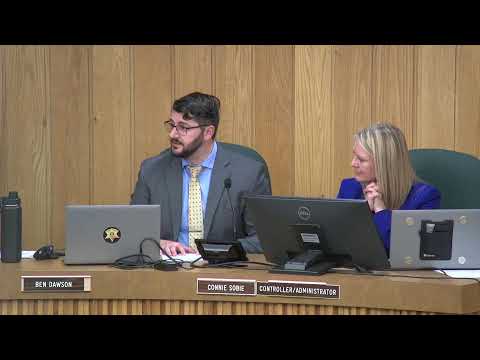
The controller’s office staff member who presented the framework (referred to in the meeting transcript as “Ben”) said the model estimates a contract value of $7,956,816 annually under the scenario shown to the board and the township. The presentation described either 39 positions in the contract model or, in related worksheets, 38 sworn officers plus two clerical positions; the presenters described additional command and deputy positions compared with prior arrangements. The framework also includes a 15% administrative fee; the plan allocates 33% of that fee toward retirement liability reduction.
Under the framework presented, Delta Township could make a one-time prepayment to the county’s retirement groups (discussed at a $2,000,000 level in the model) that would be credited against future payments. The controller’s office presenter said the plan uses a mid-range MERS (Municipal Employees’ Retirement System) earnings assumption of 5.93% for valuation crediting. Using the scenario shown, the presenter said the combined effect of the county’s unallocated pension funds plus a $2 million Delta payment and other commitments could result in roughly $9 million in contributions to the pension groups over the 10-year term (principal plus projected earnings), though the presenter described this as modeling rather than a finalized projection.
The framework also specifies operational points the board discussed: annual reconciliation of actual personnel, supplies and equipment costs (so credits or overages would be reconciled at year end), dedicated positions for a violent crimes unit deputy, a field training officer and quartermaster, and continued use of the state secondary road patrol grant for some deputy activity. Presenters emphasized that the administrative percentage would not be reduced by year-end reconciliations and that vacancy, overtime and other operational variances would be reconciled separate from the administrative fee.
Sheriff Reich, who spoke after the presentation, warned the board that the contract would increase enforcement activity and therefore increase the volume of arrests, reports and prosecutions. He said, “Justice system is a chain, not a silo. If we only staff the front end, meaning the deputies, and cut the back end, which is prosecution, we create a bottleneck.” He urged commissioners to consider effects on prosecutor and court workloads when weighing expanded patrol coverage.
Commissioners asked for clarifications on staffing, costs and mutual-aid arrangements. Questions and clarifications in the meeting record included: whether deputies assigned to Delta would still respond to extreme emergencies elsewhere in the county (the sheriff said deputies would respond to extreme violent incidents), how vacancies and overtime would be handled (presenters said overtime and vacancy costs would be reconciled), the distinction between a training officer and a field training officer, and that the county would retain employer liability for deputies even while they are assigned to Delta under contract.
The board’s motion, moved by Commissioner Haskell and supported by Commissioner Pearl Wright, authorized county leadership to pursue a negotiated contract based on the presented framework and to return a finalized agreement for consideration at a future meeting. The motion did not finalize contract language; presenters repeatedly stated the meeting’s vote provided direction to continue drafting and negotiating rather than enacting a final contract.
A separate, earlier procedural action placed the board into closed session pursuant to MCL 15.268(1)(h); that motion was moved by Commissioner Arndt and supported by Commissioner Toomey and was approved in roll call prior to the substantive discussion on the Delta framework.
The board recorded a unanimous roll-call vote to authorize staff to continue negotiations. The roll-call recorded “yes” from Commissioner Art, Commissioner Peake, Commissioner Haskell, Commissioner Pearl Wright, Commissioner Whitaker, Commissioner Mudry, Commissioner Broshaw, Commissioner Toomey, Commissioner Hansen, Commissioner Christiansen, Commissioner Holmes, Commissioner Barber and Chairman Mott.
The presenters and several commissioners emphasized the framework was intended to stabilize services for Delta Township while offering the county additional time—via the proposed three-year opt-out window—to plan for pension and service-level impacts if Delta later chose to end the contract. Presenters said the three-year out option was intended to provide more transition time than prior one-year provisions would allow.
Board members and staff repeatedly cautioned that the figures shown were framework-level modeling and that final contract language, staffing lists, and precise fiscal impacts would be developed during ongoing negotiations and returned to the board for approval.
The board adjourned after the discussion and vote.