Get Full Government Meeting Transcripts, Videos, & Alerts Forever!
Get email alerts on the Student Devices Policy topic
No spam. Unsubscribe anytime.
Wake County Board adopts revised cellphone policy after hours of amendments
Summary
The Wake County Board of Education approved Board Policy 43.18 on the second reading after hours of debate and multiple amendments that set districtwide limits and exceptions for student personal wireless device use.
The Wake County Board of Education on June 3 adopted Board Policy 43.18, governing student use of personal wireless communication devices, on its second reading after extended debate and several amendments.
The approved policy requires students to keep personal devices silenced and put away during instructional time; the board split rules by level, limiting device use most strictly in elementary schools and allowing more noninstructional access at high schools. The board also added explicit exceptions to protect students with documented needs: individualized education programs (IEPs), Section 504 plans, individual health plans, safety plans, documented translation or assistive-communication needs, and cases where school staff authorize brief, reasonable use to contact someone outside school.
Dr. Julie Crane, chief policy staff, presented the draft and walked the board through counsel’s recommended edits before debate began. “We are bringing to you tonight draft policy 4 3 1 8, student use of personal wireless communication devices, for your approval on second reading,” Crane told the board during the presentation.
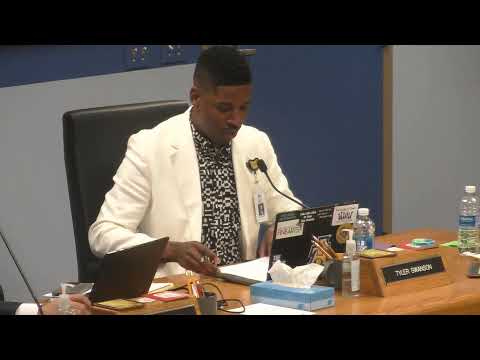
Board members debated multiple attorney-recommended changes, whether principals or teachers should be allowed to authorize device use during instruction, and how much discretion individual schools should have. Vice Chair Tyler Swanson and several principals had earlier argued for a clear districtwide baseline; other board members pushed to preserve some school-level flexibility for noninstructional times at high schools.
Boardmember Kristen Mahaffey offered an amendment setting a progressive rule by grade band: elementary students must keep devices silenced and put away while on campus; middle school students must keep devices silenced and put away between morning and afternoon bells; high schools would permit specified noninstructional use (class transitions, lunch, other noninstructional times) consistent with district guidance and as permitted by law. Mahaffey also successfully moved an amendment to require that, before any temporary confiscation, “the student will first receive a verbal warning to put their device away and/or silence their device.”
Several board members pressed for clarity about accommodations. After public comment and board discussion, the policy was revised to explicitly include IEPs, Section 504 plans, individual health plans, safety plans, and approved translation or assistive-communication devices as exceptions. During debate, board members referenced concerns raised in public comment that some students rely on wireless devices for communication and regulation; boardmember Ian Hershey said the changes should reflect the district’s survey data about current school practices.
The board also tightened language around searches and inspections of devices: a board amendment changed the threshold in the policy text to reference “reasonable suspicion” for searches of personal devices and linked to existing student-search procedures and the student code of conduct.
After the amendments were made and additional technical edits were reviewed, the board moved to a final voice vote. Chair Haggerty called for a voice vote and said, “All in favor of the policy, say aye.” Members responded and the chair stated the policy passed on second reading.
The board repeatedly noted that parts of the policy reflect anticipated or pending state legislation and retained the ability to revise the local policy if state law ultimately prescribes different requirements. Board members also signaled they expect staff to produce consistent district guidance and administrative procedures to implement the policy at schools.
The newly adopted policy will be posted with the board’s other policies. Implementation details — including any districtwide administrative rules and staff training plans — will be developed by central office staff and communicated to schools, the board said.