Get Full Government Meeting Transcripts, Videos, & Alerts Forever!
Get email alerts on the Computer Science Education topic
No spam. Unsubscribe anytime.
Leesburg IT commissioners and Loudoun schools plan internships, cyber pathway and hackathons
Summary
Loudoun County Public Schools officials outlined an expanded K–12 computer science pipeline, a four-year cybersecurity pathway and work-based learning efforts, and asked Leesburg commissioners and local businesses to partner on internships, hackathons and small-business tech assistance.
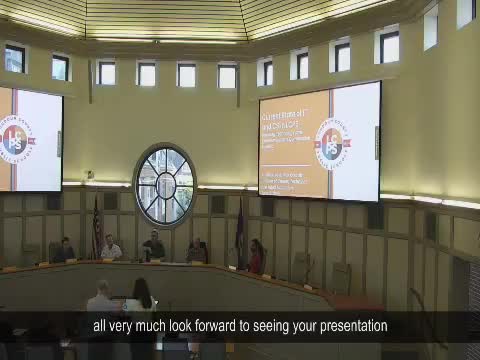
Representatives from Loudoun County Public Schools told the Town of Leesburg Information Technology Commission Tuesday evening that LCPS has expanded K–12 computer science offerings and is seeking local industry partners to provide internships, externships, guest speakers and hackathon projects for students.
The presentation by Nick Rizzida, computer science supervisor for Loudoun County Public Schools, and Christina Lee, work-based learning coordinator for the Division of Career, Technical and Adult Education, summarized LCPS’s K–12 pipeline, the division’s experiential learning efforts and specific outreach opportunities for Leesburg businesses and town departments.
Rizzida said the division received a GO Virginia grant "for $2.4 million" that helped establish the current pipeline and that LCPS now integrates computer science across its 60 elementary schools and 18 middle schools and offers standalone secondary courses. "We offer more computer science courses than any other school division in the Commonwealth," he said, noting LCPS offers about 26 distinct computer science classes at the high school level and AP Computer Science A at all high schools.
Why it matters: LCPS said the expansion is creating student demand for local work-based learning and internships, and the division asked the commission and Leesburg business community to help provide placements, capstone projects and real-world case studies that can be embedded in classroom curricula.
Key details from the presentation and discussion: - Curriculum and credentials: Rizzida described a K–12 model that introduces block-based programming early, a progression into Python and C++ through robotics (VEX V5), and higher-level courses with dual-enrollment options through NOVA Community College that can yield about eight college credits after a year of CSC coursework. Staff discussed industry credentials such as CompTIA A+ and Security+ and the question of whether to add database or other credentials. - Work-based learning structure: Christina Lee outlined a four-tier partnership framework (advisory, hiring/internships, volunteers and sponsorship) and said the Loudoun Education Foundation helps secure paid internship funding. She described a summer "Jump Ahead" program to let businesses pilot internships and said Amazon and partners will run a two-week coding camp at the AWS Think Big Space at Jay Lupton Simpson Middle School July 7–18. - Internship demand and constraints: Lee said the Virginia Department of Education’s current framework counts a set of work-based learning experiences toward program completer status and that internships carry a 280-hour requirement: "An internship is 280 hours," she said, emphasizing that students’ academic schedules make that requirement difficult to meet during the school year. LCPS is testing alternatives such as early-morning assignments in schools (digital experience specialist roles) and summer programs. - Resource teachers and coverage: LCPS plans to add five regional work-based learning resource teachers to support all high schools; the presenters listed first names of the regional assignments (Kirsten, Angie, Susan, Derek and Kelly) and said each group of high schools will be assigned a resource teacher to connect businesses with students. - Local partnerships and pilot ideas: Leesburg commissioners and attendees suggested municipal hackathons, case-study projects from small businesses (for example, point-of-sale security or chatbot deployment) and inserting information about school partnership opportunities into the town’s business-license or onboarding materials. Commission members offered to help recruit local businesses and subject-matter experts and proposed short seminars (for example, how to write an incident-response plan) that could involve high school students.
Quotes from presenters "We offer more computer science courses than any other school division in the Commonwealth," Rizzida said while describing LCPS’s secondary offerings, robotics and dual-enrollment pathways. Christina Lee described the internship-hour challenge plainly: "An internship is 280 hours," she said, noting the difficulty for students who carry full academic schedules.
Concerns and constraints noted in the meeting included the 280-hour internship requirement, the mismatch between business hours and student school schedules, and seat-time rules that limit how field experiences can be credited. Presenters and commissioners discussed partial solutions such as virtual internships, summer intensive programs, early-morning school assignments and pilot projects that could be converted into course credit.
Next steps and follow-up Commission members and LCPS staff agreed to set a follow-up meeting to refine possible pilot projects, identify business partners (including small Leesburg firms and regional IT companies) and explore logistical fixes for internship credit. LCPS representatives said they will share the work-based learning handbook and the workforce toolkit and that the Loudoun Education Foundation can help sponsor student stipends. The commission also indicated interest in hosting or promoting hackathons tied to municipal datasets and in recruiting subject-matter experts to serve as guest speakers.
The meeting ended with one formal action: the commission approved a motion to adjourn at approximately 8:13 p.m.