Get Full Government Meeting Transcripts, Videos, & Alerts Forever!
Get email alerts on the Renewable Energy topic
No spam. Unsubscribe anytime.
Denton Utilities staff seeks council direction to formalize renewable-energy policy and start 20-year integrated resource plan
Summary
Denton Municipal Electric staff briefed the City Council on updates to the city's Renewable Resource Plan, recommended a new municipal renewable energy policy and a 20-year integrated resource plan, and asked for direction on handling RECs, large loads and future procurement; council signaled support to proceed.
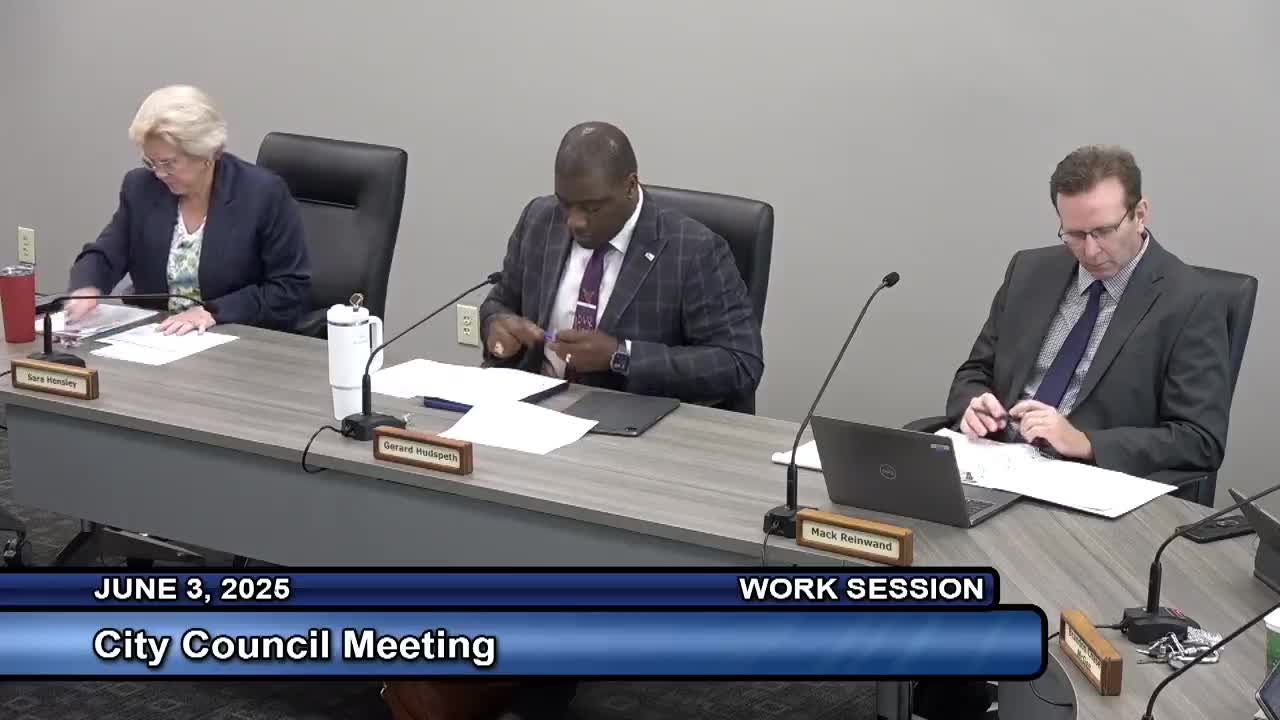
Tony Puente, general manager of Denton Municipal Electric (DME), told the City Council on June 3 that staff recommends two linked steps: adopt a city renewable energy policy that sets how Denton will count and retire renewable energy credits (RECs) and compliance premiums (CPs), and develop a 15-to-20-year integrated resource plan (IRP) to assess supply, demand-side management and long-term reliability.
The recommendation comes after Denton exceeded earlier local renewable targets and has about 455 megawatts of contracted capacity under PPA; Puente said the utility currently counts roughly 200 MW of that capacity for planning because solar and wind do not generate at full-rated capacity. He said DME expects to remain short of dispatchable generation and to rely on market purchases of RECs to fill annual gaps unless the council directs otherwise.
Why it matters: DME faces growth in load, potential large new customers such as data centers, and increasing regulatory uncertainty in ERCOT, including bills and proposals that would change interconnection and firming rules. Staff said a clear municipal policy on RECs and a long-term IRP would give a consistent accounting method, improve public reporting and create a framework to evaluate large loads and long-term contracts.
Puente summarized the staff recommendations and key policy parameters: limit REC purchases for municipal accounting to RECs generated in the same calendar year they are retired; retire ("mature") RECs and CPs that Denton counts rather than reselling them; avoid rolling excess RECs from year to year; and evaluate large loads (staff proposed a 5-megawatt threshold for internal review, with a note that state SB6 identifies 75 MW as a state large-load threshold). "If we're gonna count the RECs, we're gonna retire them in the year in which we count them," Puente said.
Council members pressed staff on specifics of the REC market and on risks posed by large customers. A council member asked whether buying RECs on the secondary market could mean Denton was purchasing RECs previously counted by another buyer; Puente said using same-year RECs reduces but does not eliminate that possibility. Another member asked whether counting RECs to claim 100% renewability while the city's own dispatchable generation remains online was "double-dipping." Puente replied that staff did not recommend buying RECs to offset generation at Denton Energy Center; instead, RECs should be used to cover the gap between renewable generation and load served.
On large loads, staff noted SB6 requires interconnection cost responsibility for large customers and said DME's internal threshold of 5 MW reflects local transmission constraints and a desire to limit exposure from long-term PPAs with speculative customers. "Not all large loads are created equal," Puente said; staff proposed a differentiated approach that could include short-term REC offsets during a probationary period for customers that lack long-term creditworthiness.
On the IRP, Puente recommended hiring an external consultant to lead a formal public-engagement process and produce a planning document that would be revisited regularly. He said staff expects the IRP process to take 18 to 24 months and the renewable policy work to take 6 to 9 months. He also reported the Planning and Advisory Board (PAB) had given unanimous direction to proceed.
Council response and next steps: Council members repeatedly expressed support for both steps and for robust public engagement; one member explicitly said they "support both staff recommendations." The council did not adopt an ordinance or resolution at the June 3 meeting; staff asked for direction to proceed with drafting the renewable policy and initiating the IRP process and to return with policy language and a timetable. The council indicated support for staff to move forward with the recommended schedule and public outreach.
Clarifying details and cost signals: Puente provided examples and numerical context during the presentation: DME served about 1.6 million MWh in 2021 and contracted renewable generation produced about 1.3 million MWh, leaving a deficit that was filled with replacement energy and RECs; Puente said DME expects to continue buying REX (RECs) when needed and estimated the total current REC inventory had market value in the $5'$6 million range if monetized. He also noted that some new regulatory proposals (HB 1500, SB 388, and other performance-credit mechanisms discussed at the state level) could change firming and backup requirements for renewables in the future and raise the cost of new PPAs.
Ending note: Staff will return with draft policy language and an IRP procurement plan. The council's direction to proceed does not bind the city to a particular future mix of resources or to a continued 100% renewable accounting approach; Puente clarified the city could change course if circumstances change.
"This plan spans a 15 to 20 year life," Puente said. "It is a living document."