Get Full Government Meeting Transcripts, Videos, & Alerts Forever!
Get email alerts on the Code Enforcement topic
No spam. Unsubscribe anytime.
Miami Code Enforcement Board grants dozens of extensions, reduces or waives fines in multi-case session
Summary
At a lengthy City of Miami Code Enforcement Board hearing, members granted routine extensions of time for dozens of properties and decided mitigation requests that in several cases reduced liens to thousands or to zero. The board cited permit-review timelines and pandemic-era contractor problems in several decisions.
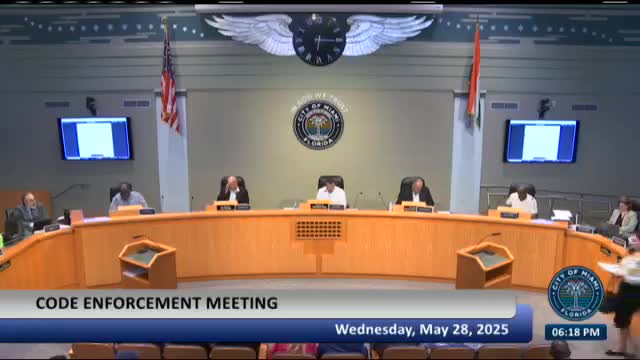
The City of Miami Code Enforcement Board on an evening hearing approved extensions of time for scores of properties and considered dozens of mitigation requests, ranging from modest reductions to full waivers of liens.
Board Chair (unnamed) opened the session by telling attendees how the meeting would run and directing property owners to the city website for paying fines or applying for extensions. The chair also reminded those present that “Any order to the board can be appealed to the Eleventh Judicial Circuit Court of Florida within 30 days.”
Why it matters: Code enforcement decisions determine whether property owners must pay city fines or are allowed more time to correct building and maintenance violations. Many of the cases heard involved after-the-fact permits, unsafe-structure corrections and disputes over whether work was timely completed or permits properly requested.
What the board did
- Extensions of time: The board routinely granted extension requests for dozens of properties across the city, most commonly approving 120-day extensions where permits were in review or contractors were changing. For example, property owners represented by attorneys asked repeatedly for 60–120 days to finish permitting and inspections; in many instances staff recommended 120 days and the board approved that recommendation by voice vote.
- Special appearances and partial releases: Stirrup Properties requested a special appearance and a partial release tied to the city’s affordable-housing financing. David Porter, president of Stirrup Properties, told the board he had applied online for mitigation and hoped to resolve the fine before closing; the board approved a partial release for one Miami-Dade property so a sale could proceed and asked Stirrup to return later on mitigation.
- Mitigation votes and amounts: The board took mitigation votes on many individual liens. Highlights include: - Patricia Thomas (98 NE 70th St.): Two large liens (one shown in the Code Check packet, one in CityView) were mitigated to $0 after she described squatters, multiple evictions and other circumstances that prevented her from addressing the property sooner. Thomas told the board the property was given to her after a relative’s death and that she had difficulty securing the house from squatters. - Multiple owner-occupied and homestead properties received substantial relief (including multiple cases reduced to $0), generally when members said the owner had shown hardship or had completed corrections and missed a procedural deadline for requesting an extension. - Several commercial and income-producing properties received reductions to the minimums allowed by the mitigation matrix (for example, commercial properties were commonly reduced to a $15,000 floor, vacant lots to $7,500, and duplex/non-owner-occupied properties to $10,000, where applicable). In some cases the board voted to set amounts lower based on the board’s discretion when permitted by the matrix.
What speakers said
- Eddie Baker, attorney representing a property owner who was pulled out of order because he had a flight, asked for “a hundred and 20 days” for two units at 40 NE 1st Ave. The board approved the 120-day extension.
- Andres Rivero, attorney for a large vacant lot development, described ongoing work and requested 60 days; the board ultimately approved a 120-day extension for the cluster of related properties.
- David Porter of Stirrup Properties said he had applied online for mitigation and asked the board to coordinate a partial release tied to an affordable-housing closing; the board approved a partial release for a Miami-Dade parcel and instructed the owner to pursue mitigation in a later session.
Context and common reasons for relief
City staff repeatedly told the board that many permit applications were in “applicant correction” or “review” status; the board often granted extensions to allow plan reviews and contractor changes to play out. Several mitigation requests cited probate, illness, travel abroad, contractor fraud or multiple contractor failures — circumstances board members cited when making relief decisions.
What’s next
Owners granted extensions were advised how to request additional time if necessary. Owners who received mitigation orders were told how to pick up their signed orders and of the 30-day window to appeal to the Eleventh Judicial Circuit Court of Florida.
The board adjourned after considering the last mitigation and extension items scheduled for that meeting.