Get Full Government Meeting Transcripts, Videos, & Alerts Forever!
Get email alerts on the Oha Budget Fy26 27 topic
No spam. Unsubscribe anytime.
OHA administration recommends raising spending limit and separating non‑OHA CIP to balance FY26–27 budget
Summary
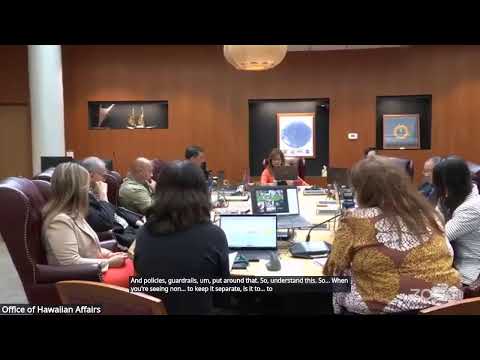
Administrator and CEO Stacy Ferreira told the Office of Hawaiian Affairs Budget and Finance Committee on June 2 that administration recommendations and revised figures could balance the FY26–27 operating budget if trustees agree to raise the spending limit to 5% and to move non‑OHA capital requests into a separate discretionary grants‑in‑aid process.
Administrator and CEO Stacy Ferreira told the Office of Hawaiian Affairs (OHA) Budget and Finance Committee on June 2 that administration recommendations and revised numbers put the agency in a position to meet the board’s June ratification deadlines if trustees approve two key process changes: raising OHA’s spending limit to 5% and moving non‑OHA capital improvement project (CIP) requests out of the operations budget and into a separate discretionary grants‑in‑aid process.
Ferreira said the current spending limit of 4.4% equates to $49,436,652 for fiscal year 2026 and $51,598,221 for fiscal year 2027. “I’m recommending that we raise the spend limit from 4.4% up to 5%, which adds 2,500,000.0 to each fiscal year,” Ferreira said, noting a 5% limit would increase the available operating draw to $51,936,652 for FY26 and $54,098,221 for FY27.
The recommendation to separate non‑OHA asset CIP requests follows “the same practice that the state legislature follows,” Ferreira said, explaining that migrating non‑OHA asset requests to a standalone funding allocation would prevent delays to ratifying OHA’s core operating budget and allow the board time for due diligence, policy review and to identify funding sources. Ferreira told trustees the administration had identified three non‑OHA CIP requests totaling $2,550,000 for FY26 and $2,375,000 for FY27 and recommended those be treated as discretionary grants‑in‑aid pending board policy.
Why it matters
The changes would alter how OHA presents and approves its biennial operating budget. Separating non‑OHA CIP from core operating costs would narrow the operating budget to OHA‑owned assets and routine operations, while large infrastructure or partner projects would be considered through a separate discretionary process. Raising the spend limit to 5% would provide about $2.5 million more per fiscal year under current trust valuation assumptions, reducing reported deficits in some scenarios.
Details and administration estimates
- Administration’s point‑in‑time comparisons: an April 30 administration request showed lower totals; after trustee briefings in May, additional requests had grown but were pared back before the June 2 update. Ferreira said that, at one previous briefing (5/28), additional requests totaled about $5.65 million for FY26 and $4.23 million for FY27, and that work over the weekend reduced those additional requests.
- Non‑OHA CIP: Ferreira identified three projects classified as non‑OHA CIP—totaling $2,550,000 in FY26 and $2,375,000 in FY27—and recommended extracting them from the core operating budget for separate board consideration and potential treatment as grants‑in‑aid.
- Carryover/discretionary funds: Ferreira said OHA currently holds roughly $5,000,000 in carryover discretionary funds and recommended the board discuss whether to place such carryover into a fiscal stabilization fund (which would be exempt from the spending limit) or apply it to non‑OHA CIP; she said further guidance from trustees is needed.
Personnel and compensation changes
Finance staff (Grace Chen) and administration presented personnel scenarios used in the revised tables. Grace Chen described three personnel scenarios: a conservative baseline with vacancy assumptions (about $20.7 million), a fully loaded payroll scenario (approximately $24.9 million), and a prorated/onboarding scenario that produced a personnel estimate near $20.65 million for FY26. Ferreira said the administration is proposing to recruit and adjust pay for several senior positions, including a chief financial officer and interim corporation counsel, and to align selected senior positions to market benchmarks informed by state salary commission reports.
Endowment/investment office funding and staffing
Ryan Lee, endowment director, explained the projected increase in the spending allowance between FY26 and FY27 was tied to the spending formula and market value smoothing: “it’s based on the spending formula, because we’re capturing high market values… we’re capturing the last 5 years of market value,” Lee said. He and trustees discussed funding for an endowment or investment office, with administration estimating a FY26 investment‑office package of roughly $1,048,000 (including contracts, equipment and personnel placeholders) under scenarios trustees requested. Trustees and staff discussed using basis‑point ranges (staff cited roughly 15–25 basis points as a typical management cost range) to size the investment office budget and to determine competitive compensation for an endowment director and supporting staff; administration said some endowment‑related compensation would be charged to noncore trust funds rather than the core operations budget.
Trustee reaction and next steps
Multiple trustees expressed support for Ferreira’s plan to separate non‑OHA CIP and to expedite ratification of the operating budget, while asking for the detailed line‑by‑line tables that administration and finance staff said they would circulate later the same afternoon. Trustee comments emphasized the need for granular, traceable figures: trustees repeatedly asked staff to show the original requests, the trustee‑initiated additions, and the administration’s adjusted amounts so the board can decide what to keep or remove.
Administration requested trustee guidance on whether to remove non‑OHA CIP items from the operations presentation; several trustees supported the separation as a process matter, but trustees did not take a final vote on budget ratification or on permanently adopting the proposed separation during the meeting.
Adjournment
The committee adjourned following a motion to adjourn; the clerk recorded several trustees saying “Aye” and the meeting was closed.
What remains open
Trustees asked for a revised, line‑by‑line budget packet that will show: original asks, adjusted amounts, personnel assumptions (vacancy and prorating), and the specific items included in the roughly $4,000,000 of additional requests the administration had revised. Administration said it will provide the detailed tables and a draft org chart with new positions for trustee review and signaled willingness to schedule additional budget meetings if needed to complete deliberations before board ratification deadlines.