Get Full Government Meeting Transcripts, Videos, & Alerts Forever!
Get email alerts on the Special Use Permits topic
No spam. Unsubscribe anytime.
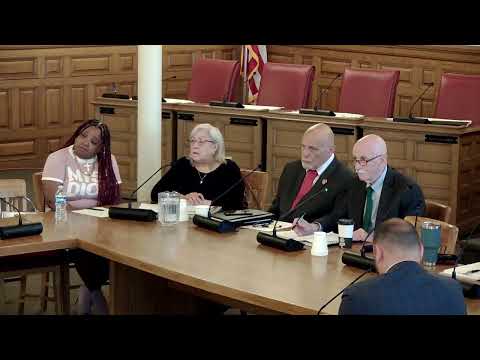
Syracuse council hears competing views on special-use permit requests for two corner stores amid code and safety concerns
Summary
At a Syracuse Common Council hearing, staff and police detailed long-running code, tobacco-sales and public-safety problems at 1205 South Geddes Street and 2000 East Fayette Street while applicants and neighbors urged allowing stores to reopen; no final council decision was recorded.
The Syracuse Common Council on an unspecified date heard testimony about two special-use permit applications for corner stores at 1205 South Geddes Street and 2000 East Fayette Street, focusing on code-enforcement histories, alleged illegal tobacco sales and concentrated police calls.
Code-enforcement staff told the council both properties have long records of violations and public-safety problems that factor into whether a special-use permit (SUP) should be issued. “Out of the 57 violations issued since 2020, nothing really has been done,” a codes representative said regarding 1205 South Geddes Street. For 2000 East Fayette Street, staff said “13 violations have been issued in all, in total since 2022,” and that electrical work performed without permits and continued tobacco sales prompted denial of a usual business certificate of use.
Why this matters: Planning and public-safety testimony framed the SUP decisions as weighing neighborhood access to small stores against documented crime, sanitation and code issues. The Planning Commission advised the council with a Crime Prevention Through Environmental Design (CPTED) review for both sites; council members were told the commission’s findings are advisory while the council can weigh broader public-safety and health impacts.
1205 South Geddes Street Jake, the city codes staff member who summarized the file to councilors, said the building has had many commercial occupants but none since February 2016 held a valid business certificate of use. Codes staff noted property-maintenance violations, reported illegal sales of a synthetic product referred to in testimony as “spike,” and trash and sanitation problems. Staff said the upstairs apartments are occupied, which raised concern about living conditions tied to building violations. The transcript shows multiple alternate spellings of the street and business history in public remarks; staff described a “new business proprietor at the moment” but said ownership of the property itself had not changed.
The applicant’s attorney, Craig Billinson, told the council he had just taken the case and that his client had spent money on repairs. “He’s spent over $30,000 in repairs, improvements, trying to correct code violations, cleaning up the place,” Billinson said. The store owner, Amar Aziadi, addressed the council through an interpreter and through his attorney, saying he hired a licensed electrician and “I fixed the electricity, I cleaned the garbage,” and that he had not opened the store while pursuing the permit process.
Neighborhood speakers offered mixed testimony. Resident Sophia Lewis said the store is the only early-morning option for her and others: “He’s the only store that opened up at 07:00 in the morning… it’d be a bad thing for it to close.” Another public commenter and a planning-commission member urged careful application of CPTED recommendations before any council action.
2000 East Fayette Street Codes staff described a separate track of violations at 2000 East Fayette Street, including unpermitted electrical work in 2024 and a finding that the store sold tobacco without a City of Syracuse license on Nov. 26, 2024. Staff said the business certificate of use was denied for selling tobacco after a cease-and-desist letter and that, unlike the Geddes property, this location did not stop selling after the initial letter. Staff summarized: the property “had extensive electrical work done without a permit” and later had that work corrected by a licensed electrician after enforcement action.
Deputy Chief Rich Shaw of the Syracuse Police Department told the council he reviewed two years of police calls for 2000 East Fayette and described a high concentration of incidents. “But between all these calls, probably over a hundred calls in a 2 year period,” Shaw said, and he listed incidents including a July 23 homicide of a 15-year-old, assaults, robberies, and suspected arson. Staff also reported roughly 68 alarm calls and about 60 proactive police property checks at that location over the two-year span.
The store’s representative said the current proprietor took ownership in mid-2024 and has since invested in repairs and security cameras. The lawyer for that owner said the client voluntarily kept the store closed pending the special-use and certificate-of-use process and had complied with many code corrections.
Planning commission and CPTED Barry Lentz, a member of the Syracuse Planning Commission, told the council the commission is advisory and stressed the value of CPTED reviews. “Crime prevention through environmental design,” Lentz said, summarizing the tool the commission used to recommend conditions that could allow a store to operate more safely. City staff and police described implementing CPTED recommendations in other cases—lighting, cameras, counter configuration and other measures—and said compliance with those measures is often a condition of recommendation.
Outcome and next steps No formal permit decision was recorded in the hearing transcript. The council heard the evidence, public testimony both for and against allowing the stores to operate, and discussions of CPTED conditions and enforcement history. A motion to adjourn the meeting occurred at the end of the record; no vote on either special-use permit appears in the transcript provided. The council, as the final decisionmaker on SUPs, will weigh the planning commission’s advisory findings, CPTED recommendations, code-enforcement histories and public-safety information when it issues any future decision on the applications.
The record contains variations in spelling and timing reported by speakers (for example, multiple renderings of the Geddes street name and slightly different accounts of when new proprietors took over). Where dates or totals were not specified in testimony, the article indicates when those items were not specified in the record.