
Senate Finance Hears NDOC $44.7 Million Supplemental to Cover Overtime, Staffing Shortfalls
Get AI-powered insights, summaries, and transcripts
Subscribe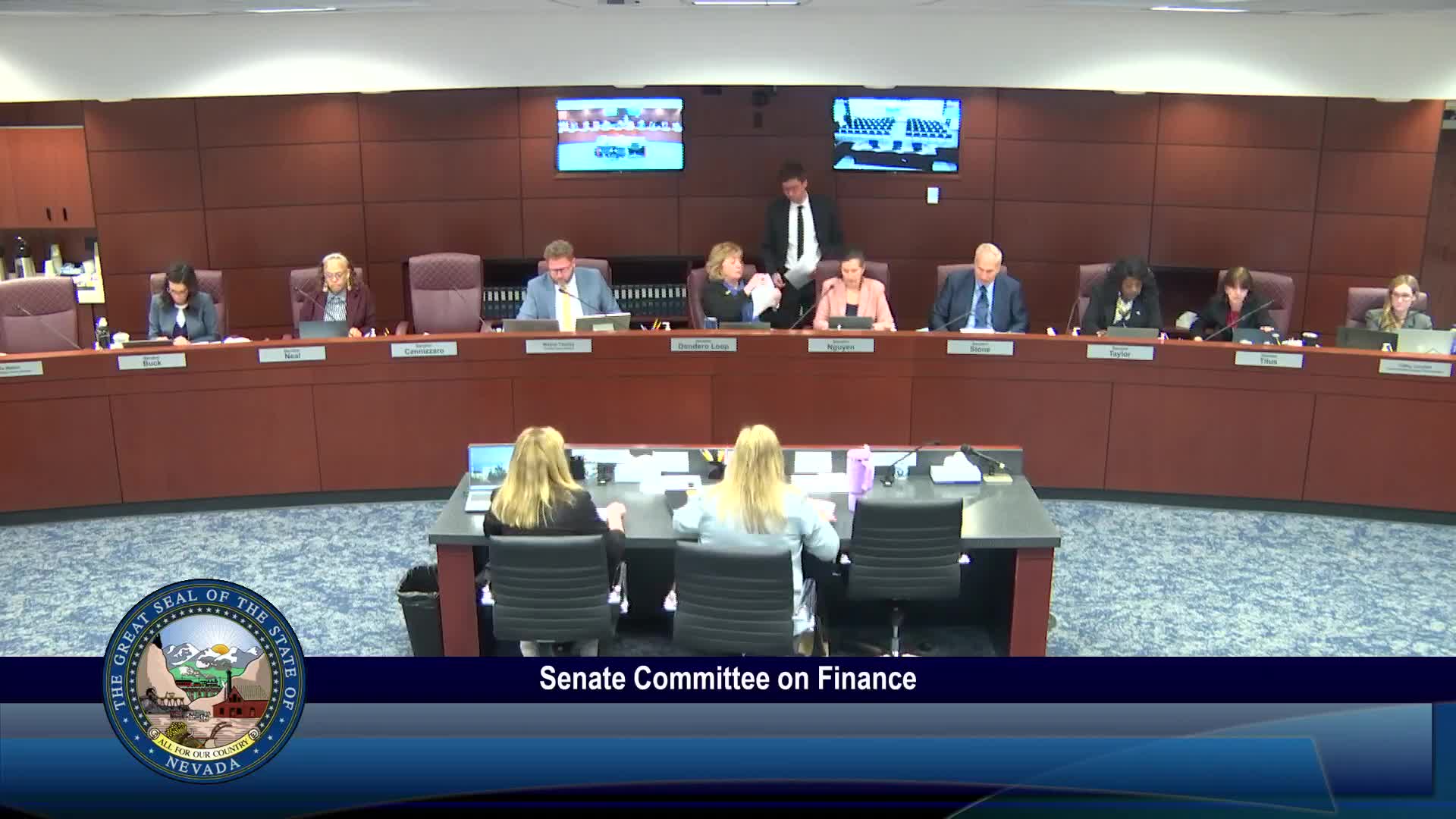
Summary
The Nevada Senate Finance Committee on Wednesday heard testimony on Assembly Bill 581, a supplemental appropriation request to move State General Fund dollars into the Nevada Department of Corrections to cover anticipated shortfalls, largely driven by overtime and staffing gaps.
The Nevada Senate Finance Committee on Wednesday heard testimony on Assembly Bill 581, a supplemental appropriation request that would move State General Fund dollars to the Nevada Department of Corrections (NDOC) to cover shortfalls across multiple facilities.
The request presented by Katie D'Socio, deputy director of support services for the Department of Corrections, totaled multiple line-item appropriations including $2,929,232 for Northern Nevada Correctional Center; $261,455 for Stewart Conservation Camp; $250,794 for a second conservation camp budget account; $222,749 for Nevada Northern Nevada transitional housing; $867,707 for 3 Lakes Valley Conservation Camp; $5,000,133.05 for Southern Desert Correctional Center; $213,574 for another conservation camp; $3,896,945 for Ely State Prison; $53,139 for Carlin Conservation Camp; $3,217,122 for Lovelock Correctional Center; $3,164,040 for Florence McClure Women's Correctional Center; $15,000,780.71 for High Desert State Prison; $6,374,786 for prison medical; and $2,363,002 for the Office of the Director. D'Socio said the appropriations are for anticipated shortfalls in personal services, utilities, maintenance contracts and inmate-driven expenses.
Why it matters: lawmakers expressed alarm that much of the shortfall is tied to overtime and long-standing vacancy and payroll-oversight issues. Senator James Stone opened the questioning by observing the request "about $44,000,000 today" and asking whether a majority of that was overtime; D'Socio responded, "Yes, sir. That's correct." Tiffany Greenemeyer, speaking for the Governor's Finance Office, told the committee the total could be higher: "it's probably gonna end up being around $53,000,000, pretty close to it."
Committee members pressed NDOC and the Governor's Finance Office on causes, accountability and remediation. Senators cited a vacancy factor D'Socio estimated at about 16 percent and an overtime-reduction plan that NDOC says has produced roughly a 20 percent decrease in overtime over the last four pay periods. Committee members repeatedly raised a history of audits and prior warnings; the Governor's Finance Office reported an internal audit of NDOC was near completion and said the office would monitor the department's pay projections each pay period and raise flags to the governor's office as necessary.
Lawmakers also questioned administrative causes for repeated budget shortfalls. Senator Dina Neal detailed examples from payroll reports, calling out individual employees with very high overtime totals (one example in the committee's materials showed 3,125 overtime hours and roughly $149,000 paid in overtime to an individual). Committee staff and witnesses said part of those totals reflect "muster pay" and other compensation categories that are currently recorded as overtime, and that improvements are needed in time-sheet recording and supervisory approval levels. Wayne Thorley of the Legislative Counsel Bureau's Fiscal Analysis Division explained limits on the Legislature's ability to override collective bargaining provisions that require volunteer overtime assignments to be offered by seniority.
On accountability, committee members described long-standing turnover in NDOC administrative posts and pressed whether the department and the Governor's Finance Office had implemented new internal controls. D'Socio said NDOC had raised timesheet approval levels, expanded supervisor training on timesheet audits and scheduled monthly budget check-ins with facilities. Tiffany Greenemeyer said she raised the issue with the governor's office after learning of the scale of overtime in February and that the GFO would continue close oversight.
Discussion vs. action: the hearing was a presentation and question-and-answer session; committee members did not vote on AB 581 during the hearing. Committee members repeatedly linked approval of the supplemental to the department's need to avoid closing facility budgets in the negative at fiscal year end.
What remained unresolved: NDOC did not provide a multi-year projection that would show how the overtime liability might change through fiscal 2027; D'Socio said phasing in newly funded positions would be part of a multi-year approach, but specific future-year estimates were "not specified" in the hearing record.
Ending: The committee closed the hearing on AB 581 after extended questioning and public-qa logistics, and proceeded to the next item on the agenda.