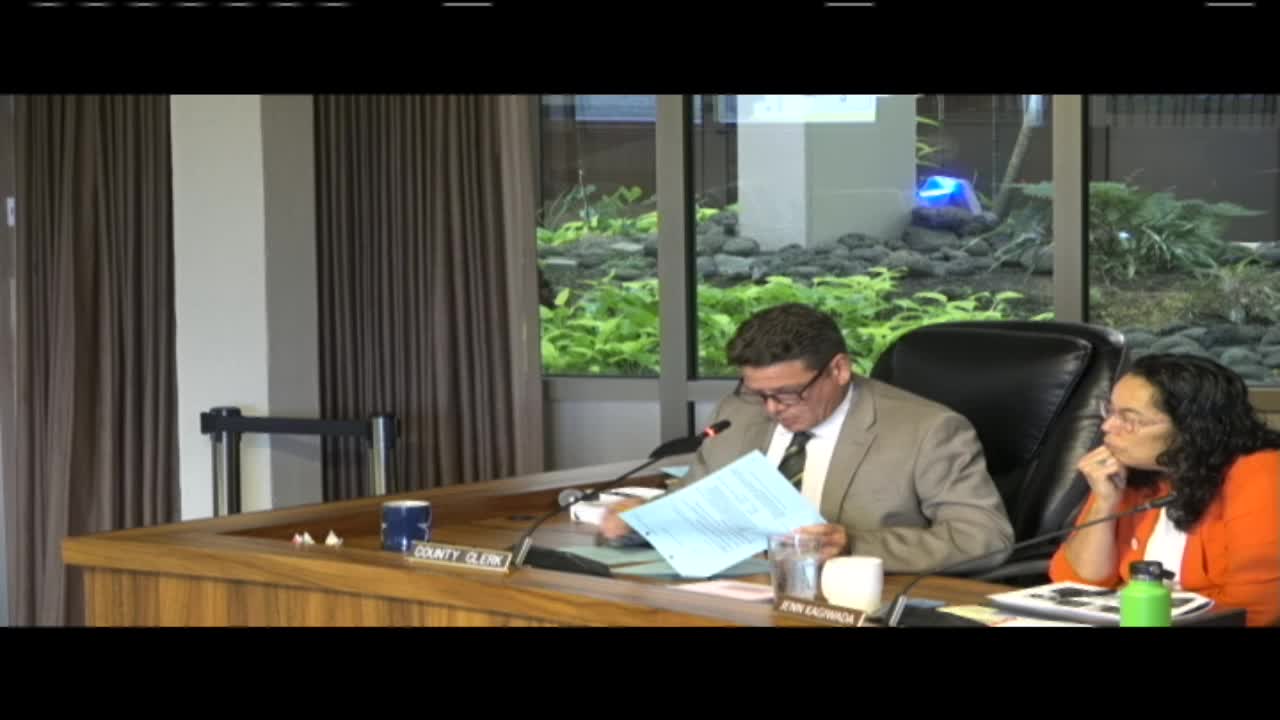
Hawaii County council advances $953 million operating budget after debate on reserves and services
Loading...
Summary
The Hawaii County Council on May 22 approved Bill 31 on first reading, adopting an amended operating budget for fiscal year 2025'26 that projects $953,268,869 in revenues and appropriations.
The Hawaii County Council on May 22 approved Bill 31 on first reading, adopting an amended operating budget for fiscal year 2025–26 that the administration said contains estimated revenues and appropriations of $953,268,869.
The budget, transmitted by Mayor Sekimo Alameda and presented by Managing Director William Buranti and Finance Director Diane Nakagawa, reflects a proposed increase in estimated revenues and appropriations from the mayor's draft and adds about $15.5 million over the first draft. The administration described the plan as fiscally conservative, with a 3.5% increase in total appropriations and a projected general fund balance equal to about 10.4% of general fund expenditures.
Why it matters: The operating budget determines staffing, public safety, maintenance of county facilities and the county's immediate fiscal posture. Council members focused questions on the administration's proposal to limit reliance on the current-year fund balance, the county's ability to respond to potential federal benefit cuts, and how vacancy and hiring challenges affect service delivery.
The administration framed the amended budget as focused on repair and maintenance, public safety and stabilizing reserves. "We're preparing the county for future years," Managing Director William Buranti said in presenting the amendment, adding that the budget aims to "be less reliant on that fund balance" and to keep a fund balance within the Government Finance Officers Association's recommended range. Finance Director Diane Nakagawa said the draft keeps approximately $4.3 million of the recent revenue gain in fund balance rather than programming it into new departmental spending.
Council questions and clarifications: Members pressed officials on the county's planning for possible federal cuts affecting SNAP and other benefits. Buranti said the issue was discussed at a recent meeting with the governor and other mayors and that the state has a plan; Nakagawa said the budget increases the budget stabilization fund by $5 million and retains the additional fund balance for use if needed. Council member Kajiwara said that keeping just $4.3 million in reserve would not be sufficient if federal food benefits were reduced for tens of thousands of county residents; Nakagawa and Buranti replied that the county and state are coordinating, and that the administration was intentionally holding some of the revenue increase in reserves.
Staffing and vacancies: The administration said the county currently has a large number of vacant positions (roughly 600 vacancies were discussed) and described an HR task force to speed hiring and update position descriptions. The budget adds positions targeted at high-priority needs, including recruitment and retention incentives and additional public safety and emergency management staff. "We've been working on scaling and expediting the time it takes to onboard our employees," Buranti said.
Debt and capital: Nakagawa said draft 2 reduced next year's debt service by using a 25-year amortization for a previously authorized bond issuance; she and Buranti warned the council that planned wastewater and other capital needs will likely require additional issuance over the coming years and that final debt-service levels depend on interest rates, amortization and timing.
Council action: On a motion to amend Bill 31 to the mayor's draft 2 and to adopt the bill on first reading as amended, the council voted to approve the amendment and passed Bill 31 on first reading. The clerk recorded the vote as 8 ayes and 1 excused member on the final first-reading passage.
What's next: The council scheduled the second and final reading for Thursday, June 5, 2025, when members may propose and vote on further amendments before final adoption.
Ending note: During the hearing multiple council members stressed the need to pair investments with continued attention to vulnerable households and to consider non-county partners for food security and resilience programs. The administration said it will continue intergovernmental work and explore private and philanthropic partnerships.