Get Full Government Meeting Transcripts, Videos, & Alerts Forever!
Get email alerts on the Aviation Noise topic
No spam. Unsubscribe anytime.
Dallas aviation staff urges zoning to limit new residential near Love Field
Summary
Department of Aviation staff briefed the City Planning Commission on Love Field noise monitoring, FAA standards and the city’s voluntary noise program, urging commissioners and staff to use zoning to reduce future residential exposure near the airport.
The Dallas Department of Aviation told the City Planning Commission on May 22 that local zoning is the most effective tool available to limit future residential exposure to aircraft noise around Love Field. Department representatives reviewed federal noise standards, how the city monitors aircraft noise and which local measures are voluntary versus enforceable.
The presentation, delivered by Seth Hawes, the airport noise monitoring specialist, explained that the Federal Aviation Administration uses the day-night average sound level (DNL) and that FAA policy identifies 65 DNL as the significance threshold for aircraft noise exposure. Hawes said the FAA regulates aircraft and flight operations while the city, through planning and zoning, is the primary lever to prevent new residential uses from locating inside high-noise contours.
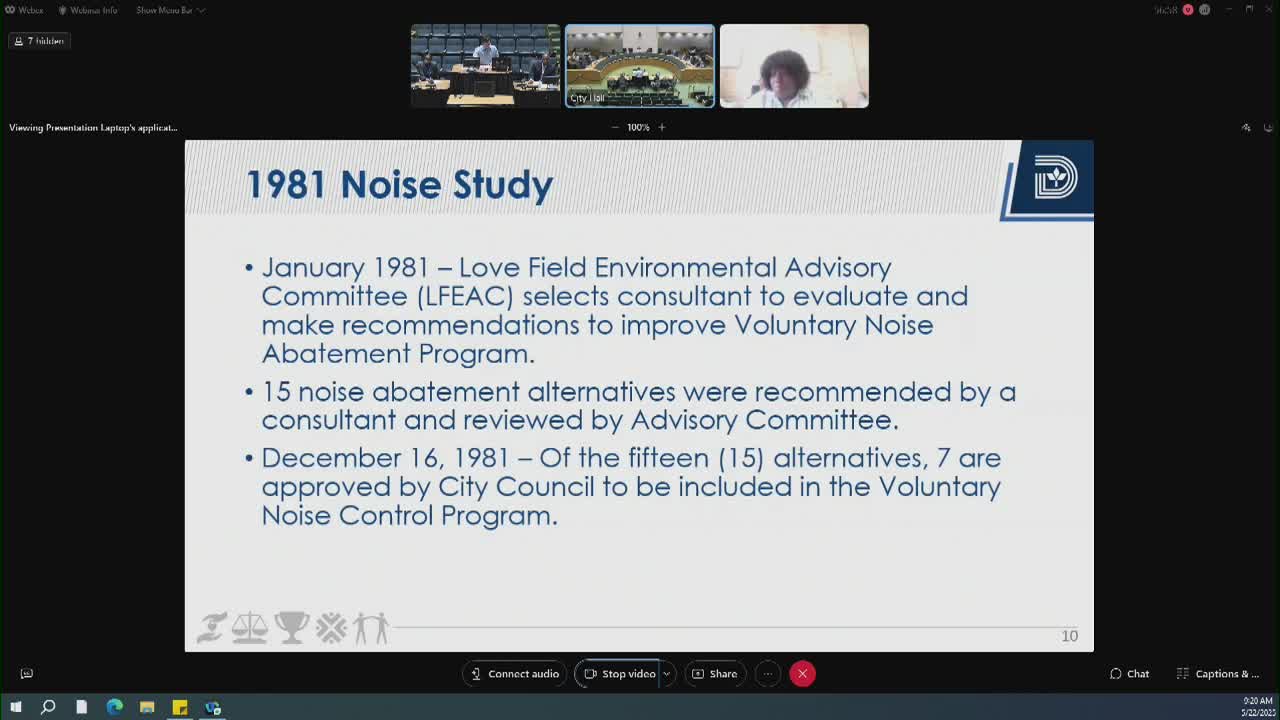
Hawes summarized Dallas’s voluntary noise program—adopted elements include preferential nighttime runways, a Trinity departure procedure for jets over 12,500 pounds, a ban on maintenance run-ups from midnight to 6 a.m. (enforceable by city ordinance) and airline commitments to optimal takeoff profiles. He described the airport’s noise-monitoring array (four microphones) and the practice of pairing noise events with flight track data, then using that information when residents raise concerns.
Commissioners asked whether the city monitors other aviation facilities; Hawes said Dallas Executive Airport and the Vertiport are included in the department program but their 65 DNL contours are much smaller. Commissioners asked whether the FAA 65 DNL standard is ever revised; Hawes said the standard has not changed but the topic is under industry discussion.
Planning staff and commissioners discussed practical steps: how the City’s review of rezonings and entitlements should incorporate proximity to the contours; how building codes (sound attenuation in updated IBC codes) affect interior noise levels; and whether overlay districts or development standards might be used to discourage residential uses in at-risk areas. Planning staff noted short- and mid-term actions including flagging rezonings near contours in staff briefs and longer-term options such as overlay districts or code changes.
Why it matters: Hawes emphasized that the number of U.S. residents exposed to aircraft noise has fallen dramatically over decades because of quieter aircraft and reduced residential exposure near airports; city zoning is the local government instrument to avoid new housing locating where aircraft noise is “significant” by FAA standards. Dallas aviation staff asked commissioners and planning staff to view contours with nuance and to consider the potential for contours to change over time when evaluating cases near the airport.
What comes next: Aviation staff said they will continue biennial contour studies and share data with planning staff. Commissioners asked staff to include contour maps in future briefs and to generate a similar contour graphic for Dallas Executive Airport on request.