Get Full Government Meeting Transcripts, Videos, & Alerts Forever!
Get email alerts on the Budget Equity Tool topic
No spam. Unsubscribe anytime.
Sacramento staff report progress applying budget equity tool to police and utilities cuts; council asks for wider use and capacity
Summary
City staff updated the Sacramento City Council May 20 on a pilot Budget Equity Tool designed to assess how budget reductions would affect vulnerable residents; departments including police and utilities have applied the tool to reduction proposals this budget cycle.
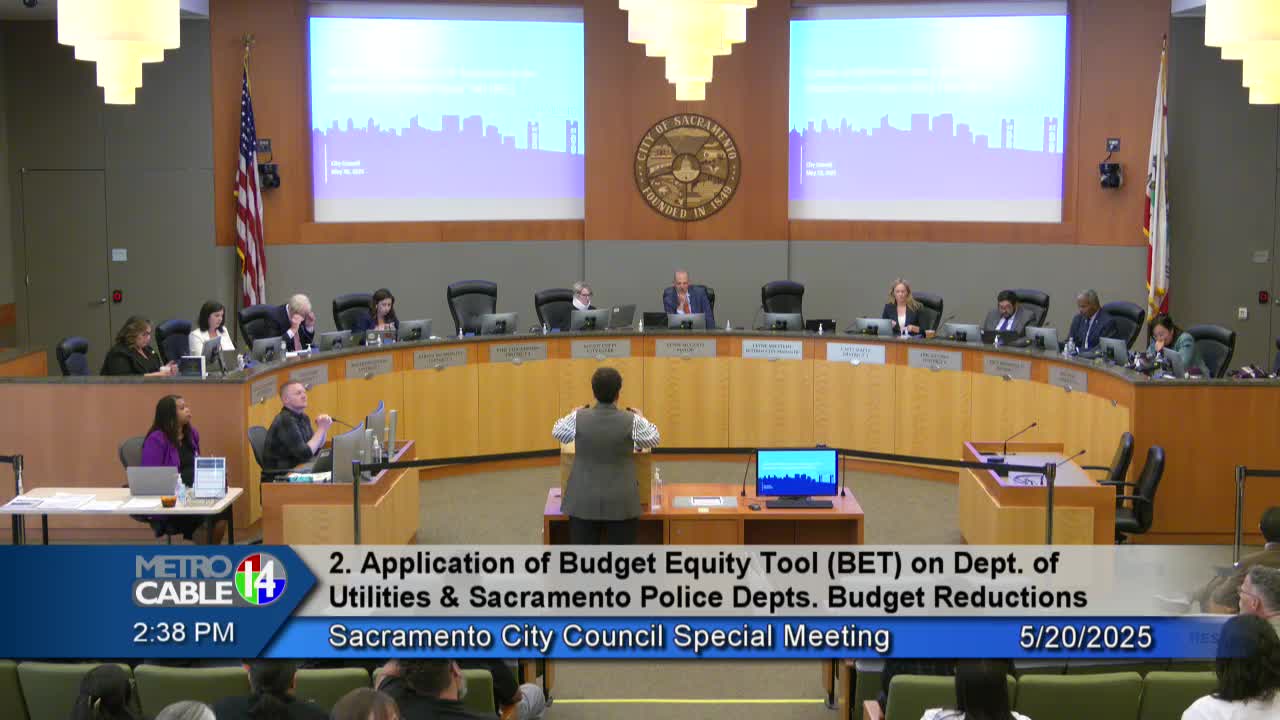
The Sacramento City Council heard an informational briefing May 20 on the city's Budget Equity Tool (BET), a framework city staff adapted from a model developed during the COVID era to assess how budget reductions affect historically underserved communities.
"The budget equity tool is… a set of instructions for thoughtful inclusive analysis of budget reduction decisions that impact vulnerable communities," said Ami Zenzaleh Barnes, the city's diversity and equity manager, who led the briefing. Barnes said the tool is designed to help staff and council explore who would benefit or be burdened by proposed reductions and to document impacts for future corrective action.
Barnes said the tool was piloted in 2024 and expanded in the current budget cycle. Departments that completed BET analyses this year included the Sacramento Police Department (44 BETs submitted), Fire (14), the Department of Utilities (DoU), Office of Innovation and Economic Development (10), and Convention and Cultural Services. The tool emphasizes four components: goal setting and outcomes, service impacts and data, location impacts (geography), and ongoing evaluation.
DoU used the BET to analyze the Sacramento Utility Residential Rate Assistance (SIRRA) program, a low‑income bill assistance program established in 2012. "DoU observed and was able to illustrate the impacts to Districts 2, 5 and 8 would essentially carry a heavy burden if the program was eliminated," Barnes said, and that analysis influenced how the department considered reductions.
Barnes explained the tool is not a numeric scoring system or a "magic bullet." It is intended to prompt engagement, deliberation and data‑informed decisions. She said departments often needed additional time and one‑on‑one consultations with the equity office to translate data into meaningful impact narratives; that work is time intensive and requires more staff capacity.
Councilmembers welcomed the pilot but urged further operationalization. Councilmember Banks and others asked that BET analyses be included with department reduction proposals during the March budget process and that the city require a clear equity rationale when council members submit policy proposals. Councilmember Maple said public‑facing programs that touch vulnerable residents should be a priority for BET review. Several members asked whether the equity office had enough staff; Barnes confirmed the office has limited capacity and said she and one colleague are the primary points of contact, with other city staff offering subject‑matter help when available.
Public comment included a handful of callers and one in‑chamber speaker who identified as a community video archivist; the testimony ranged from endorsement of the tool to requests that the city more fully resource the equity office.
Barnes closed by urging continued council direction: the BET requires sustained effort, training and clear priorities from the council to guide departmental application and to scale implementation over the next several budget cycles.
No formal action or vote was taken on the BET at the meeting; the report was informational and generated council feedback and policy requests.