Get Full Government Meeting Transcripts, Videos, & Alerts Forever!
Get email alerts on the Animal Shelter Barc topic
No spam. Unsubscribe anytime.
BARC shelter’s budget, staffing and one‑time cleaning contract draw council scrutiny
Summary
Director Tina Paez said the FY‑26 BARC budget proposal relies on a $12.9 million general fund transfer but removes a one‑time kennel‑cleaning contract; councilmembers and the director described staffing shortages and a plan to pursue nonprofit partners and consulting support for long‑term improvements.
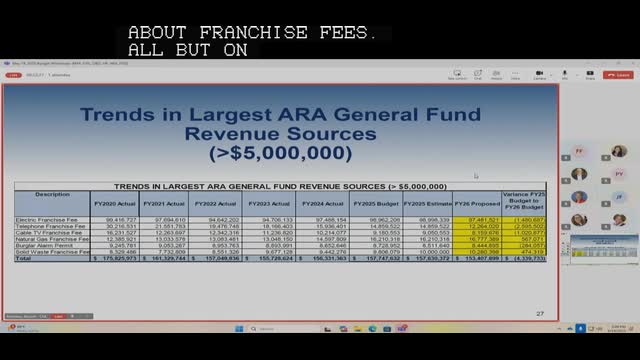
The Houston Animal Shelter (BARC) will receive a proposed FY‑26 transfer from the general fund of $12.9 million, a funding stream that Director Tina Paez told councilmembers represents roughly 46% of ARA’s general fund budget. Paez and councilmembers discussed operations, staffing shortages and a one‑time kennel cleaning contract that is not in the FY‑26 baseline.
Paez said the previous administration and a subsequent budget amendment provided money for a vendor to perform kennel cleaning and that the contract addressed safety and adoptability issues arising when shelter staff had to perform both caregiving and intensive cleaning duties. She described staff injuries and animals becoming aggressive when employees attempted dual duties. "The animals were attacking them and they were no longer adoptable," Paez said of the circumstances that led to the temporary cleaning contract.
Councilmembers asked how many animal control officers and other shelter staff the department will have. Paez and staff reported a unit of 35 people that includes supervisors, managers, bike case investigators, animal cruelty investigators, animal control officers and trainees; they said 24 of those are animal control officers and trainees. Paez confirmed one animal control officer retirement and said trainees are expected to move into vacancies as part of normal progression; she also said animal control officer positions are treated as critical for hiring exceptions in some instances.
Councilmember questions probed whether the BARC Foundation was contributing funding. Paez said the foundation is largely inactive and the department is working to replace board members; she noted the foundation had funded some equipment purchases and adoption programs in the past.
Paez described a two‑part strategy for strengthening BARC’s operations: (1) issue an RFP to identify a nonprofit partner to take on outreach, adoptions, spay/neuter and education functions (non‑enforcement, non‑medical) and (2) engage a small consulting contract to produce a business plan and fundraising package that can be presented to foundations and philanthropists. Paez said the goal is to present a business plan attractive to animal‑welfare funders and to create a sustainable supplemental funding stream.
Councilmembers also asked about a new BARC facility. Paez said the General Services Department has engineering designs in progress and "may have something before council before the end of this year," and that a new facility would double capacity but is likely two to three years from completion.
The FY‑26 proposed budget reduces BARC’s current year baseline by about $500,000 compared with the FY‑25 estimate, Paez said, and the council discussion focused on whether short‑term contract restoration or foundation fundraising should be pursued to address cleaning, medical and staffing shortfalls and to bolster adoption and outreach programming.