San Antonio updates SA Climate Ready plan: municipal solar projects moving, community funds and neighborhood pilots emphasized
Loading...
Summary
The city reported progress on municipal on-site solar and several community resilience initiatives including a $1 million school grant lesson learned, a Community Action Fund of neighborhood/business grants, a Low-Income Community Resilience pilot, the Climate Ready Neighborhoods Network, and an e-bike rebate pilot with hundreds of applicants.
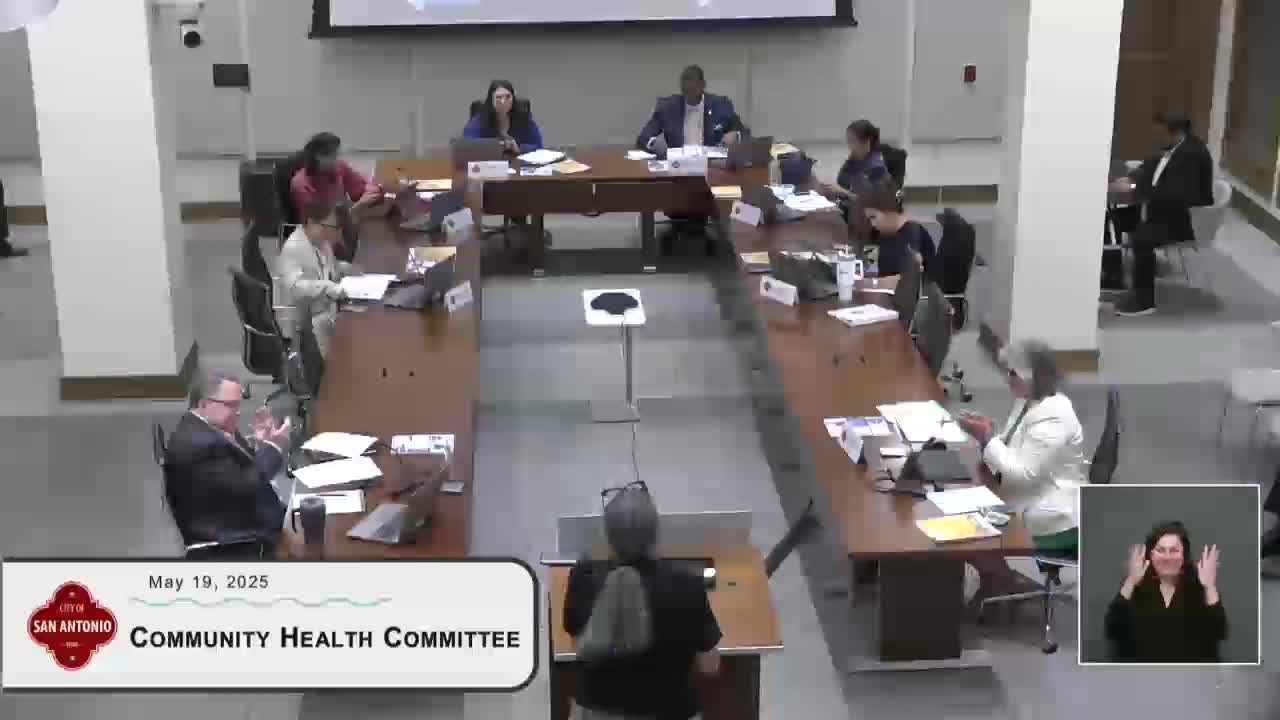
Doug Melanch, San Antonio’s sustainability officer, presented an update of the SA Climate Ready plan and related resilience programs to the Community Health Committee on May 19. Melanch said the city is updating the 2019 plan with science-based targets, prioritized implementation strategies and new data-visualization tools to translate emissions and impact scenarios into actionable milestones.
Melanch reviewed municipal on-site solar activity: council approved up to 13 megawatts of rooftop and carport solar in November 2023 with an estimated cost cited in the presentation; the program has completed projects producing just over 4.1 megawatts, has two projects under construction and has authorized additional work that would bring the total near 8 megawatts in the near term. The presentation said the full 13-megawatt program could yield an estimated $1.8 million in annual energy savings and offset roughly 11% of the city’s electricity usage under the assumptions shown.
Melanch described a Community Action Fund built from lessons learned in EcoScholars and other efforts. The fund includes a $2.5 million business grant program, a $2.0 million neighborhood and community grant program (individual awards up to $15,000–$20,000) and an ongoing $125,000 microgrant program to support local outreach and communications. Melanch said staff will release a midyear report on how these community grants are performing and will pursue partnerships and philanthropic matches to sustain funding where possible.
The Climate Ready Neighborhoods Network was presented as a capacity-building initiative that convenes community- and faith-based organizations to become local points of distribution, communications and coordination for resilience. Melanch said the program provides convening, microgrants and field guides and focuses on buildings and landscapes, programs and services, connectivity and access, and power and operations.
Melanch also summarized a Low-Income Community Resilience pilot in South San and Quintana funded at $825,000 that identified extreme heat as a priority vulnerability. The city used consultant support and community convening to prioritize residential weatherization and cooling, cooling-recreation features and creation of a local cooling committee; Melanch said about $100,000 was used for consultants in FY24 and roughly $450,000-committed so far in FY25 for projects and implementation steps.
Finally Melanch described an e-bike rebate pilot aimed at income-qualified residents. The presentation said the pilot planned up to 1,000 vouchers, attracted 616 applications, and will require participants to complete a bike-skills class and allow anonymized usage tracking through a National Renewable Energy Laboratory smartphone tool to measure trip displacement and frequency. Melanch said the first disbursements will begin the week following the presentation, and staff will report usage outcomes to inform any future scaling decisions.
Council members asked about community engagement in the SA Climate Ready update, how to translate greenhouse-gas targets into clear metrics, the lifespan and maintenance of solar panels, the status of cool-pavement installs and the portion of the Low-Income pilot already committed. Melanch said the city will use ICLEI’s ClimateView/Clearview data-visualization tools to run scenarios and align strategy with measurable short- and mid-term milestones, and staff are convening subcommittees and community stakeholders to accelerate the plan update.