Get Full Government Meeting Transcripts, Videos, & Alerts Forever!
Get email alerts on the Housing Affordability topic
No spam. Unsubscribe anytime.
Council hearing spotlights gap between regional AMI and Philadelphia affordability, advocates urge 50% targeting of lowest incomes
Summary
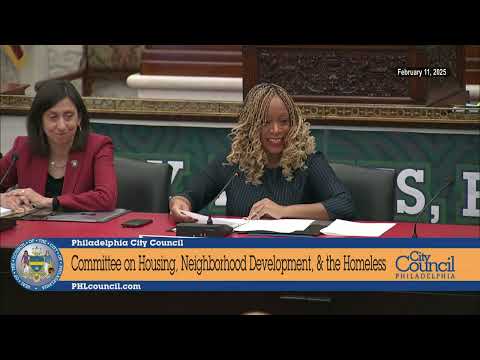
Councilmember Jamie Gauthier, chair of the City Council Committee on Housing, Neighborhood Development and the Homeless, opened a May 20 public hearing to examine whether using the regional area median income (AMI) in city housing programs leaves Philadelphia's lowest-income residents unable to access subsidized units.
Councilmember Jamie Gauthier, chair of the City Council Committee on Housing, Neighborhood Development and the Homeless, opened a public hearing on Resolution No. 240,297 on May 20, 2025 to examine whether setting eligibility for city housing programs by the regional area median income (AMI) leaves Philadelphia residents without access to subsidized housing.
"Our city's housing affordability crisis is only getting worse," Gauthier said at the start of the hearing, adding that the committee was convened to "shine a light on the depth of our city's affordable housing crisis and how the city is failing our lowest income residents." She also said creating a Philadelphia-only AMI was not the focus of the hearing.
The committee heard a data briefing from Mark Dodds, interim deputy director of the Division of Housing and Community Development (DHCD), who described how the department allocates funds from multiple federal, state and local sources and the limits those sources place on income eligibility. "Nearly one third of DHCD funding benefits households in the lowest income category, less than 30% area median income or AMI," Dodds told the committee and summarized findings the department provided in a spreadsheet and two-page explainer.
Dodds said DHCD's analysis showed the department serves low-income households across council districts and maintains a public housing action plan dashboard. He also said DHCD's program-level data only captured about 60% of clients for some programs and that data gaps exist when legal or privacy constraints prevent subrecipients from sharing household income information.
Advocates and subject-matter witnesses told the committee the regionwide AMI -- roughly $114,000 in 2022 and cited in testimony as approaching $124,000 in later data -- systematically sets eligibility levels that are too high for many Philadelphia households, whose median income is about $60,000. Mindy Watts of Interface Studio and Emily Dowdowel, president of policy solutions at Reinvestment Fund, both told the committee that tying local programs to a regional AMI makes limited city resources accessible to higher-income households in the region while excluding the city's poorest residents.
"The city does have the ability to set its own income eligibility targets for its housing programs," Watts said, urging the city to consider targeting half of its housing dollars to households earning less than $30,000 per year. That specific recommendation'a core ask from the Philadelphia Coalition for Affordable Communities (PCAC)'was repeated by multiple witnesses and community members, who described the share of households earning under $30,000 and the resulting lack of affordable options.
Witnesses and nonprofit housing providers pressed for expansion of the city's shallow rent subsidy pilot, which DHCD and partners use to reduce cost burden for tenants in subsidized buildings. Dodds and several CDC representatives described the program as highly cost-effective: testimony cited the average shallow rent subsidy participant at about 22% AMI and an annual per-household cost of roughly $3,000 to $4,000. Multiple speakers urged increasing annual shallow-rent funding from current pilot levels (testimony referenced roughly $1.25 million) to $5.25 million to serve an estimated additional 800 households.
Council members asked DHCD for additional program-level follow-ups. Among the committee requests were: (1) more complete enrollment and expenditure data by AMI bands and by program; (2) expanded building-level information beyond a narrow FY24 sample; and (3) a clearer accounting of how many "tangled titles" DHCD reaches annually compared with the estimated universe of unresolved titles in the city. Dodds agreed to explore those follow-ups and to work with council on public engagement plans for the administration's forthcoming housing plan to create and preserve 30,000 units.
Committee members and witnesses also discussed funding risks tied to federal support and the Neighborhood Preservation Initiative (NPI or MPI). DHCD said MPI funding is time-limited and estimated roughly $50 million remains; witnesses and councilmembers said the city should plan for the eventual decline of MPI and consider sustained local revenue streams for housing, such as an annually recurring bond or dedicated general-fund allocations to the Housing Trust Fund.
Public testimony included accounts from homeowners, tenants, and disability advocates describing difficulty affording repairs, rising rents, inaccessible housing and episodes of displacement. Dominique Howell, an independent living specialist and housing advocate, described spending nearly a year in a shelter and said accessible units were scarce: "Without accessible housing, people with disabilities are pushed into nursing homes costing over $70,000 annually." Angelita Ellison and Gloria Maria Cartagena Hart told the committee about generational homeownership, denied repair assistance and housing instability in neighborhoods including Kensington.
Several nonprofit and community development organizations offered concrete policy and program proposals: (1) expand the shallow rent subsidy program and open eligibility to more providers; (2) preserve and prioritize public land and disposition for deeply affordable rental housing and shared-equity models; (3) create a quick-acquisition revolving fund so community entities can acquire at-risk properties before speculators; (4) explore pooled insurance or other mechanisms to buffer CDC projects from rising construction and insurance costs; and (5) update the housing action plan with explicit, measurable targets for very-low-income households.
The hearing concluded without a committee vote. Councilmember Gauthier thanked witnesses and community groups, including PCAC, and closed the hearing after members said they would continue working with DHCD on the housing plan and follow-up data requests.