Get Full Government Meeting Transcripts, Videos, & Alerts Forever!
Get email alerts on the Commission Rules Presentation topic
No spam. Unsubscribe anytime.
City attorney’s office briefs El Paso Civil Service Commission on duties, evidence standard and virtual-attendance rules
Summary
Assistant city attorney reviewed the Civil Service Commission’s quasi-judicial role, duties under the city charter and ordinance 80-65, the preponderance-of-the-evidence standard for appeals, limits on ex parte communications and the city’s virtual-attendance policy.
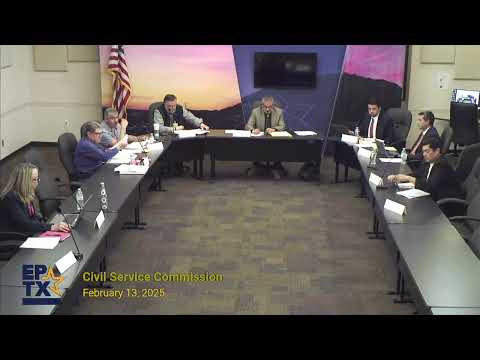
Assistant City Attorney Robert O’Neill presented an annual briefing to the El Paso Civil Service Commission on Feb. 13 describing the commission’s responsibilities, standards for appeals and limits on its powers.
O’Neill told commissioners the commission is established by the City Charter and governed by ordinance 80-65 and its own civil service rules. He said the commission is a quasi‑judicial body with authority to hear disciplinary and qualification appeals and to appoint hearing officers, but it is not a policy‑making board and may only recommend changes to charter provisions or city ordinance.
On evidentiary standards, O’Neill said the commission and hearing officers use the preponderance-of-the-evidence standard (more likely than not, about 51%) in reviewing appeals, not the criminal standard of beyond a reasonable doubt. He described options available after a hearing officer recommendation: accept, reduce the recommended discipline, remand for new evidence, or reject and conduct a de novo hearing.
O’Neill reviewed limits on the commission’s authority, including that discrimination/harassment claims follow Equal Employment Opportunity processes and that ex parte communications about cases are prohibited. He also explained the city’s virtual-attendance policy: a physical quorum is required to open the meeting and count for quorum; remote participants may vote but do not count toward quorum and must request virtual attendance by 10 a.m. the preceding Friday.
O’Neill warned commissioners that acting outside the charter, ordinance or the advice of counsel could expose individual members to personal liability and stressed the commission’s duty to remain neutral and fact-finding in disciplinary and qualification appeals.
The presentation was given as agenda item 6 and followed by commission questions; no vote was required.