Get Full Government Meeting Transcripts, Videos, & Alerts Forever!
Get email alerts on the South Suburban Operating Agreement topic
No spam. Unsubscribe anytime.
Littleton board readies sustainability demands for South Suburban operating-agreement talks
Summary
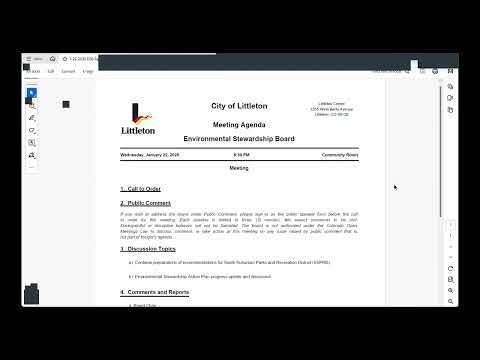
The Littleton Environmental Stewardship Board agreed at its meeting to finalize a set of recommendations it will present to City Council for negotiations with South Suburban Parks and Recreation, focusing on establishing a formal sustainability governance structure, a baseline greenhouse-gas inventory and measurable targets tied to regular reporting and transparency.
The Littleton Environmental Stewardship Board agreed at its meeting to finalize a set of recommendations it will present to City Council for negotiations with South Suburban Parks and Recreation, focusing on establishing a formal sustainability governance structure, a baseline greenhouse-gas inventory and measurable targets tied to regular reporting and transparency.
The board said the operating agreement with South Suburban — which governs maintenance and programming of parks and recreation assets that serve Littleton residents — is an opportunity to require clearer sustainability goals, accountability and public engagement.
Board members and staff spent the meeting working through a draft list of priorities to recommend to City Council and to negotiators, including: creating a sustainability governance body or formal internal structure within South Suburban; commissioning a greenhouse-gas inventory as a baseline for emissions; adding measurable targets, timelines and reporting requirements; adding a sustainability section to South Suburban’s monthly reports; and specifying a public-engagement standard before making changes to assets, operations or services.
Laura (Environmental Stewardship Board member) led the discussion and said the board should present a concise one- or two-page summary to Council ahead of a March study session with South Suburban. The board also discussed asking the city attorney to draft enforcement and dispute-resolution language the negotiators can consider.
On reporting cadence, board participants discussed three linked reporting layers: a sustainability section in South Suburban’s monthly report to the public; regular (quarterly) updates to whatever governance structure is agreed; and a fuller published status report on the action plan (board members discussed semiannual or annual formats depending on capacity). Several members said a greenhouse-gas inventory should be refreshed on a multi-year cadence (industry practice discussed was every 3–5 years) so progress toward any emissions target can be measured.
The board debated whether the sustainability body within South Suburban should be staff-based or a citizen advisory panel subject to Colorado open-meetings rules. Some members said a staff committee could be quicker to act but would not trigger meeting transparency; others said an advisory or governance body with public meetings would provide better accountability.
Board members also discussed options for financial incentives and city funding. One example floated: city funds that could be used to match tree-planting or other projects in Littleton only, rather than general district-wide subsidies. The board agreed to include a recommendation that Council consider whether targeted city funding is appropriate to accelerate priorities identified in the action plan.
On enforcement and accountability, members asked the city attorney to review feasible mechanisms to include in the operating agreement. The board did not adopt a single enforcement approach at the meeting; members instead asked staff to return with options for negotiators to consider, including dispute-resolution language and scheduled status reviews. "We hope and expect a good faith partnership between the city and the district," said Scott (Environmental Stewardship Board member).
Next steps: the board agreed to finalize a one- to two-page packet of recommendations and materials and present that to City Council at the March 25 study session; staff will ask the city attorney for draft enforcement/dispute-resolution language and will prepare the materials Council and the negotiating team will use.
The board emphasized it does not intend to be prescriptive in every operational detail, but wants measurable baselines, timelines and transparent reporting to ensure commitments can be tracked.