Get Full Government Meeting Transcripts, Videos, & Alerts Forever!
Get email alerts on the Education Kirkwood High Strategic Plan topic
No spam. Unsubscribe anytime.
Kirkwood High presents strategic plan centered on engagement, new homeroom structure and supports
Summary
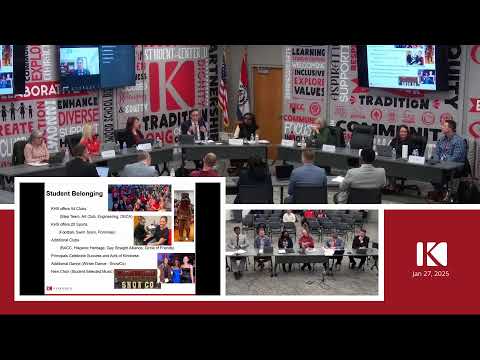
Kirkwood High School Principal Seth Harrell told the Kirkwood School District Board of Education on Jan. 27 that the high school’s strategic plan centers on student engagement, expanded instruction supports and systems to identify and assist students before they fall behind.
Kirkwood High School Principal Seth Harrell told the Kirkwood School District Board of Education on Jan. 27 that the high school’s strategic plan centers on student engagement, expanded instruction supports and systems to identify and assist students before they fall behind.
“Community, tradition and excellence” are central, Harrell said, and the high school is aligning instruction, scheduling and professional learning so teachers can “act on students before it’s too late.”
The presentation described several schoolwide priorities: strengthening professional learning communities (PLCs) with dedicated time and a PLC handbook; a curriculum and assessment refresh that includes formative assessments and a pilot of AMP as a new assessment tool; a Turnitin pilot for academic-honesty and AI-detection support; an expanded set of AP and dual-credit offerings; and a new homeroom structure intended to provide student choice and protected collaboration time for departments.
Associate Principal Mike Gavin and other administrators said PLC leaders now have dedicated time during the school day to plan and collect common data, and teachers are using Total Participation Techniques (a Kagan-derived text) to establish common classroom practices. Gavin described a shift away from relying solely on summative assessments toward more frequent formative checkpoints to identify needs earlier.
Harrell and the administrators described the homeroom rework as a three-part block: an initial announcements segment followed by two blocks (labeled Academic Homeroom 2 and Academic Homeroom 3) in which students may select a teacher to work with or be assigned when they do not select a teacher. Administrators said the schedule gives departments rotating blocks for collaboration and gives students a regular weekly period in which they can choose structured academic support or enrichment.
School leaders reported on student outcomes and supports. Ninth-grade principal Alex Clark said 97.8% of ninth graders were on track after one semester; he said nine ninth-graders were below the three-credit threshold and that counselors and problem-solving teams were working on interventions. Assistant principal Mike Gavin reported that 401 of 408 sophomores met the on-track criteria at the last pull of data. Dr. Ford reported a 3.39 average GPA for the senior class and said 14 seniors were not on track, with plans in place to support those students toward graduation.
Staff described districtwide supports tied to equity and social-emotional learning: restorative-practice training for administrators and counselors, a CHAOS ambassador program that trains students to recognize trauma signs among peers, a student panel for a Feb. 14 wellness day on mental health, and an upcoming Special Olympics event the high school will host. Librarians and counselors described expanded peer tutoring during homeroom, makerspace improvements, and increased dual-credit and online course participation.
Administrators also noted extracurricular and partnership successes: participation in the Gateway Arch National Park engineering contest (Kirkwood students were among the winning team), expanded AP offerings (an increase administrators characterized as allowing more students access to AP), continued partnerships with South Tech and STL CAPS, and growth in eSports and other clubs.
District staff provided a brief financial update in the meeting’s consent items: a finance presenter reported December 2024 revenues of about $35.8 million (largely current property taxes), operating expenses of about $8.9 million for the month and an annual insurance assessment of about $1.8 million paid to the Missouri United School Insurance Council (MUSIC), which the presenter said was roughly a 33% increase from the prior year. The board approved the December financial statements and approved routine agenda and consent items earlier in the meeting.
Board members praised the presentation’s detail and the staff’s focus on early identification and intervention. Questions from the board and responses from administrators covered transition supports for students coming from out-of-district schools, plans to scale CHAOS training and the Turnitin pilot (which administrators described as imperfect for AI detection but useful as an instructional tool), and efforts to highlight non‑college postsecondary pathways for students pursuing careers or technical training.
Votes at a glance
- Motion to approve the meeting agenda for Jan. 27, 2025 — Moved by Motika; seconded by Kathy; approved by voice vote. - Motion to approve the presented consent agenda items (items 5.02–5.1) — Moved by Kathy; seconded by Pangborn; approved by voice vote. - Motion to approve the December 2024 financial statements — Moved by Pangborn; seconded by Motika; approved by voice vote. District finance staff reported December revenues of about $35.8 million, operating expenses of about $8.9 million and a MUSIC insurance assessment of about $1.8 million (an increase of roughly 33% year over year). - Motion to return to closed session for personnel — Moved by Motika; seconded by Pangborn; roll-call recorded as affirmative by members named on the record (Mark Boyko, Pangborn, Hepburn, Motika, Andrews, Kathy, Sharon).
The board did not take any new formal policy actions during the high school presentation portion of the meeting. Administrators said the strategic plan items described are in active implementation or pilot phases and will return to the board as needed for program approval or budgetary items.
Sources and next steps
Administrators asked the board for continued support as the high school implements the homeroom rotation, the AMP assessment pilot and selected instructional tools. Several board members urged continued outreach to families of students entering from private or out-of-district schools; administrators described existing shadowing opportunities and a new-student social that they intend to expand.
The board listed future committee and meeting dates and then recessed to a closed session for personnel matters.