Get Full Government Meeting Transcripts, Videos, & Alerts Forever!
Get email alerts on the Cannabis Regulation topic
No spam. Unsubscribe anytime.
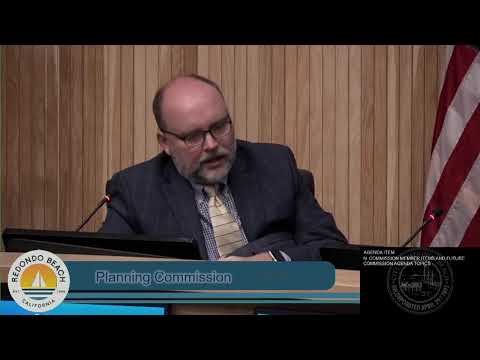
Redondo Beach planning commission votes to retain 1,000‑foot separation between cannabis retailers
Summary
At a special meeting and public hearing Feb. 3, the Redondo Beach Planning Commission recommended that City Council keep a 1,000‑foot separation between cannabis retailers after reviewing proposed zoning amendments and public testimony. The commission also discussed delivery rules, state track‑and‑trace requirements and local permitting.
The Redondo Beach Planning Commission on Feb. 3 recommended that the City Council retain a 1,000‑foot separation requirement between cannabis retail operators, reversing a proposed change that would have removed that distance restriction.
The recommendation came after a staff presentation on draft amendments to the city—s municipal code governing commercial cannabis activity, and more than an hour of public testimony and commissioner questions about buffers, delivery permitting, public safety and whether the city should move forward while state regulation and market conditions shift.
Community services director Elizabeth Haas presented the amendments and the package timeline, telling the commission the city has worked on a retail program since 2018 and that the proposed drafts refine definitions and zoning provisions in two ordinances the council directed staff to return to the commission for review. Haas said the draft ordinances clarify that permitted commercial cannabis activity in Redondo Beach is limited to storefront retail and retail delivery and that the city attorney will finalize recital language before the council packet is published.
Haas walked commissioners through key edits in the redlined drafts, including clarified definitions for "commercial cannabis activity," alignment with state definitions for "daycare centers," removal of an unused "development agreement" definition, and a new definition for financial qualifications the council sought to ensure operators maintain adequate liquid assets. Staff also noted the council removed a draft provision that would have barred a retailer from locating within 1,000 feet of another retailer, and added a smaller buffer around a commercial area adjacent to Dale Page Park.
The commission—s discussion focused on two issues: whether the downtown/commercial corridor along Artesia Boulevard could end up with both permitted retailers because district boundaries straddle the street, and how delivery operations would be regulated. Commissioner questions repeatedly returned to whether outside delivery services could operate in Redondo Beach, how the city would collect tax revenue, and how the city would verify operators— compliance with state track-and-trace requirements.
Planning staff and the city attorney—s office told the commission that the city council previously limited the program to two retail storefront permits to avoid proliferation, that staff would require any delivery operator seeking a city permit to demonstrate participation in the state track-and-trace system, and that the council planned to schedule first reading of the revised ordinances on Feb. 11. Director Weiner summarized the commission—s narrow role: the planning commission was asked to review zoning amendments and provide written comments to council rather than decide policy on whether cannabis retail should exist in the city.
Public testimony reflected a range of views. Several residents urged caution or opposed retail stores, raising public‑health and youth‑exposure concerns and calling attention to Measure E, a 2022 ballot measure cited by speakers as a community expression against retail cannabis. Other speakers with cannabis industry experience urged the city to regulate and tax sales locally to improve product safety and provide community benefits; one operator described contributions to local charities and argued that licensed, tested retail is preferable to unregulated activity.
After deliberations and several competing motions, the commission voted to recommend that the council retain the 1,000‑foot separation requirement between retailers rather than remove it as in the proposed amendment. The motion passed with a recorded vote of five in favor and two opposed.
The commission recorded its recommendation as a formal comment to the City Council. City staff said they will incorporate the commission—s feedback and present the ordinances back to council at its Feb. 11 meeting for introduction and first reading. If adopted by council, staff said the next steps would include finalizing permitting procedures and the public Request for Proposals for the limited number of retail permits the council authorized.
The commission—s recommendation does not itself change the municipal code; it is an advisory action to the council. Council action is required to make any ordinance amendments effective.
Votes at a glance
- Planning Commission recommendation (Feb. 3, 2025): Recommend City Council retain 1,000‑foot separation between cannabis retailers (oppose removal of the 1,000‑foot buffer). Outcome: recommendation approved 5–2.
What—s next
City Council is scheduled to consider introduction and first reading of the amended ordinances on Feb. 11; staff will forward the commission—s written comments and the council will decide whether to adopt, modify or reject the proposed revisions.
Sources: staff presentation to the Planning Commission, Feb. 3, 2025; public testimony during the Feb. 3 Planning Commission special meeting.