Get Full Government Meeting Transcripts, Videos, & Alerts Forever!
Get email alerts on the School Budget topic
No spam. Unsubscribe anytime.
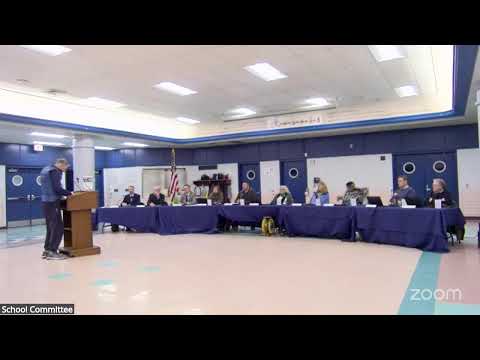
South Kingstown school committee forwards FY26 budget to town council, requests $500,000 municipal increase
Summary
After a multi-hour budget presentation and debate, the South Kingstown School Committee voted to forward its fiscal year 2026 proposal to the Town Council under “Option 2,” which asks the town to absorb certain shared-service costs and adds a $500,000 increase to the municipal transfer to close a roughly $830,000 shortfall.
The South Kingstown School Committee voted to forward its fiscal year 2026 budget proposal to the Town Council, asking the town to shift shared-service costs to municipal responsibility and to increase the property-tax transfer by $500,000.
The committee adopted “Option 2” after a presentation from Superintendent Pedraza and district finance staff that laid out a projected net increase of about $2.4 million driven by lower federal and state aid, contractual salary and benefit increases, and anticipated transportation costs. Ryan Kilpatrick summarized the option’s two core elements as “requesting to shift approximately $314,000 in shared services to the town” and “utilizing $500,000 in our fund balance,” and said the recommended package would allow the district to end FY26 “just hovering right above that 2% ceiling” the district uses for reserves.
The budget presentation framed the request as a tradeoff: either (1) shift shared services and use $500,000 of fund balance while asking no additional municipal appropriation, (2) shift shared services and ask the town for an additional $500,000 in the municipal transfer (the committee’s chosen Option 2), or (3) make an additional $500,000 in programmatic cuts. Kilpatrick and Superintendent Pedraza told the committee the district already proposed approximately $1.5 million in reductions (including 16.8 FTEs tied to enrollment declines) and that without additional municipal support further reductions would affect student programs, summer credit-recovery, and extracurriculars.
Nut graf: The committee’s decision sends the district’s preferred approach to the Town Council for consideration in municipal budget workshops and a joint meeting; the move aims to avoid immediate program cuts while relying on the town to take on long-running shared-service costs and to authorize a $500,000 increase in the property-tax transfer.
Committee members focused on two competing concerns: preserving programs and keeping a prudent fund balance. Several members said preserving the credit-recovery summer program and limiting direct student impacts were priorities; others warned that relying on fund balance would create a structural deficit in subsequent years. The presentation quantified the district’s position: the general-fund proposed budget under Options 1 and 2 was shown as $63,087,510; the total proposed budget (general fund plus restricted and enterprise funds) appeared as $66,839,725 in the materials the district provided.
Kilpatrick explained key assumptions that produced the $2.4 million net increase: salary increases for bargaining units (teachers 2.5%, paraprofessionals/clerical 2.25%, and a 2.25% assumption for custodians/maintenance pending negotiation), a transported-contract increase of 4% (the second year of a two-tier system), and benefit increases (health and dental modeled at 8%). On revenue the district used the governor’s proposed state aid (about $5.82 million in state aid in the draft) and assumed reduced carry-forward and federal allocations compared with FY25.
The presentation identified three concrete budget levers: (a) move select shared services (school-resource officers, crossing guards, field maintenance, shared computer/tax software) to the town budget (approximately $314,000); (b) use fund balance where necessary (district materials showed a proposed $500,000 draw in Option 1 and continued capital funding from existing reserves); or (c) enact an additional $500,000 of cuts that would hit student-facing programs and services. Kilpatrick warned that the deepest cuts would eliminate the high school’s summer credit-recovery program and would affect athletics, arts, professional development, and other programs.
Several committee members urged the committee to ask the town for the additional appropriation rather than rely on fund balance. After discussion, a member moved to forward Option 2 (shift shared services and request $500,000 from the town). The motion was seconded and passed on a roll-call vote with the committee recorded as voting in the affirmative.
Ending: The committee will submit the Option 2 package to the Town Council for the town’s budget workshops and a joint town–school budget meeting scheduled in March. District staff said they will update the committee on any changes to state or federal aid and may reconvene if adjustments are required.