Get Full Government Meeting Transcripts, Videos, & Alerts Forever!
Get email alerts on the Budget Taxation topic
No spam. Unsubscribe anytime.
Holyoke council rejects sewer levy subsidy, splits on $1.11M stabilization transfer
Summary
At a Holyoke City Council meeting, members unanimously rejected an order to subsidize a $927,778 sewer shortfall from the tax levy and then narrowly failed a separate measure to transfer $1,114,335 in earned interest from the general stabilization account to capital stabilization amid debate over using ARPA funds for tax relief or capital needs.
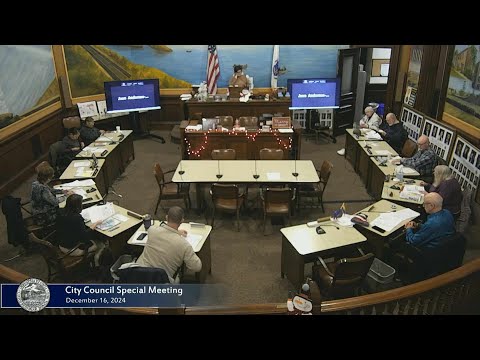
Holyoke City Council on Monday unanimously denied an order that would have subsidized a projected $927,778 shortfall in the city’s sewer enterprise budget from the property tax levy, then split 8-5 on a separate motion to transfer $1,114,335 from the general stabilization account to the capital stabilization account to cover the deficit and fund capital items.
The council first voted to uphold a Finance Committee recommendation to deny the order to subsidize the sewer enterprise from the levy rather than using reserves. Councilor Devine reported the committee vote was 4–1 to deny the order; the full council then recorded unanimous support to deny the order.
The discussion then moved to a separate proposal filed by Councilor Devine to transfer $1,114,335 of earned interest from the general stabilization account into capital stabilization. The mayor argued the transfer would “cure the deficit” and also leave a small amount for capital needs, saying the approach “not only cures [the] deficit, but also gives us a little bit in our capital to invest in ourselves.” The mayor added he would not use ARPA funding for this purpose: “That is not on the table, nor am I gonna, propose anything that'll include ARPA to subsidize.”
Many councilors urged a narrower use of stabilization funds. Councilor Jourdain said his vote for drawing $927,778 from stabilization was “a compromise,” and criticized the larger transfer size, saying, “Somehow $200 got added to this for, apparently, some other purposes…those should be discussed on their own merits.” Councilor Jardine (spelling as in the meeting transcript) urged the council to focus on the immediate tax-rate implications and to avoid rolling additional capital items into the sewer fix.
Several councilors pressed the mayor to consider using $2,000,000 in American Rescue Plan Act (ARPA) funds that had been previously allocated to the Victory Theater but not yet reprogrammed. Councilor Jordan noted the city has not yet programmed those dollars to the U.S. Treasury and suggested using at least part of the ARPA balance to reduce the levy. The mayor responded that he did not plan to rely on ARPA to balance recurring budget items and said the proposed path using stabilization interest would be viewed favorably by bond-rating agencies because it uses earned interest rather than one-time federal funds.
Budget and tax-rate mechanics also shaped the debate: councilors warned that the proposed levy would rise from about $63 million in fiscal 2024 to roughly $66.8 million — a 6.2% increase — and that average assessments had already increased substantially this year. Councilor Bacon said voters had recently rejected a tax surcharge and urged caution about increasing the tax burden on residents.
On the transfer motion to move $1,114,335 from general stabilization to capital stabilization (filed as item 2), the council recorded the following roll-call outcome: Anderson Burgos, Devine, Gibner, McGrath Smith, Murphy Ramboletti, Israel Rivera, Jenny Rivera and Sullivan voted yes; Bartley, Graney, Jardine, Ocasio and Bacon voted no. The motion failed 8–5. After the failed vote, councilors debated next steps; a later motion to reconsider did not carry and the council voted to table related budget items for further consideration the next day.
The council also heard clarifying process remarks from staff: Tanya (auditor) confirmed the meeting was being recorded and explained that the council could vote on the “shift” (tax classification) even if the budget had not yet been balanced, but that final tax rates and a complete tax recap form depend on whether the sewer deficit is covered from stabilization or passed to taxpayers.
Why it matters: The votes decide how Holyoke will cover a near-$1 million sewer enterprise shortfall and whether the city will use earned interest, federal ARPA dollars, or a tax levy increase. Council action (or inaction) will affect the fiscal-year 2025 tax rate calculation and, ultimately, property tax bills for city residents. The split on the stabilization transfer shows ongoing disagreement over using one-time or earned funds for recurring or capital needs and whether to reprogram unspent ARPA funds for immediate tax relief or housing and neighborhood investments.
Councilors indicated follow-up steps: staff and the mayor were asked to provide clearer written proposals about ARPA reprogramming and any capital spending suggested for the capital stabilization account, and the council tabled remaining related items for the following meeting so members could review alternatives and impacts on the tax recap.