Get Full Government Meeting Transcripts, Videos, & Alerts Forever!
Get email alerts on the Gibson Park Resilience topic
No spam. Unsubscribe anytime.
Revere City staff drop proposed vegetated berm at Gibson Park; will redesign park and pursue drainage funding
Summary
City officials told residents they will remove a planned vegetated berm from Gibson Park designs after state regulators said new seawalls are not allowed; the city secured $380,000 for drainage design and is exploring whether a $1.9 million berm earmark can be repurposed.
Revere City planning staff said they will remove a proposed vegetated berm from the Gibson Park resiliency plan and focus on park improvements and drainage design after state regulators advised that new seawalls are not permitted.
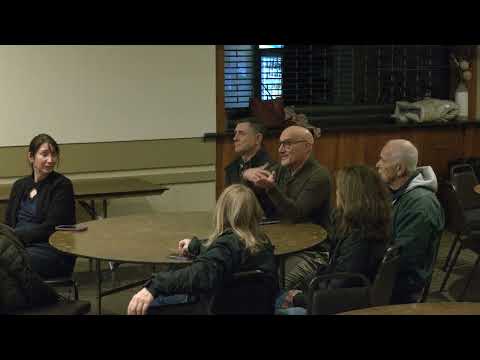
Tom (Planning and Development) told a community meeting that the city’s conversations with the state’s coastal regulators made clear that “a seawall is not something that would be allowed.” He said coastal regulators also flagged limits on the number and siting of maintenance access points for any shoreline work. Based on that guidance and neighborhood opposition, staff said they plan to revise the park designs to exclude the berm.
The change follows a July neighborhood meeting and a formal MEPA (Massachusetts Environmental Policy Act) filing the city submitted on July 1. Tom said the MEPA certificate that followed raised design and maintenance-access concerns but did not provide the written opinion the city had requested. He said follow-up calls with the state’s coastal zone management director confirmed the regulatory constraint: repairs to pre‑1978 seawalls are allowed, but new seawalls cannot be built after that date.
Nut graf: The decision shifts the project away from a structural shoreline barrier to a combination of park improvements and targeted drainage work; staff said the move responds to neighbors’ access and tidal‑connection concerns while preserving the city’s ability to pursue shore‑adjacent improvements that state rules allow.
Staff outlined three near‑term steps: (1) redesign Gibson Park without the berm, (2) move forward with detailed drainage engineering for the Riverside neighborhood, and (3) determine whether the $1.9 million earmarked for the berm can be applied to drainage or must be returned. The city has secured $280,000 through a Housing Choice grant plus about $100,000 in city funds, totaling $380,000 to pay for drainage design work. Tom said the expected construction cost for drainage installation is substantially larger—“more on the scale of $3 million to $3.5 million.”
Tom characterized the berm as a partial solution that would reduce nuisance flooding events but not eliminate damage in larger storm surges. He said the planned berm height tied into the neighborhood’s existing high ground and warned that any structure built higher than the surrounding high ground could force water to a low point (identified in discussion as “1A”), potentially making flooding worse at that location.
Residents raised alternative ideas such as dredging and local seawall repairs; Tom and other staff explained that dredging or new seawalls involve federal and state authorities and larger, costlier programs (for example, an Army Corps study or tide‑gate options that would require federal funds and local matches). Tom encouraged residents to submit formal comments to the MEPA public comment portal during the open period so regulators will consider neighborhood input.
Staff emphasized that excluding the berm will require design changes to some park elements (for example, subsurface stormwater storage beneath the new multipurpose field may need revision because it could clog if the berm is removed). Elle Baker (planning staff) was listed as a project contact for park‑design questions.
Tom said there is $1.9 million currently designated for the berm through an earmark and acknowledged the city does not yet know whether those funds can be repurposed. He outlined two likely scenarios if the city cannot use the $1.9 million for other work: return the funds or attempt to reallocate them toward drainage improvements, which are costlier than the berm funding alone. He asked residents for feedback over the coming month and said staff would defer to the ward councillor’s judgment on whether to change course.
Ending: Staff said redesigned park plans and drainage‑design contracts will be the subject of a future meeting; residents were told the MEPA public comment period remains open (comments referenced in the meeting run through January 10 on the MEPA website) and were urged to submit written feedback if they have concerns about the new approach.