Get Full Government Meeting Transcripts, Videos, & Alerts Forever!
Get email alerts on the Economic Development topic
No spam. Unsubscribe anytime.
City presents $6.8M operating request for economic development and small business programs
Summary
Deputy Director Bill Webster told Columbus City Council the Department of Development’s 2025 request focuses on small-business programs, continuation of Accelerate Columbus and the Ground Floor Growth initiative, and managing roughly $121 million in project investments tied to incentives, TIF and bonds.
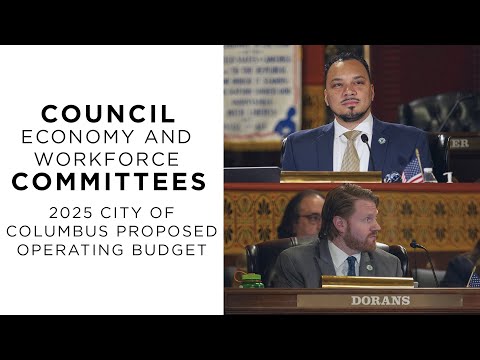
Deputy Director Bill Webster presented the Department of Development’s proposed 2025 operating budget to the Columbus City Council, asking for $6.8 million for economic development and small business work and describing program priorities including Accelerate Columbus, the Ground Floor Growth initiative and the EDAP program.
Webster said the $6.8 million operating request is a roughly 2% increase over last year and funds staffing and programmatic support to manage about $121 million in project investments, including roughly $50 million in tax-increment financing and about $71 million in bond funding. “In short, our operating budget of $6,800,000 provides the staffing and programmatic support needed to manage $121,000,000 in project investments,” Webster said.
Why it matters: Council members emphasized small businesses’ role in neighborhood economies and job creation. The department tied program spending to job results, saying incentive programs have supported more than 19,000 new jobs and retained over 5,300 jobs and have attracted more than $5.4 billion in private investment since the programs began.
Details and context -Webster reported 2024 accomplishments for small-business programming: Accelerate Columbus supported community partners with $925,000 and assisted more than 500 small-business owners; over two years, nearly 1,000 businesses were reached. The department said it invested $1.2 million in the Ground Floor Growth program, and reported two businesses already open from that initiative with three more expected in 2025. -The proposed economic development operating budget for 2025 is $6.8 million: about $4.5 million (66%) for small-business programming, $1.9 million for staff, and $400,000 for miscellaneous activities. The department noted a separate projected $14.2 million in incentive payments that will be transferred later in the year after reporting is finalized. -Webster described planned 2025 investments: an additional $250,000 for Accelerate Columbus (bringing it to roughly $1.1 million), continuation of Ground Floor implementation with $500,000 to support lease costs and $1 million in bond funding, continuation of a $2.5 million commitment to the EDAP program, and a $1 million investment to support an accessory dwelling unit (ADU) program. -On return on investment, Webster said the department’s analysis shows “for every $1 of public investment that we make, we are seeing approximately 17 to $20 in return private investments,” though he acknowledged the multiplier varies by project and broader market conditions affect outcomes. -Project and industry focus: Webster and council members discussed health care and technology as growth sectors; city staff noted the new Wexner Medical/OSU projects are expected to increase incentive payments and private investment as they ramp up.
Discussion highlights -Council members pressed for clarity on trends and workforce implications; the department emphasized partnerships with Columbus State, Columbus Promise and other workforce programs to prepare residents for higher-skilled roles. -Council members noted the budget is tight even as it is historically large, and stressed the importance of measuring small-business program outcomes beyond funding amounts.
Ending -The department offered to answer follow-up questions from council offices and noted staff will continue coordinating with the council’s economic development and small-business committee as programs move into implementation and reporting phases.