Get Full Government Meeting Transcripts, Videos, & Alerts Forever!
Get email alerts on the School Safety Sro topic
No spam. Unsubscribe anytime.
Oconee County boards approve SRO memorandum assigning up to 16 deputies to 12 schools
Summary
Oconee County officials on Jan. 29 approved a memorandum of understanding creating a School Resource Officer (SRO) program that the county sheriff and the school district say will place one deputy at each of the county's 12 schools supported by four command staff, for a total of up to 16 deputies.
Oconee County officials on Jan. 29 approved a memorandum of understanding creating a School Resource Officer (SRO) program that the county sheriff and the school district say will place one deputy at each of the county's 12 schools supported by four command staff, for a total of up to 16 deputies.
The agreement, adopted jointly by the Oconee County Board of Commissioners and the Oconee County Board of Education, sets cost sharing at 90% for Oconee County Schools and 10% for the county government, requires monthly reimbursement, and runs through February 2026 with automatic annual renewals unless a party gives 30 days' written notice (any party may terminate with 60 days' notice).
The MOU prioritizes on-campus security and a preventative approach to school safety. Sheriff Hale, who briefed both bodies, described the program as part of a broader effort to ‘‘prevent these things from happening’’ and said deputies will receive behavioral-threat assessment training and work with school staff on prevention and resiliency. "My job as the sheriff is to secure this county," Hale said. "We're one big family."
School district staff described operational and policy elements negotiated among the sheriff, the superintendent's office, the board of commissioners and the school board. The agreement establishes selection criteria and duties for SROs: board staff said the SRO selection criteria contain 11 qualifications and the agreement lists 21 duties intended to preserve the educational mission while allowing deputies to focus on law enforcement and prevention. The MOU also provides that SROs will perform sheriff's-office duties for at least 25 days per year when schools are not in session.
Budget estimates included in the materials before the boards put the program cost, assuming full staffing, at up to $1,391,282 through June of the current fiscal year, with the Board of Education's portion estimated at $1,252,153. The district's requested amount for fiscal 2026 was listed as $2,234,307 of a $2,482,563 total estimated cost for a full year, again assuming a fully staffed program. Board staff said the Board of Commissioners will provide a preliminary cost estimate by April 1 and a final cost by May 1 to align with the school budget cycle.
Sheriff Hale and other speakers said recruiting and filling sworn positions will take time because of current staffing constraints, and that the office expects to begin posting positions immediately after the agreement's passage. Hale said the 16-position structure (12 school-assigned deputies plus four command/supervisory positions) is intended to ensure coverage when deputies are absent and to provide training and supervision.
Public commenters and some board members praised the program but raised questions about officer rotation, familiarity, enforcement of student misconduct, and the funding split. Stephen Elshara, identified as a resident, asked how permanent assignment of SROs might affect familiarity and "complacency," and how enforcement of student conduct (for example, smoking or drug use) would be handled. Angela Martin, a parent and resident, said she hoped the jobs would be posted that night and called safety "our number one priority."
One board member said the 90/10 split differs from nearby counties, where some SRO programs are 50/50 or use other formulas; that member said they supported the plan to start the program but urged future discussion about greater cost-sharing. County staff and commissioners noted that some comparable agreements do not publicly specify splits and that county resources beyond the direct 10%—including 911 systems, investigations, and other infrastructure—are used in support of school safety.
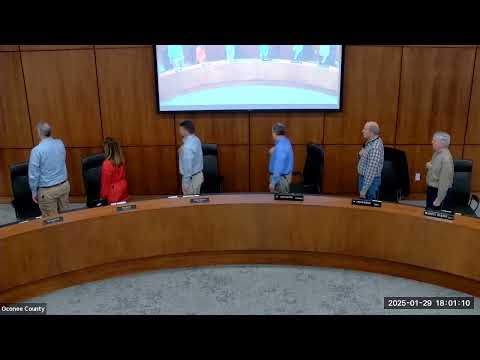
Both bodies approved the MOU and the necessary budget amendments. The Board of Commissioners approved the agreement by voice vote (motion seconded; "Aye" — motion carries). The Board of Education voted 5-0 to approve the MOU and associated budget amendments.
Implementation steps identified in the discussion include immediate recruitment by the sheriff's office, county-provided preliminary and final cost estimates to the school board in April and May respectively, and annual automatic renewals unless notice is provided. Board staff indicated the MOU was negotiated in sections: policy and budgeting were negotiated between the chairmen and the operational sections between district staff and the sheriff's office, with legal review of later sections.
The boards signed the agreement after the votes and adjourned the joint meeting.
Ending note: The MOU outlines responsibilities, training and equipment expectations (personnel, vehicles, radios, vests, uniforms and maintenance) but implementation will depend on recruitment timelines and final budget figures that county staff will provide before the school budget deadline.