Get Full Government Meeting Transcripts, Videos, & Alerts Forever!
Get email alerts on the Micromobility topic
No spam. Unsubscribe anytime.
Committee presses city mobility staff on obstructive scooter parking and enforcement
Summary
City transportation staff described enforcement and industry practices for shared scooters and bikes, and committee members urged more proactive measures — signage, geofenced parking areas and stronger operator accountability — to protect sidewalk access for people who use mobility aids.
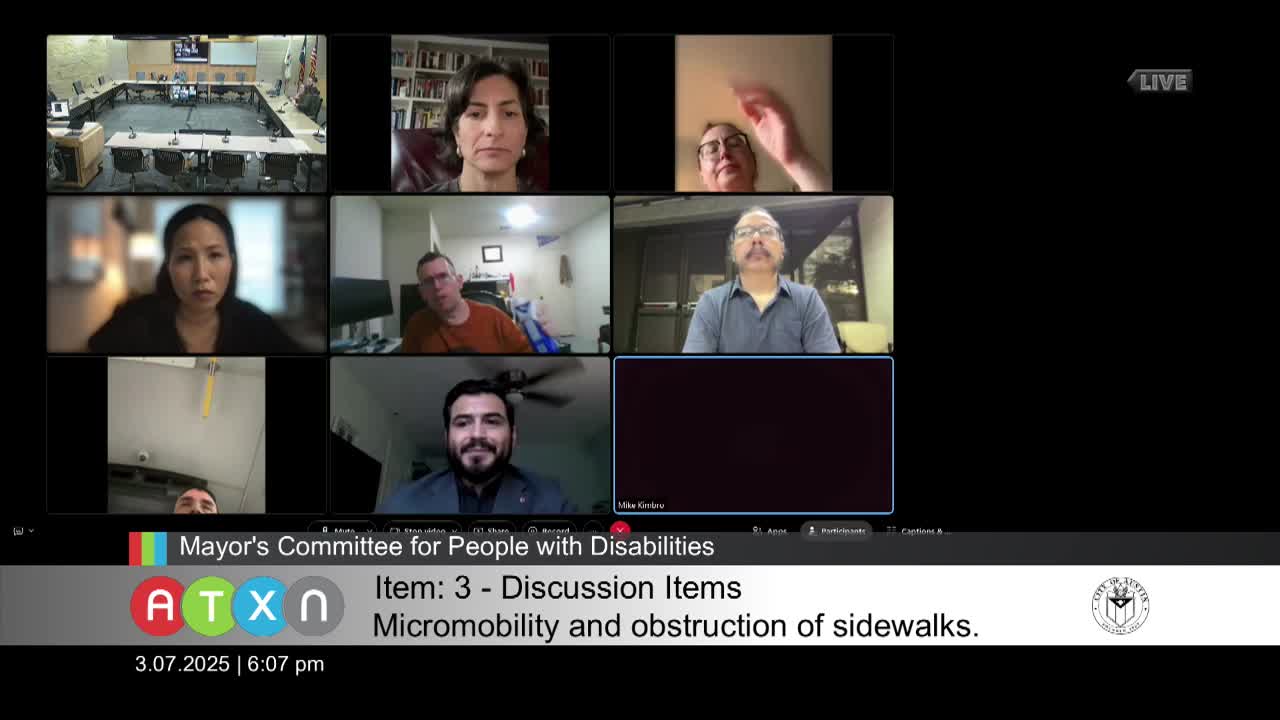
City transportation staff briefed the Mayor's Committee for People with Disabilities on sidewalk obstructions caused by shared micromobility devices and said the city relies on a combination of operator responsibilities, city monitoring and parking enforcement to address improperly parked scooters.
Joseph Lajio of the City of Austin’s Department of Transportation and Public Works introduced himself and his role in enterprise management and shared mobility oversight: “My name is Joseph Lajio of the department enterprise management for transportation public works,” he said. Michael, the city’s shared-mobility program manager, explained the city’s role in managing provider relationships and permits and said Bird and Lime are the current shared-device operators working under city permits.
Staff described the enforcement workflow: parking enforcement and mobility safety officers log improperly parked devices, create a customer service request with a photo and dispatch the request to the provider; providers have a two-hour service-level objective to rectify the obstruction, after which parking officers may impound the device. Staff said the city can require providers to remove devices and may suspend operators for recurring problems, but that tracing an individual rider who left a device in a walkway is difficult because another person might move the device after the trip ends.
Committee members pressed for more proactive strategies. Commissioners suggested in-app reminders, more frequent rider education, targeted signage at high-use hubs, permanent “parking boxes,” geofencing in apps to steer riders to correct parking areas, and stronger operator action against repeat offenders. One commissioner noted that the current system is largely reactive and urged more direct accountability: “In the two hours that the path is obstructed… somebody in a wheelchair or somebody using a white cane has to go out of her way…and they just make people's lives dangerous,” a committee member said.
Staff said the city is piloting new tools—including AI-assisted review of parking photos and geofence mapping—and working with providers on incentives and app features to improve parking behavior. Staff also said they are planning additional community outreach, an upcoming open house and a mobility-committee briefing on April 17 to report progress and gather further feedback.
Ending: Staff said they will continue to refine enforcement and education measures, explore signage and parking-box pilots in high-use areas, and return to the mobility committee with updates; the Mayor's Committee encouraged more rapid steps to reduce sidewalk obstructions for people with disabilities.