Get Full Government Meeting Transcripts, Videos, & Alerts Forever!
Get email alerts on the Housing Grants topic
No spam. Unsubscribe anytime.
City housing staff brief committee on HUD action-plan and federal grant priorities
Summary
City of Austin housing staff presented the annual HUD action-plan process to the Mayor's Committee for People with Disabilities, outlined four federal formula grants (CDBG, HOME, HOPWA, ESG), described last year’s outcomes and data improvements, and solicited committee feedback on priorities and accessibility of program delivery.
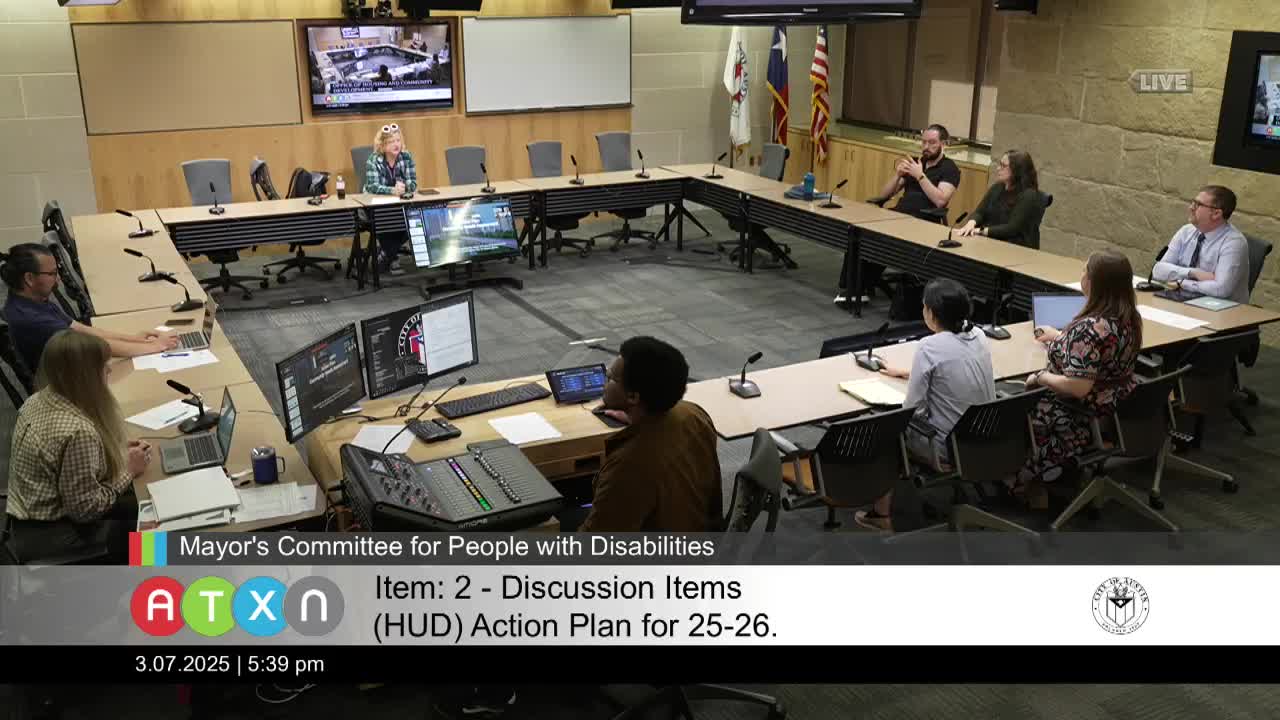
City of Austin housing staff on March 2025 told the Mayor's Committee for People with Disabilities they are preparing the city’s annual action plan to apply for four federal formula grants and asked the committee for feedback on priorities, data needs and program accessibility.
Rocio Pena Martinez, grants program manager in the city’s housing department, and Julie Smith, the department’s community engagement specialist, explained the action-plan process and emphasized that the grant planning is part of a five-year consolidated plan. “I'm Rocio Pena Martinez. I'm the grants program manager for housing department,” Pena Martinez said. “I'm here today to talk to you a little bit about our HUD grants, process that we're currently in called the action plan.” Smith said her role is to listen and to fold commission feedback into ongoing engagement: “I'm the community engagement specialist with the housing department. I'm here primarily to listen, and first just wanted to help set the stage for know, why we're here and what we'd like to hear from you.”
The staff listed the four federal formula grants that feed the action-plan process: the Community Development Block Grant (CDBG), the HOME Investment Partnerships Program (HOME), Housing Opportunities for Persons With AIDS (HOPWA) and the Emergency Solutions Grant (ESG). Staff presented a table summarizing fiscal year 23–24 goals, outcomes and expenditures and said those figures will be compared to outcomes at the end of the next grant year. Pena Martinez noted the department will apply for all four grants each year and will not know final award amounts until HUD completes review.
Staff said they are building a new internal data and policy team to improve demographic reporting on populations served, including people with disabilities, and promised to return with more targeted data. “We have a brand new data and policy team…we will be able to come to commissions with very specific data on the populations that you serve,” Pena Martinez said. The presenters also summarized common themes from prior engagement—requests for transparency, clearer data, better outreach to specific populations and accountability for partners—and said those requests informed the department’s current priorities.
Committee members asked whether the city has contingency plans if federal rules change or funding is delayed. A committee member raised concern about recent federal initiatives and possible effects on grants and requested a communication strategy and contingency planning. Pena Martinez said the city’s new intergovernmental relations office is coordinating communications about federal changes and that department leadership is discussing alternative funding such as general funds should HUD awards change. She also said, where possible, staff are considering alternatives to avoid service interruptions.
Committee members pressed on how ongoing assistance for households would be affected if federal funds were not awarded. Pena Martinez said programs under the grant umbrellas vary—some households receive ongoing, repeat services while others receive one-time or as-needed assistance—and that effects would depend on the specific program. Committee members urged prioritization of households with members with disabilities to avoid disruptions in service for vulnerable families.
Members also raised accessibility of application and service processes, asking whether applications are accessible for people who are blind or deaf. Pena Martinez said grant-funded programs are administered by several city departments and community partners and that accessibility standards apply; staff will take the committee’s feedback back to program teams. A committee member suggested voluntary demographic collection for disability status to improve outreach; staff said they are exploring voluntary questionnaires and coordinating with other departments.
Members commented on the presentation’s visual accessibility—one member said the slides’ typeface was too small for many attendees—and staff accepted that feedback and committed to improving the presentation materials and making them more accessible.
The housing staff asked the committee for priorities to inform the city’s HUD application and said they will include the committee’s feedback in city reporting to HUD. They also committed to circulate memos from the intergovernmental relations office and return with more detailed demographic data in future meetings.
Ending: The committee did not take any formal action on the item; staff will incorporate feedback into the action-plan process, pursue improved data collection, and follow up with the committee on communications about federal rule changes and contingency planning.