Get Full Government Meeting Transcripts, Videos, & Alerts Forever!
Get email alerts on the School Properties Shelters topic
No spam. Unsubscribe anytime.
Legislators press agencies for inventory, maintenance plan for closed schools eyed as emergency shelters
Summary
Members of the House Education Commission pressed Department of Education, DITOP and other agencies for an updated inventory and clearer maintenance responsibilities for schools in disuse that policymakers are considering as emergency shelters, while agencies said title custody and funding remain constraints.
Representatives on the House of Representatives’ Commission of Education on March 7 pressed government agencies for a single, updated inventory and a clear maintenance plan for schools currently closed or in disuse that are being evaluated as potential emergency shelters.
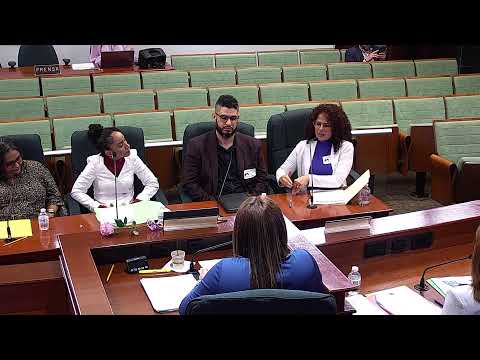
The request came during a multi-hour hearing in Salón de Audiencias Uno where lawmakers and agency representatives debated who holds title to closed school properties, which agencies are responsible for upkeep, and whether investment in those sites is practical and secure from vandalism and other risks.
Representative Reinaldo Figueroa Acevedo, a member of the commission, said the lists supplied by the Department of Education were incomplete. “La lista que provee educación no estaba completa,” he told the panel, saying his district alone contains more schools than the department’s list shows.
Saraí Ruiz Maizón, director of the Office of Public Policy at the Department of Education (representing the secretary), told the commission that responsibility for operations and maintenance is separate from title custody: “las escuelas que son de OMEP corresponden mantenimiento de áreas verdes a OMEP… Las que pertenecen y son cerradas de autoridades de edificios públicos corresponden a las autoridades de edificios públicos,” she said, describing how maintenance duties vary by which agency operates or administers a given facility.
Agencies reiterated that the Department of Transportation and Public Works (DITOP) or its equivalent holds title to the government’s real estate while other agencies operate and maintain facilities. José Torres, representing the government property custodian, told the commission that DITOP is building a single, centralized property inventory and digital platform—referred to in testimony as SUBI/PRI—to consolidate multiple, inconsistent lists: “al inicio de la vista nos preguntaron si había un inventario. Ese es el trabajo que estamos realizando, levantar, actualizar un inventario de todas las propiedades que tiene el gobierno,” he said.
The Department of Education said it currently lacks a complete condition report for the schools in disuse. The agency reported it could provide lists of closed schools it has cataloged, but not a full structural or title audit for every facility. The department said it has identified about 856 active schools on record and that certain closed sites are under review case-by-case.
Agencies and legislators discussed prior investments and ongoing improvements tied to emergency-readiness: witnesses said the government has identified roughly 284 facilities that might be used this year, that the education department has invested in more than 222 generator units to power refuge sites, and that cistern work affecting a program of about 344 facilities is more than 50 percent complete. Officials warned that costs originally estimated several years ago have risen, and that funds intended for school improvements (the so-called “Innova” list) are being re-evaluated for scope and purchasing power.
Lawmakers repeatedly raised concerns about vandalism and security for schools left vacant after elections or closure, and urged that any decision to invest in closed schools include plans for year‑round security, maintenance and access improvements. Representative Lizy Burgos Muñiz asked that the commission seek an economic and fiscal analysis from the Office of Legislative Budget to estimate the cost of implementing a program to ready closed schools as shelters, including long‑term maintenance.
Several members of the commission asked agencies to provide the following information to the record or the committee within short timelines: (1) an updated inventory showing which schools are titled to DITOP versus OMEP or the Public Buildings Authority; (2) condition reports for the schools identified as potential refuges; and (3) documentation of past allocations directed specifically to the Innova list and how those funds were spent or reprogrammed.
Agency witnesses said a formal interagency evaluator committee—already convened by housing, health, emergency management and education—has inspected identified shelters since February and that an inspection report was due to the Department of Education in April enumerating deficiencies and recommended improvements.
The hearing closed with commissioners asking staff to collate the requested materials so the committee can consider legislation or budget requests that clarify custody, maintenance responsibility and funding pathways for converting or maintaining closed schools as emergency shelters.
Ending: The commission left the record open for the agencies’ inventory and asset lists and signaled it will use that evidence to determine whether to pursue legislation or budget requests to fund and secure closed schools selected for shelter use.