
Charles County senators back bill requiring advance notice before displacing contracted school bus providers
Get AI-powered insights, summaries, and transcripts
Sign Up Free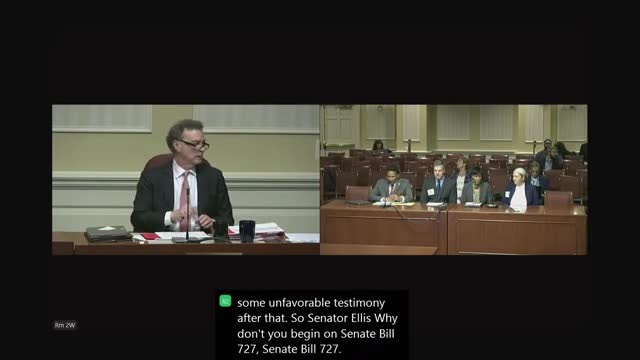
Summary
A hearing on Senate Bill 727 drew testimony from Charles County school bus contractors, county officials and labor and school-board representatives about proposed notice requirements before a local school system brings student transportation in house.
Senators heard competing testimony on Senate Bill 727, a Charles County delegation bill that would require advance notice before a local school system displaces contracted student bus transportation providers.
The bill’s sponsor, Sen. Arthur Ellis, said the measure was aimed at protecting small businesses who invest heavily in yellow school buses and associated equipment. “Imagine investing in a piece of equipment, an asset that expected to last 10 years or more… you mortgage your home and you personally guarantee that investment,” Ellis said in his opening remarks.
Supporters described contractors as small, locally owned firms that operate most of Charles County’s daily routes and urged a statutory baseline of notice before the school system transitions routes to an in-house fleet. Mark Koch, chair of the Charles County School Bus Contractors, told the committee the group represents 24 small businesses operating about 315 buses and transporting “over 28,000 students every day.” He said contractors typically make significant capital investments—reported in testimony as roughly $150,000 per bus—and risk financial ruin if contracts end without warning.
Several contractors said Charles County Public Schools (CCPS) currently uses short contracts—three years was cited repeatedly—and that neighboring jurisdictions offer longer terms. Jennifer Jordan, owner of D and J Buses, said many contractor buses are “Charles County specific and cannot be used in other jurisdictions.”
Opponents warned the bill would constrain local school authority and could raise costs for taxpayers. Christian Goble, legislative and political coordinator for AFSCME Maryland Council 3, said the union was “respectfully opposed,” arguing the proposed notice periods (initially framed as up to 10 years in testimony) would set an unusual precedent that could favor privatization and block cost-saving decisions. CCPS Chief of Operations Mike Heim told the panel that the district reimburses contractors through multiple line items—described in testimony as a per-vehicle allotment paid over six years (testimony described the per-vehicle allotment as roughly $35,000 per year for six years, with a total reimbursement figure cited in testimony of about $212,000 plus an excise tax payment)—and that CCPS needs flexibility to make “fiscally responsive decisions.”
Members of the Charles County Board of Education and its superintendent also opposed the bill. Board officials argued it would tie the board’s hands when confronting transportation budget pressures; Yonel Morley, board chair, said transportation is a large unfunded item and that mandates could prevent the board from “managing its transportation budget.” Superintendent Maria Navarro said the district supports a mixed model of contracted and in-house transportation and that the bill “imposes unrealistic terms that deteriorate our ability to make the best decisions for our school system.”
Committee members asked contractors and school officials to clarify details including contract lengths, how CCPS reimburses contractors, and the county’s fleet size—testimony gave several figures: contractors reported a jump in CCPS-owned buses from 22 to 69 over four years; CCPS staff said the system has 18 spare buses available for contractor use when needed. Several witnesses said earlier local work groups had produced compromises (a six‑year contracting term was mentioned as a possible compromise during debate).
The committee did not take votes on the bill during the hearing. Testimony closed with advocates urging the panel to balance small-business impacts against the school system’s responsibility to manage taxpayer funds.
Looking ahead, witnesses said they remain open to negotiated amendments; sponsors indicated a willingness to adjust the proposed notice term to reach a compromise between contractor stability and local fiscal control.