Get Full Government Meeting Transcripts, Videos, & Alerts Forever!
Get email alerts on the Education topic
No spam. Unsubscribe anytime.
Connecticut officials highlight $11.2 million investment and early gains from high-dosage tutoring
Summary
State education leaders, researchers and tutors described a state-funded high-dosage tutoring rollout to 43 districts—backed by an $11.2 million ARP ESSER state set-aside grant—that focused on grades 6–9 math, produced early academic and attendance gains, and faces staffing and timing challenges.
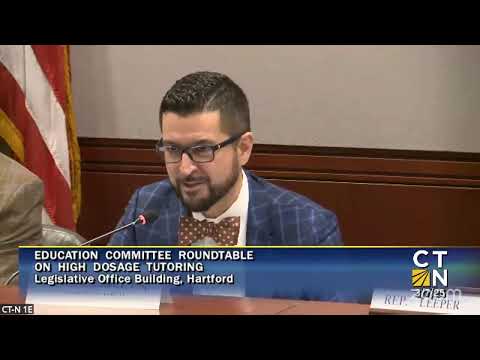
Connecticut education officials and outside researchers described the state's rollout of high-dosage tutoring and early evidence of benefit at a public forum hosted by the Connecticut Coalition for Achievement Now on Oct. 27, 2025.
The state Department of Education allocated $11,200,000 from the ARP ESSER (American Rescue Plan Elementary and Secondary School Emergency Relief) State Set-Aside to a competitive grant program that funded high-dosage tutoring in 43 districts, 14 of which are alliance districts, officials said. The program emphasized in-person instruction, targeted grades 6 through 9 mathematics, required small student-to-tutor ratios and set session expectations at about three times per week for roughly 30 minutes.
Why it matters: Supporters said high-dosage tutoring produces measurable learning gains, improves student attendance and builds confidence, and that sustained, predictable funding would preserve staffing, community partnerships and program fidelity.
At the forum, Carly Robinson, director of research at the SCALE initiative at Stanford University, summarized the evidence base for what the research community calls "high-impact, high-dosage tutoring," saying it involves "one-on-one or small-group instruction from a consistent, well-trained tutor" who uses high-quality curriculum and data to guide instruction. "These regular meetings are happening several times per week," she said.
Irene Parisi, chief academic officer at the Connecticut State Department of Education, said the department used the ARP ESSER State Set-Aside to create a discretionary competitive grant that required districts to adhere to the tutoring model and prioritize in-person implementation where possible. "We committed $11,200,000 allocated from the State Set-Aside portion of our ARP ESSER to create that competitive grant, to allow for 43 districts to ultimately participate," Parisi said.
Ajit Gopalakrishnan, the department's chief performance officer, added that the grant review process stressed fidelity and alignment: approved programs needed curriculum and materials aligned with district instruction, and districts could either contract with vetted private providers or use district staff. "Who provides the tutoring is really key," he said, noting districts had to balance speed of startup with tutor quality and retention.
District leaders and tutors described classroom-level effects. Bob James, secondary math curriculum supervisor for East Hartford Public Schools, said students who received consistent tutoring not only gained math skills but became more likely to attend school on tutoring days and to participate in class. "Once they start to have success in their regular math course, they can see, 'This tutoring that I'm getting ... is helping me,'" James said.
Parents and tutors gave concrete examples. Beatrice Perez, whose son received high-dosage literacy tutoring in New Haven, said he "went from barely reading anything" to reading chapter books and engaging more in class after nearly two years of tutoring. Tutor Ebony McMillan, who works in East Hartford, said the program also helped build an educator pipeline: her high-school-age son told her he wanted to tutor next year after seeing her work.
Officials and researchers identified challenges. Gopalakrishnan said staffing and turnover were persistent problems: some districts received private tutoring providers quickly but experienced tutor inconsistency or departure. Timing also limited the first-year effort; many districts did not fully launch until mid-year of the 2023–24 school year, effectively shortening implementation. Parisi said those lessons informed future planning, including stronger local leadership and clearer vetting of providers.
Evaluation and outcomes: The state convened a research collaborative, the Center for Connecticut Education Research Collaboration, to evaluate the grants. Gopalakrishnan and Parisi said preliminary findings mirror national research: greater gains for in-person tutoring versus virtual, improved math confidence, and attendance benefits on tutoring days. Robinson noted randomized trials nationally have shown effects ranging from about half a year to more than a year of additional learning in some contexts, and that implementation fidelity matters most.
Program design and local partnerships: The department required districts to specify frequency, curriculum alignment and tutor training in grant applications; roughly 80 districts applied for funding and 43 were awarded grants. Districts used a mix of vendor partnerships and local recruitment, including AmeriCorps-style organizations (named in the forum as Go Tutor Corps/Go TutorCore) and local college graduates, to staff programs. Several speakers urged matching local commitment with state funds, including the department's desire for local "skin in the game" through matching or district contributions.
Costs and next steps: Panelists urged stable funding. Participants referenced a governor's budget proposal that includes additional tutoring funding in the 2026'27 biennium and urged avoiding funding gaps between school years. James and others said the startup costs already paid by districts increase the return on continued investment because infrastructure, training and partnerships are in place.
The forum closed with leaders calling for continued investment and expansion of tutoring, further evaluation of program components (including potential AI tools to support tutors), and attention to tutor recruitment and retention as critical to sustaining gains.