Get Full Government Meeting Transcripts, Videos, & Alerts Forever!
Get email alerts on the Civic Process Budget Rules topic
No spam. Unsubscribe anytime.
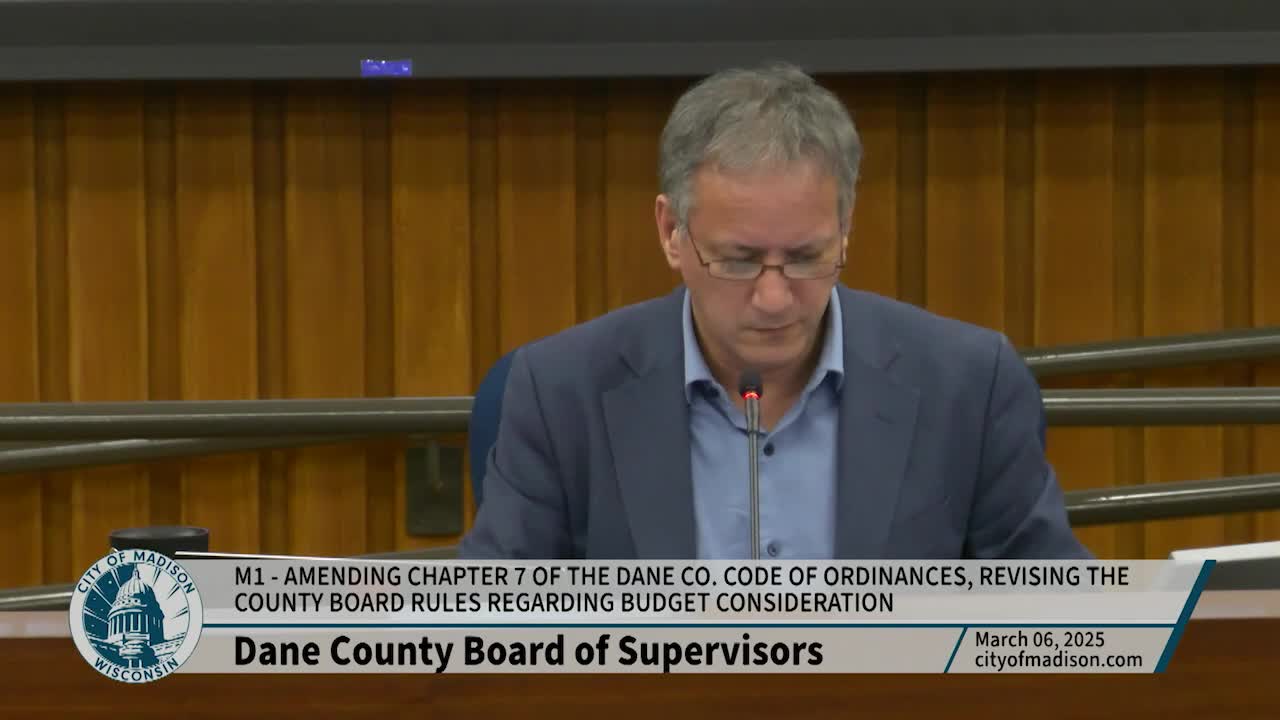
Board rejects change to budget hearing rules after hours of debate
Summary
An effort to shorten public-comment time at county budget hearings was proposed in ordinance OA 41; an amendment striking a proposed 3-minute cap passed, but the main ordinance failed to gain the two-thirds majority needed to change board rules.
The Dane County Board debated changes to Chapter 7 of the Dane County Code of Ordinances (OA 41), a proposal that would amend board rules around public comment during budget hearings. After extended discussion and an amendment that removed a proposed three-minute cap for budget registrants, the full ordinance failed to reach the required two-thirds majority and was not adopted.
The amendment (moved by Supervisor Chawla and seconded by Supervisor Heusselman) struck language that would have said “no registrant shall speak more than three minutes” at county budget hearings. That amendment passed on a voice/roll-call count (the clerk recorded the amendment carrying after a 22–12 roll call on the amendment). After further debate about committee scheduling, public access and chair discretion for suspending rules, the board voted on OA 41 as amended. The clerk recorded 12 ayes, 21 nos and 4 absences; because the change to board rules required a two-thirds majority, OA 41 as amended failed.
Supporters of removing the three-minute cap argued the limit would unnecessarily constrain public testimony when registrant counts are low and that chairs can use rule suspension at the start of a meeting to manage very large registrant lists. Supervisor Wegleitner said, “I support this motion because I think, limiting time without having the context of how many people have registered … is an artificial unnecessary limitation.”
Opponents favored a standard, consistent time limit to ensure more people could be heard; Supervisor Kemp said setting a standard can “actually afford people more an opportunity to speak publicly before the county board.” Some supervisors emphasized access concerns for residents who must travel to testify and the value of multiple hearings for complex departmental budgets.
The chair and board office said additional non-ordinance guidance and procedural changes derived from a board-wide survey would be used to shape the budget process (scheduling, guidance to directors, and other operational practices) even though OA 41 was not adopted.
What failed and what passed: the board adopted the amendment to strike lines limiting comment to three minutes, but the main ordinance OA 41 as amended did not receive the required two-thirds vote to change board rules and therefore failed.
Next steps: The county board office indicated it will use the survey results and internal guidance to implement process changes where possible; any rule changes requiring ordinance revisions would require future votes and the higher voting threshold for board-rule changes.