Get Full Government Meeting Transcripts, Videos, & Alerts Forever!
Get email alerts on the Emergency Communications topic
No spam. Unsubscribe anytime.
Milwaukee centralizes 911 operations under Department of Emergency Communications; officials report improved metrics
Summary
City officials told the Milwaukee Fire and Police Commission that the Department of Emergency Communications completed managerial control of the consolidated emergency communications center in February and credited pay increases, technology upgrades and staffing changes with improved call-answer and response-time metrics.
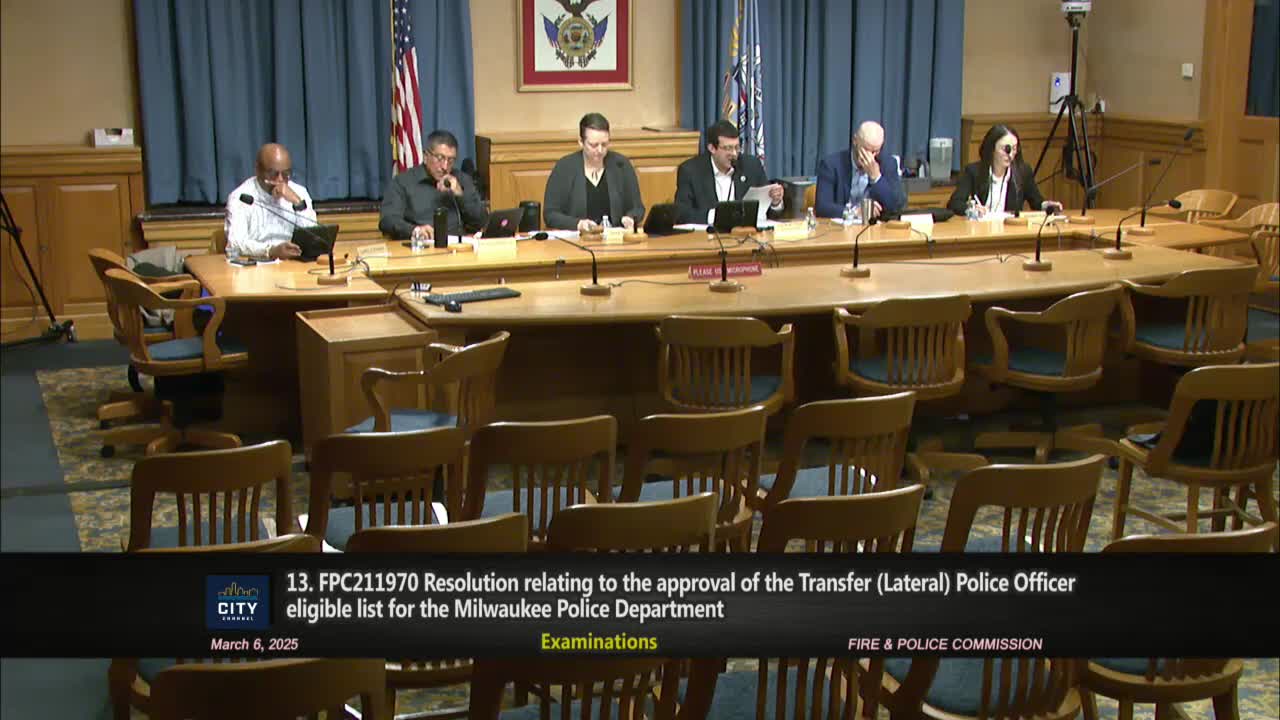
At the March 6 meeting of the Milwaukee Fire and Police Commission, Department of Emergency Communications leaders said the city completed the transition of operational control for its consolidated emergency communications center on Feb. 16 and reported sustained improvements in 911 performance.
The update came during a presentation to the commission by Director Bueno and Deputy Director Dummerat, who described steps the department took since 2017 to meet national standards and stabilize staffing. “On February 16, the DEC finally completed our transition of the management and positional authority for Milwaukee's consolidated emergency communication center,” Director Bueno said, adding the change occurred “with no outward interruption.”
The department told commissioners the consolidation and related reforms were aimed at improving pay, technology and staffing. Deputy Director Dummerat said the DEC raised wages after a market study, changed hiring and career-path structures, upgraded the 911 phone system and implemented a common computer-aided dispatch system. “We updated our 911 phone system, and implemented a common CAD. The immediate effect of that simple change was to reduce our fire response times by almost 1 minute,” Dummerat said.
The presentation placed several figures on the record: the DEC said it hired one of its largest classes in 2024 with 31 employees; vacancy rates for call takers and dispatchers have fallen to about 10 percent from levels the presenters described in prior years as high as 50 percent; and the department reported it exceeded NENA (National Emergency Number Association) standards for answer and call-handling every month since February 2024. The department also said it handled more than 950,000 calls in the prior year.
Commissioners pressed for additional detail. Commissioner Spence asked whether the city had materials for public education about how 911 calls are handled; Deputy Director Dummerat said DEC ran a “not 911” outreach campaign in February 2024 and that the department plans further community education this year. Commissioner Fung asked about demographic and geographic data on staffing; presenters said they can share basic gender and ethnicity breakdowns but that more detailed personal-history data (childcare status, ZIP-code of residence) was not currently collected.
Officials described several forward-looking initiatives. The DEC has hired a business-intelligence analyst, Uday Khumbar, to consolidate CAD, phone, HR and finance data for data-driven planning, the presenters said. The department plans to roll out a universal call-taker model (UCT) intended to reduce transfers by routing most calls through a single trained point of contact; DEC leaders said they expect UCT to apply to all call takers by the end of the third quarter of 2025 and to phase in for dispatchers thereafter. The DEC is pursuing accreditation and a public-facing data portal to publish response and answer-time metrics.
Commissioners and department leaders also discussed quality assurance and workforce morale. Dummerat said the department is redesigning quality-assurance and training programs to both correct problems and celebrate employee successes. Deputies said that reduced mandatory overtime and clearer career paths — from call taker to roles in quality assurance, training or management — have improved recruitment and retention.
The presentation was informational; no formal vote was required on the consolidation itself. Commissioners thanked the presenters and noted the consolidation had moved without a public operational incident since the Feb. 16 transition.
The commission later took routine votes on probation extensions and personnel actions related to the DEC that are recorded elsewhere on the agenda.