Get Full Government Meeting Transcripts, Videos, & Alerts Forever!
Get email alerts on the Court Reporter Discipline topic
No spam. Unsubscribe anytime.
JVCC committee recommends fines and revocation in two court-reporter matters involving Latoya Young
Summary
A complaint review committee of the Judicial Branch Certification Commission recommended on a motion passed by the committee that court reporter Latoya Young be assessed an administrative penalty in one matter and face permanent certification revocation in a separate matter.
A complaint review committee of the Judicial Branch Certification Commission recommended on a motion passed by the committee that court reporter Latoya Young be assessed an administrative penalty in one matter and face permanent certification revocation in a separate matter.
The committee voted to accept staff findings that Young violated multiple provisions of the JVCC code of ethics in cause number 0714, a complaint filed by Sergio Hernandez alleging Young failed to provide a readable transcript after payment. The committee recommended a $1,200 administrative penalty, to be paid within 12 months of the final order. The committee separately accepted prosecutor recommendations in cause number 0796 — a complaint filed by Melinda Saucedo, JVCC compliance manager — that Young failed to timely file records in appeals before the Fifth Court of Appeals and in multiple other appellate matters; for that matter the committee recommended permanent revocation of Young’s court-reporter certification effective on the date of the final order.
Why it matters: Court reporters’ timely and accurate filing of appeal records is central to appellate review and defendants’ rights. The committee’s recommendations, if adopted by the full JVCC, would remove Young’s authority to serve as a certified court reporter and obligate her to pay the administrative penalty in the separate matter.
The complaints and findings The complaint in cause 0714, filed July 18, 2024, alleged Young failed to provide a readable transcript to the complainant after payment. Committee backup material says Young initially sent files that were not readable and later sent a PDF; Young told the committee she no longer had access to her Dallas County email account and apologized for the delay. The committee found violations of JVCC code-of-ethics provisions cited in staff backup and recommended the $1,200 administrative penalty (broken down in the motion as $350 for section 4(b)(1), $250 for section 7(e), $350 for section 8(e) and $250 for section 10(g)(1)).
In cause 0796, filed Jan. 15, 2025, JVCC staff reported that Young failed to timely request extensions and failed to file appellate records in several matters pending before the Fifth Court of Appeals; the investigation identified at least 12 additional appellate records not filed as of March 7, 2025. The backup notes that appellate orders issued for two cases after the report was finalized (an Alameda case ordered filed by March 31, 2025, and a Bell case ordered filed by March 17, 2025) and that the appellate court warned Young it may bar her from sitting as a reporter if she does not comply with the deadlines.
JVCC staff also told the committee that, because of the circumstances in the Alameda and Bell matters, the Office of Court Administration issued a temporary cease-and-desist order in those matters; staff clarified the cease-and-desist was intended to preserve the functioning of the judicial system and would not prevent Young from attempting to comply with court orders or from completing outstanding transcripts. Ronald Morgan, the JVCC director, summarized that temporary OCA action during the meeting.
Young’s statements Latoya Young told the committee she had sent files generated by her software that were not in PDF form and that she can provide the complainant’s files and offer a full refund. On the broader appellate-record issues, Young said she was overwhelmed by family circumstances and that some notifications came to court officials rather than to her as a substitute reporter; she acknowledged long delays in filing some records but also said she had filed records in some matters after receiving notice. Directly to the committee she said, “I sent him the files, and I guess I didn't realize I sent him the files from my software instead of a PDF initially... I do have his files that I can send him, and I'll be willing to give him a full refund.”
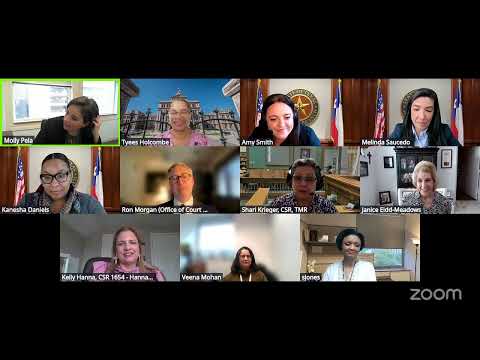
Committee action and next steps Committee members made separate motions for the two causes and voted to accept staff recommendations. For cause 0714 the committee adopted the proposed violations and the $1,200 administrative penalty; for cause 0796 the committee adopted the prosecutor’s recommended finding of violations and recommended permanent revocation of Young’s certification. The committee’s motions and votes were the committee’s formal recommendations to the JVCC; the JVCC commission will receive the committee’s recommendations and vote at an upcoming commission meeting. Committee chair Molly Pila explained that if the committee determines violations exist, the respondent will be mailed a notice of violation and will have the opportunity to settle or contest the matter in writing before the commission.
Several committee members raised questions beyond deadlines — including concerns about filings that appeared deficient (for example, incorrect voir dire forms or other defects) and the number and recurrence of extension requests — and noted that some failures involved patterns across multiple cases rather than an isolated missed deadline. Committee members also discussed procedural communication with appellate clerks and JVCC investigatory practice.
The committee’s recommendations will be forwarded to the full JVCC for final action; Young will receive written notice of the committee’s recommendations and the next steps in the enforcement process.