Get Full Government Meeting Transcripts, Videos, & Alerts Forever!
Get email alerts on the Parks And Recreation Cip topic
No spam. Unsubscribe anytime.
San Mateo staff seek $5 million for FY26 parks capital plan; Central Park, East Hillsdale projects highlighted
Summary
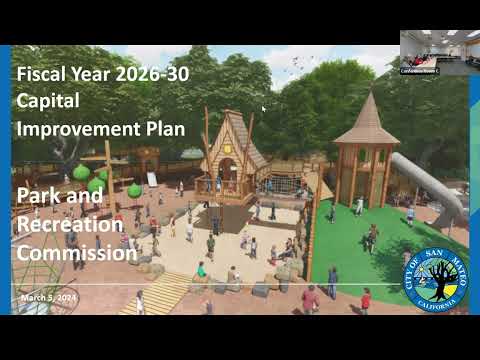
SAN MATEO, Calif. — At a March 5 Parks & Recreation Commission meeting, city staff presented a proposed five-year (FY26–30) parks capital improvement plan and asked commissioners to review and comment on a FY26 funding request of $5,000,000.
SAN MATEO, Calif. — At a March 5 Parks & Recreation Commission meeting, city staff presented a proposed five-year (FY26–30) parks capital improvement plan and asked commissioners to review and comment on a FY26 funding request of $5,000,000.
The proposal, presented by Parks & Recreation staff member Suzanne, laid out projected revenue from development-related in-lieu fees and other sources, a request to the Measure S fund and a set of prioritized projects including the Central Park playground renovation, East Hillsdale (Hidden Park) work, synthetic turf replacement, and assessments for childcare facilities and overall park amenities. "Swimming pools. Our swimming pools are a priority. Our Central Park is a priority. Our East Hillsdale Park is a priority," Suzanne told commissioners.
Why this matters: the commission's comments will inform a package the city bundles with other departments for City Council preview in April and final approval (if adopted) in June 2025. The CIP would determine the use of developer in-lieu fees, Measure S allocations and other city funding for projects that shape neighborhood recreation access and citywide park maintenance.
Key funding and projects
Staff said their conservative revenue forecast averages about $4.5 million per year from in-lieu fees (used to estimate available funds for projects) and that projection produced roughly $15 million across five years for parks. In addition to those fees, the presentation identified a request of $1.6 million from Measure S for parks work. For FY26 specifically, staff proposed allocating $5,000,000 across projects and funding sources.
Suzanne told the commission that Central Park already holds the largest single allocation in the parks fund — roughly $13 million — and that the city’s total park-related funds on hand were "close to $20,000,000". Central Park’s playground contract was awarded the week before the commission meeting; staff said the project still needs construction-management support and asked for additional funding to secure that oversight. The presentation included a line item of $750,000 to fund construction-management services for Central Park’s playground renovation to ensure active field oversight.
Explaining the role of a construction manager, a project manager on staff said: "During the construction phase, after we have secured a general contractor, the contractor needs to be managed. Make sure that they fulfill the requirements of the contract documents." Staff explained construction-management services are typically competitively bid and are often estimated at 5–15% of a project budget.
Staff identified other ongoing and new projects the CIP would support if funded: continued work at East Hillsdale Park (also referred to by the neighborhood as Hidden Park), King Center assessment and improvements (the city is pursuing resiliency-center features for the King facility), synthetic-field replacement (one turf field), Parkside aquatic play-area replacement, tree planting, and smaller repairs and scoping work such as a $50,000 scoping estimate for the Bridal Park water feature.
Planned studies and future-year items include a $150,000 assessment of two childcare facilities (Lakeshore and Shoreview) to evaluate upgrades needed for licensed childcare operations, a planned $600,000 parks amenities assessment to inventory and prioritize maintenance across the park system, and a $650,000 allocation penciled for FY27 to renovate the Japanese Garden (fence, tea house roof and pond repairs, staff said).
Public comment and neighborhood concerns
A neighborhood association representative, identified in the meeting as the president of the Beresford Hillsdale Neighborhood Association (name not provided on the record), asked the commission for an update on East Hillsdale/Hidden Park and for upgrades at West Park, which the commenter said has deteriorated play equipment and a damaged basketball court. The resident also warned that Hillsdale Mall redevelopment — described in public remarks as adding roughly 1,500 housing units — will increase local demand for parks and suggested the city consider requiring the developer to contribute to park funding or facilities.
"...it seems to be delayed, delayed, delayed, and we would like to see it started or at least have an update on when that maybe, at least started," the resident said, asking staff to report back to the neighborhood association with a timeline.
Discussion highlights and staff responses
Commissioners asked for clarity about what projects are likely to proceed in the near term and what remains in preliminary planning. Staff said East Hillsdale work has progressed and pre-bid qualification for that project was complete; the project would begin soon. Central Park’s larger renovation faced a prior delay after initial bids exceeded the budget and staff performed value engineering; the contract was awarded only after that process.
Commissioners asked whether the commission or staff had explored public–private partnerships or sponsorships; staff said the city is investigating such options but had not yet implemented a program. A commissioner also suggested a joint session with the Measure S oversight committee and an update from the Parks & Recreation Foundation to explore additional funding opportunities; staff said they could provide more information to the commission.
On resiliency: staff described the federal grant definition the city is using for a resiliency hub at the King facility, which would include features such as "temporary shelter in times of disaster," meal distribution, restroom and shower facilities, power and public Wi‑Fi, and community training programs to build preparedness.
Scope, uncertainties and next steps
Staff emphasized several constraints that affect the CIP: wild swings in development-fee revenue year to year, the need to balance funds across parks citywide rather than concentrating on a single neighborhood, federal grant requirements for some projects (for example, resiliency-center features) and the high cost of facility work compared with park renovations. Staff asked that the commission provide feedback and signaled they would bring the CIP forward with the city’s broader capital schedule for City Council preview in April and potential approval in June 2025.
The commission did not take a final vote on the CIP at the March 5 meeting; commissioners provided feedback and requested periodic updates on allocations and project status at future meetings. One commissioner requested that staff provide a clearer itemization of funds currently allocated versus unallocated in the parks fund at a subsequent meeting.
Ending
Staff said they will bundle the parks CIP recommendations with the citywide CIP for City Council preview in April and, pending council action, to make funds available July 1 for the next fiscal year. Commissioners asked staff to return with updated project timelines, clearer fund-allocation detail, possible Measure S coordination, and additional information from the Parks & Recreation Foundation as available.