Get Full Government Meeting Transcripts, Videos, & Alerts Forever!
Get email alerts on the Ethics Ordinance topic
No spam. Unsubscribe anytime.
Marietta council directs ethics committee to refine code, requests clean draft after debate on disclosure amounts and appeals
Summary
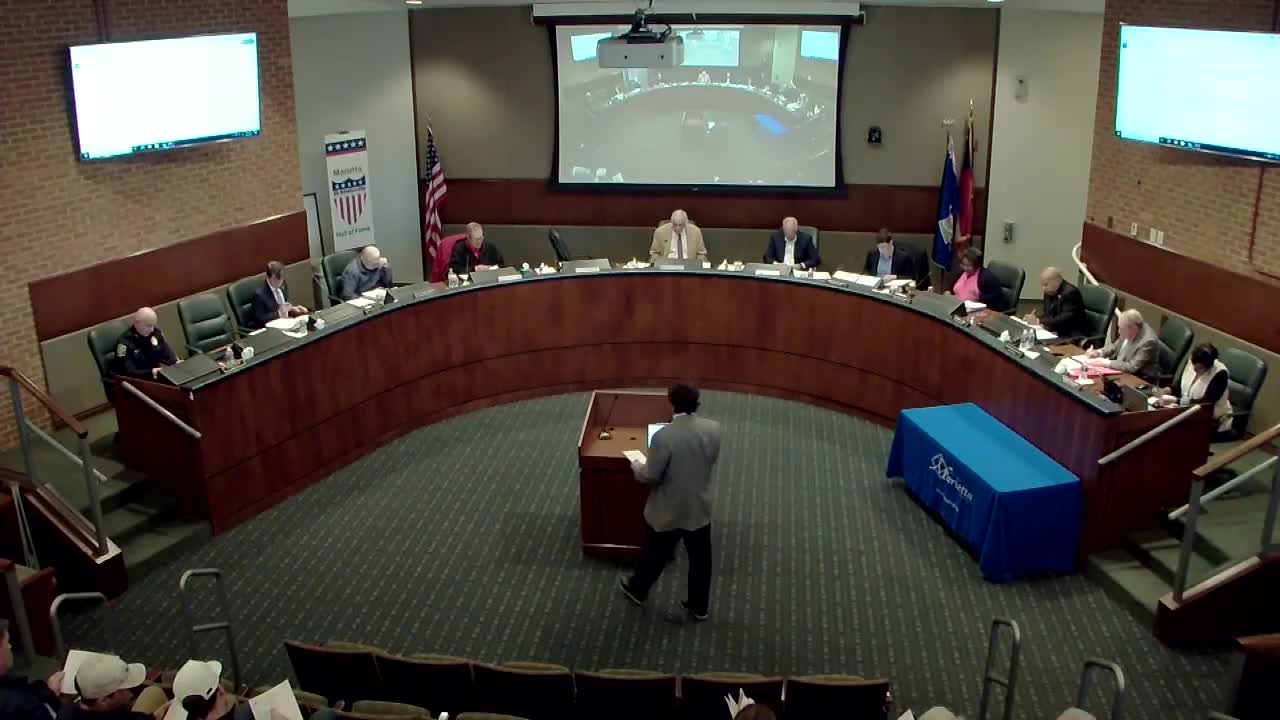
After a lengthy discussion on disclosure thresholds, definition of constructive knowledge, and whether the ethics committee should render punishments, the council asked the committee and city attorney to return with a clean revised ethics ordinance and a standalone provision addressing election qualifying-period complaints.
The Marietta City Council spent substantial time reviewing recommendations from the ethics committee and its counsel about updating the cityethics ordinance, directing the committee to return with a revised, clean draft and additional clarity on several points including disclosure thresholds, the knowledge standard for conflicts, and appeals from committee findings.
Julie Livingston, who introduced the committee's work at the meeting, said the committee had produced a redline but had been asked to look for simpler language used by other Georgia cities. Council members pressed for a clearer statement of purpose, tighter definitions, and more precise disclosure thresholds. One council member urged aligning the local disclosure threshold with state reporting and recommended lowering the threshold to $5,000 (from $10,000) to match what council members already disclose to the state.
Members debated whether the ethics committee should be strictly fact-finding or also issue punishments. The current ordinance, as discussed, allows the committee to find facts and impose reprimands or remove appointed board members; removal decisions are appealable to the council, while the factual finding itself is not currently appealable. Several council members expressed concern that an unappealable formal finding could permanently damage a person's reputation without sufficient recourse and asked that either both facts and punishment be appealable or that the committee be limited to fact-finding with recommendations and the council retain final action on punishments.
The council also discussed the appropriate burden of proof for committee findings. Most ordinances reviewed by staff use preponderance of evidence or clear and convincing standards; the current city ordinance uses clear and convincing for the ethics committee and beyond a reasonable doubt for matters going to counsel. Council members asked staff and committee members to consider a reasonable-person constructive-knowledge standard but to avoid "gotcha" enforcement of inadvertent failures.
After deliberation, council members moved that the ethics committee return with a single, clean draft of a revised ordinance (rather than just a redline) and bring back, separately and sooner if possible, a single provision addressing complaints during the election qualifying period. That motion passed 5-2. Council members also asked the committee to consider changing the disclosure threshold to $5,000 to align with state disclosure rules and to clarify appellate procedures for committee findings and punishments.