Get Full Government Meeting Transcripts, Videos, & Alerts Forever!
Get email alerts on the Street Furniture topic
No spam. Unsubscribe anytime.
Council approves coordinated street furniture program to add shelters, kiosks and public toilets; directs targeted roll-out and publisher concurrence for newsr
Summary
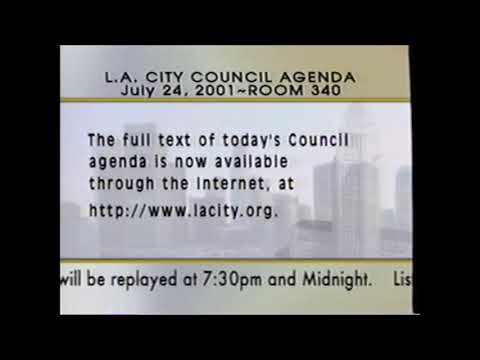
The Los Angeles City Council approved a citywide coordinated street furniture program on July 24, directing staff to negotiate a 20-year agreement with JCDecaux and to prioritize placement of automated public toilets in areas with high concentrations of homeless residents.
The Los Angeles City Council on July 24 approved, as amended, a coordinated street furniture program that directs staff to negotiate a 20-year agreement with JCDecaux (identified in the record as Infiniti/Infinity De Co) to provide bus shelters, kiosks, computer information terminals and automated, self-cleaning public toilets. The Public Works Committee report, adopted as amended, instructs staff to return within 60 days with negotiation results; if an agreement with JCDecaux cannot be reached, staff are to negotiate with Adshall Inc. The final motion passed on the council floor as the Public Works report, 12 ayes and 2 noes.
Why it matters: The program bundles multiple street elements — transit shelters, newsstand/kiosk offerings, information terminals and automated public toilets — into a single citywide contract that includes guaranteed minimum revenue sharing to the city and operational commitments by the vendor. Supporters say the consolidated approach lets the city fund and maintain costly public toilets and higher-service features by using advertising revenue from shelters and kiosks; opponents urged a more cautious pilot approach and separate handling of controversial elements such as modular news racks.
What the council approved: Staff presented committee recommendations that the Bureau of Street Services and the Chief Legislative Analyst (CLA) negotiate a 20-year contract with JCDecaux and, failing agreement within 60 days, open negotiations with Adshall Inc. The council approved those recommendations and added or accepted amendments requiring:
- Prioritization of siting automated public toilets in areas with a high concentration of homeless residents as an initial deployment strategy (Councilmember Ed Pacheco’s motion). - A requirement for concurrence or a defined negotiation process between the city and newspaper publishers before modular news racks are deployed in any location (Councilmember Bernsen’s amendment); the council directed that news rack placement and any related advertising be coordinated with publishers and the city through the negotiation process or a separate agreement. - Inclusion of dedicated city enforcement/inspection funding in the contract, explicit maintenance schedules, First Amendment and newsstand issues to be resolved with publishers, and collective-bargaining provisions for relevant employees.
Details from staff presentation: Lynn Ozawa of the CLA told the council the coordinated proposal would include up to 2,500 transit shelters, automated self-cleaning toilets, trash and recycling receptacles, newsstand and advertising kiosks, computer information terminals, and community information panels. JCDecaux’s revenue-sharing proposal guarantees a minimum of $150,000,000 to the city over 20 years, indexed to CPI. The CLA and Board of Public Works recommended JCDecaux as a responsible bidder after outside counsel advised that a February 2000 French conviction raised in bid protests remained on appeal and therefore did not render the firm non-responsible under the city's bidder questionnaire.
Concerns and safeguards raised on the floor: Several councilmembers asked for pilot deployments and clearer siting and enforcement plans. Councilmember Nate Weiss moved to reopen the public hearing and secured limited additional comment from community representatives, who raised questions about vandalism, graffiti, toilet security, and how tokens for homeless or low-income users would be distributed. Staff and the Assistant City Attorney, Christopher Westhoff, described token systems used elsewhere (reusable tokens or keys issued by homeless service providers) and maintenance options such as graffiti-resistant coatings and metal/mesh construction for vulnerable elements. Staff also said many cities require a 20-year contract to amortize capital costs for this scope of work and that some municipalities had adjusted hours or maintenance levels in response to local issues.
Vote and next steps: The council adopted the Public Works Committee report as amended; the clerk recorded 12 ayes and 2 noes. Staff were instructed to negotiate a contract consistent with the council's amendments and to report back with the negotiated terms and implementation recommendations. The council explicitly preserved the role of individual councilmembers and city departments in siting decisions and asked for processes to include neighborhood input, police input on security-sensitive locations, and Department of Neighborhood Empowerment involvement for terminals serving neighborhood councils.
What remains unresolved: Staff said negotiations will address final design, maintenance frequency, the exact number and placement of toilets, the interplay with local specific plans and historic-district guidelines, and how publishers and neighborhood councils will participate in design and siting work. Modular news racks remain subject to additional discussion with the publishing industry and possible separate agreement.
Speakers quoted in this article spoke during the Planning/Public Works committee reports and the council floor debate on item 22 on July 24; attributions follow the council transcript.