Get Full Government Meeting Transcripts, Videos, & Alerts Forever!
Get email alerts on the Land Use Zoning topic
No spam. Unsubscribe anytime.
Orange County commissioners find Fiddlehead Corner rezoning inconsistent with county plans, approve family‑care zoning text changes
Summary
After a public hearing and hourlong deliberation, the Orange County Board of Commissioners voted to reject changes that would expand a rural neighborhood activity node for a proposed 100‑unit Morrow Mill / Fiddlehead Corner development, while approving unrelated text amendments to allow family care facilities in the county's UDO.
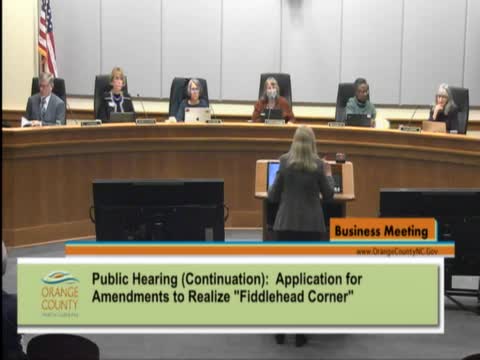
The Orange County Board of County Commissioners on March 6 rejected a proposed comprehensive plan and zoning change for a 100‑unit master‑plan development known in paperwork as the Fiddlehead Corner (also referred to by some speakers as the Morrow Mill proposal), finding the application inconsistent with the county's adopted land‑use framework, and adopted a formal statement of inconsistency. The board separately approved two UDO text amendments to permit family care facilities and related zoning language.
The board's action came after a public hearing during which the applicant described the proposal as a conservation cluster neighborhood aimed at older adults, and after neighbors and tribal descendants raised concerns about water, wastewater and the site's proximity to the Harrah/Hard River. The commissioners voted 6‑0 to adopt the statement that the rezoning and related comprehensive‑plan amendment were inconsistent with the county's plans and to deny the proposed expansion of the rural neighborhood activity node. The family‑care zoning text amendments passed on a separate vote, 6‑0.
County staff and the applicant emphasized the project's technical protections for water and wastewater, while several commissioners expressed concern about long‑term water availability, applicability of the county's rural node policy and precedent for changing the node's intended character.
"What we are proposing for you to review tonight is a conservation cluster neighborhood," applicant representative Scott Bridal told the board, noting the project would cluster dwellings to preserve open space and that the developer proposed roughly 68–70% open space. Bridal said the proposal would result in about "1.1 units per acre," which he said is comparable to single‑family densities in the area, and that the project is intended to provide housing attractive to seniors.
Public commenter Dante Bowman Jr., who identified himself as a Hillsborough resident and descendant of Okeechi ancestors, criticized siting the project near the Hard River. "The Hard River is where my ancestors...water is life, is sacred to my people and it also should...be sacred to y'all as well," Bowman said during the hearing.
Engineer Kevin Davidson, representing the applicant on wastewater, told commissioners the proposed treatment technology is widely used and that the design includes a permitted backup drainfield. Davidson said the developer expects the system to be serviceable and that a catastrophic system failure requiring public sewer connection is not the anticipated outcome. Geologist Edwin Cox explained hydrogeologic basics and said counties commonly use a 1,000‑foot rule of thumb as a zone of influence when evaluating whether a high‑capacity well could affect nearby private wells.
Several commissioners said the county needs to be cautious before allowing a change that would permit residential development with a community well and on‑site treatment in a predominantly agricultural‑residential area. "For me, it takes us to a place where we're stepping away from that consistency in the short term," Commissioner Carter said, explaining why she opposed changing the node designation. Commissioner Green likewise said she found the water availability risk the "stumbling block" and could not support the project.
Planning staff clarified that the Unified Development Ordinance sets thresholds for nonresidential uses inside activity nodes and that the ordinance as drafted did not prevent the applicant's proposed residential uses from being considered under conditional zoning; nevertheless, multiple commissioners worried that approving the change would set a precedent to convert other rural nodes to similar residential developments.
Votes at a glance: - Attachment C‑4 and C‑5 (UDO text amendments to permit family care facilities and related wording): APPROVED, 6‑0. - Attachments C‑2 and C‑3 (proposed UDO text changes related to rural neighborhood activity nodes): DENIED (motion to not adopt), vote recorded as carried by the board during final action. - Attachment B‑7 (proposed comprehensive plan amendment expanding the rural neighborhood activity node to include the full project area): DENIED (board adopted a motion to deny the amendment; board then approved a statement of inconsistency), vote: board voted to deny the amendment and later adopted the statement of inconsistency 6‑0.
Following the votes, the board adopted a resolution finding the Fiddlehead Corner master‑plan conditional district zoning application inconsistent with the adopted Orange County 2030 Comprehensive Plan (and with the county's Unified Development Ordinance), citing that the majority of the development lies outside the rural neighborhood activity node and that the proposal more closely resembles an urban development pattern than the agricultural‑residential future land‑use classification for the parcels. The board also removed several paragraphs of staff draft language before adopting the final statement of inconsistency.
Next steps: Because the board found the application inconsistent with the comprehensive plan and denied the related plan amendment, the applicant's proposed rezoning cannot proceed as presented. The record shows the applicant and staff indicated options such as revising the proposal to fit existing zoning or pursuing other locations or future plan revisions. The family‑care text change passed on its own and will be incorporated into the county's UDO per the usual adoption process.
The meeting also included other routine business and a county manager note that a federal Department of Energy grant shared among Durham, Granville and Orange counties — cited at $1.5 million in meeting remarks — has been placed on hold, a development staff said may affect local projects supported by that grant.