Get Full Government Meeting Transcripts, Videos, & Alerts Forever!
Get email alerts on the Water Supply topic
No spam. Unsubscribe anytime.
Hutto council hears update: recharge contract on track but pipeline limits constrain added supply
Summary
Hutto city officials told the City Council on March 6 that a private recharge project contracted to deliver treated water to the city remains on schedule but that technical limits on transmission and treatment mean the new supply will not immediately translate into unlimited additional water for Hutto.
Hutto city officials told the City Council on March 6 that a private recharge project contracted to deliver treated water to the city remains on schedule but that technical limits on transmission and treatment mean the new supply will not immediately translate into unlimited additional water for Hutto.
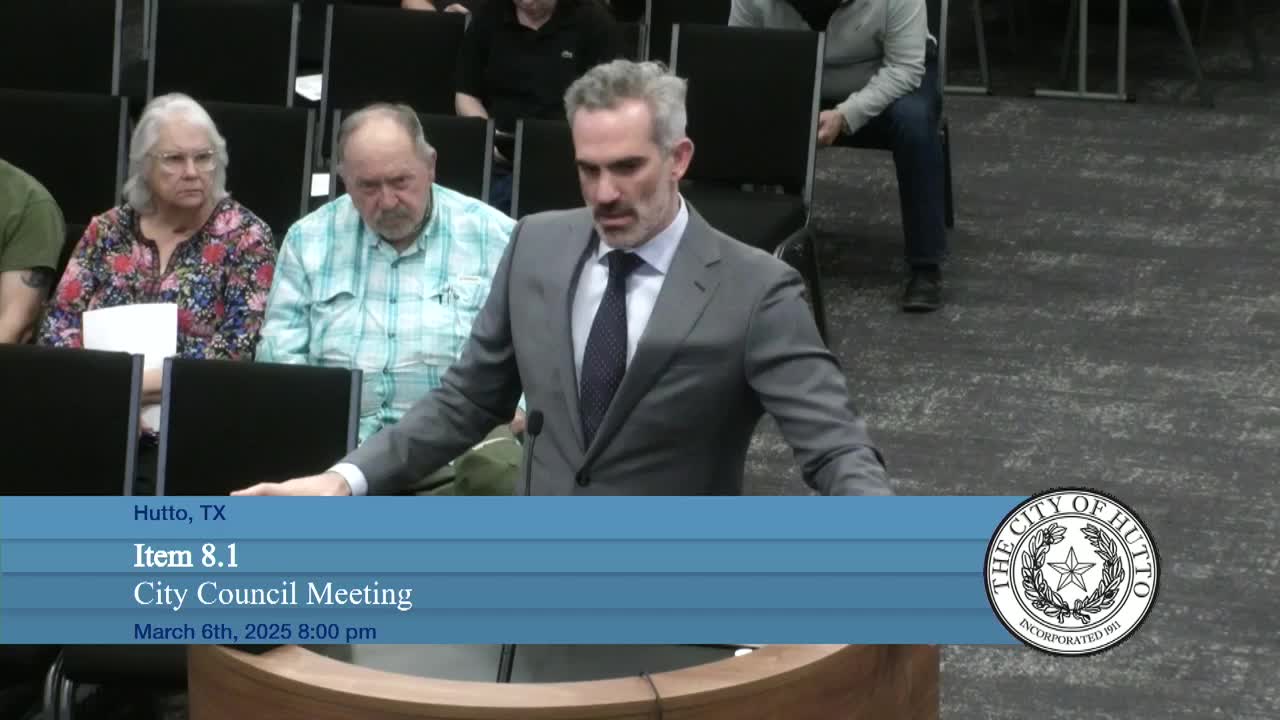
The city’s outside counsel, Adam Friedman, told council members the recharge agreement had a second amendment confirming financing and a delivery date. “The second amendment was … a notification that Recharge had secured its financing for the project and that the delivery date under the contract would be for, I think, 02/09/2026, and it is still on target for delivery of that water,” Friedman said. He and Public Works Director Rick Horado said easements for the delivery pipeline have been secured and initial on-site construction has begun.
Council members pressed staff for context about how the new water will work inside Hutto’s system. Horado said the existing pipeline between the Shiloh pump station and the city can physically move about 6,000,000 gallons per day. “That pipeline from Shiloh out into the system is a 6,000,000 gallon pipeline. The recharge contract is for delivery of 4,000,000 gallons per day,” Horado said. He added the planned recharge delivery would use roughly 4 million of that 6 million-gallon capacity, leaving about 2 million gallons per day of transmission capacity for future sources.
Friedman and Horado identified a remaining technical question: treatment for iron. Friedman said the contract obligates the recharge developer to treat delivered water to TCEQ limits, “including iron.” He added the outstanding question is whether the treatment facilities being built to process the contracted 4 MGD could be designed or expanded to also treat additional, non-recharge water so Hutto could route more of its existing or future supplies through that same plant. “The only hanging issue is are we gonna be able to get further iron treatment for additional water, not the 4 MGD that’s all set,” Friedman said.
Council members described the transmission limit as the most important constraint. “It doesn’t matter how many wells you dig. You only got one pipeline,” Mayor Schneider said during discussion, stressing that storage, additional transmission mains, or another point of entry will be needed to put significantly more water into service. Council member Clark summarized the timing concern: “This water is intended to meet our demand through 2028,” he said, adding that he wants clearer, regularly updated forecast data on when additional sources or capacity will be required.
Staff described other pieces of the city’s strategy. Horado and other staff said additional storage tanks, distribution and transmission projects, and well rehabilitation are all in play to stretch available supply and mitigate peak-day pressure. Horado explained that having recharge water available would allow the utility to rotate and perform maintenance on its wells and pumps: with the extra supply “it gives us that opportunity to do so and to be a little more resilient,” he said.
Council action: two procedural votes
Council members took two votes tied to the item’s handling. First, by a 5–2 vote the council approved a motion to pull the recharge memo and a factual update into the open meeting for discussion (motion made by Mayor Schneider; seconded by Council member Porterfield). The roll call on that motion recorded Ayes from Council members Thornton, Kolar, Porterfield, Mayor Schneider and Mayor Pro Tem Gordon; Nays from Council members Clark and Thompson.
After the public discussion, the council voted 6–1 to release the recharge memo to the public (motion passed; recorded Nay from Council member Thompson). City staff and counsel said the memo is largely factual and would be published with the privileged/confidential label removed.
What is confirmed and what remains unclear
- Confirmed: the recharge contract amendment indicates financing is secured and delivery of 4,000,000 gallons per day to the Shiloh pump station remains on schedule for Feb. 9, 2026, according to Friedman. Easements for the pipeline had been secured and pipeline construction has started. - Transmission limit: the existing Shiloh-to-city pipeline has an approximate capacity of 6,000,000 gallons per day; with 4 MGD of recharge delivered there will be roughly 2 MGD of remaining pipeline capacity unless the city builds more transmission capacity. - Treatment question: the recharge developer will treat the 4 MGD to meet TCEQ limits, including iron. Whether the same treatment facility can be sized or modified to treat additional city water is under evaluation and would require agreement on design, timing and payment. - Schedule and quantities: staff said construction progress is underway; Friedman noted he saw a construction rate “about 300 feet per day” and would confirm the number. City staff also said they will provide updated daily usage and projections to council at future meetings.
Why the council pressed for public clarity
Council members said the conversation matters because planned development and capital projects assume water availability, and residents will face restrictions if supply and delivery capacity are exhausted. Council member Clark urged staff to keep the public and council regularly updated so policy decisions about growth, conservation stages and infrastructure investments are informed by current data.
Next steps
City staff and counsel said they will publish the recharge memo, continue work on the iron‑treatment design options, and provide updated consumption and capacity charts in future briefings. Council members asked staff to present more detailed capacity and cost information at the council’s next meeting that addresses the timeline to additional transmission capacity, the role of storage tanks in managing peak demand, and how conservation and leak‑control measures are affecting projections.
No formal policy or procurement decision on new transmission lines or treatment capacity was made March 6; the votes recorded were limited to bringing the status update into public discussion and releasing the memo to the public.
Ending note
Council members repeatedly emphasized that the recharge delivery increases Hutto’s available sources but does not eliminate the need for transmission, storage and treatment investments if the city expects to support continued growth.