Get Full Government Meeting Transcripts, Videos, & Alerts Forever!
Get email alerts on the Transportation Safety topic
No spam. Unsubscribe anytime.
Advocates and city officials point to increased interagency Vision Zero coordination, urge faster action to reduce traffic fatalities
Summary
Public witnesses and the city administrator described new multi‑agency efforts to reduce traffic deaths after Vision Zero and Highway Safety functions were moved under the Office of the City Administrator. Advocates recommended stronger enforcement, data improvements, and public engagement as 2024 traffic fatalities remained high.
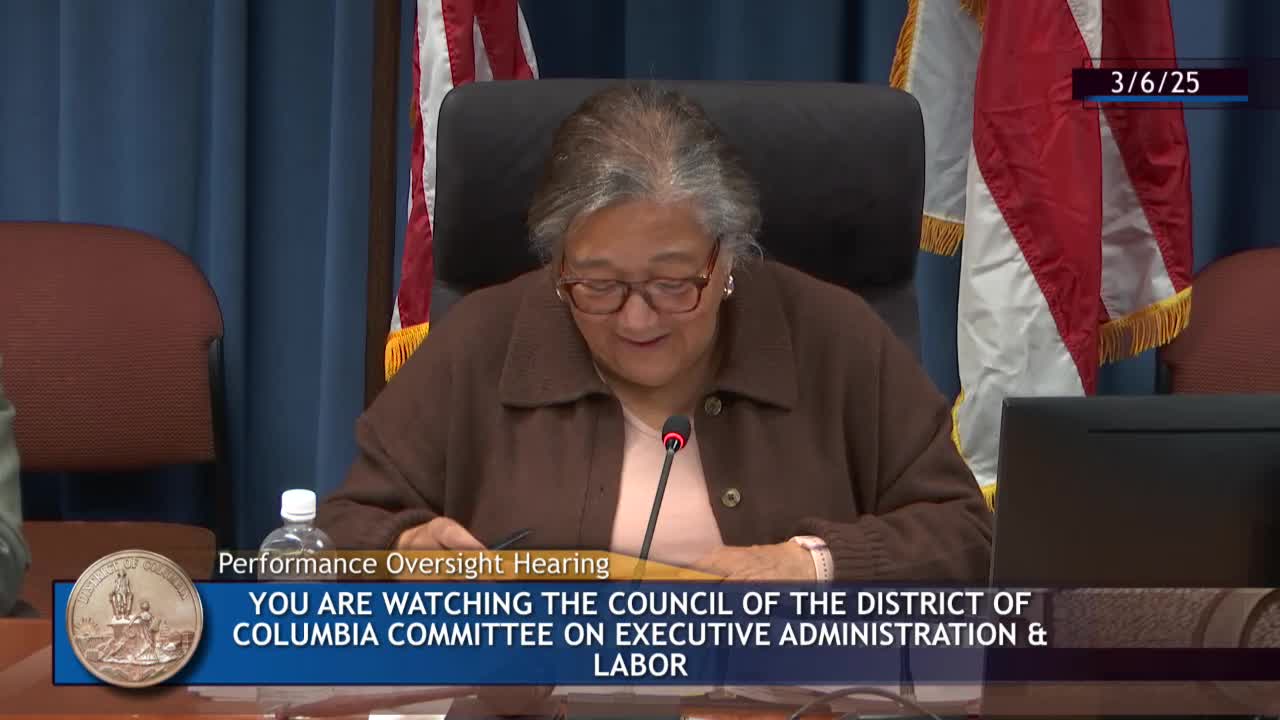
Several public witnesses at the March 6 Committee on Executive Administration and Labor hearing credited recent management changes for improved coordination on traffic safety and urged a stepped‑up, data‑driven push to reduce traffic deaths.
City Administrator Kevin Donahue said a Sustainable Urban Infrastructure team in the OCA now coordinates DPW, DDOT, the Department of Energy and Environment, the Vision Zero office, and the Highway Safety Office. He said the Vision Zero team is updating the plan this calendar year and highlighted interagency efforts to keep high‑visibility corridors clean and address related roadway issues.
Public witnesses described recent pilots and enforcement initiatives. Heather Foote, a transportation and pedestrian safety analyst, summarized two initiatives: a school‑area event on Minnesota Avenue SE that combined DDOT engineering changes and MPD enforcement, and a pilot targeted enforcement corridor on New York Avenue NE and Southern Avenue SW aimed at speeding, distracted driving and seatbelt compliance. Foote and others said the Highway Safety Office’s corridor approach — combining signage, MPD enforcement, and community engagement — represents better coordination since Vision Zero and Highway Safety moved under OCA.
Why it matters: Roadway fatalities and serious injuries rose in recent years; witnesses and advocates said Vision Zero needs sustained attention, more resources for enforcement and infrastructure, and stronger public education about safety measures.
Data and advocacy points • Fatalities: Witnesses noted that traffic fatalities were higher in recent years; advocates cited 52 traffic fatalities in 2024, matching a 16‑year high, and urged renewed effort to reverse that trend.
• Data accuracy: WABA and other advocates asked for improved data integration, including EMS/trauma data, to ensure crash and injury counts are accurate and to target interventions where they are most needed.
• Enforcement and pilot programs: Witnesses described MPD traffic units, mobile trailers to detect handheld phone use (warnings only during pilot), and new targeted corridor enforcement intended to change driver behavior and reduce incidents on high‑injury segments.
• Public input: Advocates asked for broad public engagement in a Vision Zero strategic update and for transparency about pilot outcomes so the city can assess effectiveness before scaling.
Ending Witnesses and the OCA said a revised Vision Zero plan will arrive later in 2025; advocates asked the committee to press for public input, accurate data integration, and resources for both engineering and enforcement. Committee members signaled interest in follow‑up on enforcement resourcing and data quality in upcoming hearings.