Get Full Government Meeting Transcripts, Videos, & Alerts Forever!
Get email alerts on the Solar Setbacks Wmas topic
No spam. Unsubscribe anytime.
House panel moves Rep. Murphy's bill requiring 3/4-mile solar setback from parks and WMAs to general register
Summary
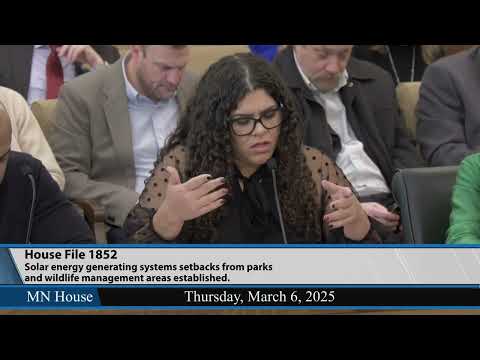
House File 1852, introduced by Rep. Kelly Murphy, would establish a three-quarter-mile setback for new utility-scale solar projects from state parks, county parks and wildlife management areas; the House Committee on Energy Finance and Policy voted 8-7 to re-refer the bill to the general register.
House File 1852, a bill introduced by Representative Kelly Murphy to require a three-quarter-mile setback for new large-scale solar projects from state parks, county parks and wildlife management areas (WMAs), was re-referred to the general register after a roll-call vote of 8-7 in the Minnesota House Committee on Energy Finance and Policy.
Representative Kelly Murphy, the bill author, opened discussion by saying, "House file 18 52 establishes a solar setback, to help protect our county parks, our state parks, and wildlife management areas." Murphy described the measure as intended to protect habitat, provide safe space for hunters and preserve public investments in natural-resource lands.
Supporters, including Eric Simonson, a lobbyist for the Minnesota Deer Hunters Association, testified in favor. Simonson said the association, which he described as representing more than 11,000 members, supports the setback ‘‘especially as it relates to WMAs.’’ He told the committee WMAs cover about 1,300,000 acres statewide and stressed that many hunters rely on public lands; he said the setback would reduce the risk of "unintended damage" to energy equipment and would give hunters "a buffer zone." "Hunters take safety very seriously," Simonson said.
Trade groups and industry representatives opposed the measure. Madeline Smarillo of the American Clean Power Association testified against the bill, saying, "the 3 quarter of a mile setback is not grounded in science." Smillo argued that utility-scale solar can be sited to benefit pollinators and habitat and warned the setback would "jeopardize the property rights of surrounding landowners." George Jamie, director of government affairs for Clean Energy Economy Minnesota (SEAM), said the bill would "significantly restrict landlords' ability to make decisions about their own property" and could slow projects needed to meet the state's energy and grid needs.
Members debated multiple topics during the hearing: the appropriate distance for a setback (Murphy described three-quarters of a mile as roughly 4,000 feet), whether fencing and other mitigation could address safety concerns, the mix of adjacent land uses around WMAs (including farming, co-ops and residences), and the statutory framework for siting the large energy projects. Representative Hollins asked how the bill arrived at three-quarters of a mile, noting that effective rifle ranges are typically far shorter than that distance. Representative Jones and others urged exploring alternatives such as berms, tree buffers, fencing, liability mechanisms or PUC project-level review rather than a blanket setback.
Representative Acum noted the bill language as written targets 50-megawatt arrays; she observed the photograph offered by Murphy did not appear to show a 50-MW array, meaning the example used in testimony might not be covered by the bill as drafted. Multiple members pointed out that existing permitting and siting review for energy projects occurs at the Minnesota Public Utilities Commission (PUC), which conducts project-level review and coordinates with state agencies.
The committee voted on Representative Murphy's motion to re-refer House File 1852 to the general register. The roll call, as read into the record, recorded the following votes:
Yes: Chair Swazinski (Aye); Vice Chair Murphy (Aye); Representative Anderson (Aye); Representative Baker (Yes); Representative Igo (Yes); Representative Meckland (Yes); Representative Sexton (Yes); Representative Weiner (Yes).
No: Lead Acone (No); Representative Kraft (No); Representative Carroll (No); Representative Frazier (No); Representative Hollins (No); Representative Jones (No); Representative Mahamud (No).
There being eight ayes and seven nays, the motion passed and House File 1852 was sent to the general register for consideration by the full House.
Votes at a glance: House File 1852 (Murphy) ' Referred to general register by committee vote 8-7. Motion mover: Representative Kelly Murphy (mover recorded; no second recorded in committee transcript). The committee did not adopt any amendments and took no immediate further action beyond re-referral.
Why it matters: Committee supporters said the bill would protect public investments in state- and county-managed natural lands and reduce risk to hunters and to energy equipment; opponents said the setback is excessive, may be "not grounded in science," would limit private landowners' options and duplicate existing project-level permitting at the PUC. The debate left open possible alternatives such as project-level mitigation, fencing, berms, vegetation buffers and liability rules.
Next steps: With the committee vote, the bill moved to the House general register for further consideration. The committee's discussion did not include a final statutory citation for any setback standard; members also flagged drafting issues such as the bill's 50-megawatt threshold and asked for follow-up from agencies including the PUC.
Clarifying details extracted from the hearing: MDHA testified WMAs amount to about 1,300,000 acres statewide; the Deer Hunters Association said Minnesota averages about 475,000 hunters per season and that deer hunting contributes "over a half a billion dollars" annually to Minnesota's economy. Representative Murphy and several members described the proposed setback as three-quarters of a mile (about 4,000 feet); witnesses noted some existing arrays can be much closer to WMAs (Murphy cited examples as close as about 50 feet). Representative Acum noted the current draft targets 50-megawatt arrays.
Speakers (first reference includes role): Representative Kelly Murphy (bill author, Minnesota House); Eric Simonson (lobbyist, Minnesota Deer Hunters Association); Madeline Smarillo (representative, American Clean Power Association); George Jamie (director of government affairs, Clean Energy Economy Minnesota/SEAM); Representative Hollins; Representative Jones; Representative Tapke; Representative Kraft; Representative Carroll; Representative Acum; Representative Meckland; Representative Sexton; Representative Weiner; Representative Igo; Representative Mahamud; Representative Frazier.
Authorities referenced (as stated in the committee): statute (not specified) regarding wind setbacks and project siting (referenced by multiple speakers); public-utilities permitting authority (PUC project-level review) (referenced by multiple speakers). The transcript did not cite a specific statute number for solar setbacks.
Discussion vs. decision: The record separates discussion (safety concerns, habitat impacts, alternatives such as berms or fencing, property-rights concerns) from the formal committee decision (vote to re-refer the bill to the general register). The committee did not adopt policy amendments nor direct staff to draft a specific alternative; Mr. Simonson and industry testifiers offered supportive/opposed testimony, and some members offered to work on liability or narrower options.
Searchable tags: ["House File 1852","solar setbacks","wildlife management areas","WMAs","hunters","property rights","PUC","Minnesota House"]