Get Full Government Meeting Transcripts, Videos, & Alerts Forever!
Get email alerts on the School Finance topic
No spam. Unsubscribe anytime.
Minn. committee hears mixed testimony on bill to let districts transfer funds, delay new mandates
Summary
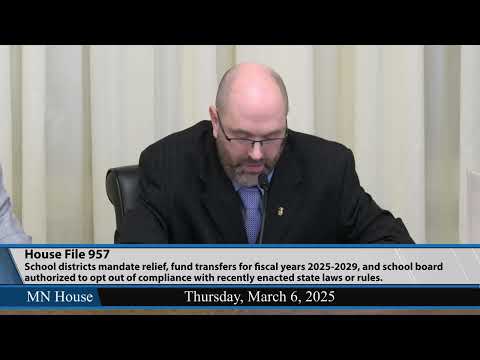
House File 957, described to the committee as a temporary funding and mandate-flexibility measure, was the subject of an informational hearing March 6 before the Minnesota House Education Finance Committee.
House File 957, described to the committee as a temporary funding and mandate-flexibility measure, was the subject of an informational hearing March 6 before the Minnesota House Education Finance Committee.
The bill would allow school boards by local resolution to transfer unencumbered dollars between accounts and to opt out of compliance with new education mandates enacted during the 2023–24 biennium, unless restricted by federal law. Committee members were told the bill is information-only and that no committee action will be taken at the hearing.
Why it matters: Supporters said HF 957 would let districts respond to sharply rising costs, declining enrollment and local priorities without increasing state obligations or property taxes. Opponents said the proposal risks creating a patchwork of differing obligations across districts and could reduce services for students who generated targeted funding, including English learners and students served by student-support personnel programs.
Local officials who testified in favor of the bill described immediate fiscal pressures. Dave Kirkvleet, identified in testimony as superintendent of Subica Public School District 820, said his district faces declining enrollment, inflationary cost increases and urgent facility needs. “Our budget is really struggling,” Kirkvleet told the committee, and he described a failed Feb. 11 referendum for $1.9 million (and $50,000 per year for technology/capital levy aid) that he said would have addressed roof repairs and bus purchases. He said the district could not use food-service dollars to repair a leaking roof above its kitchen because of fund restrictions.
Adam Johnson, superintendent of New York Mills, presented district-level UFARS data and described statutory operating debt calculations and how restricted funds can leave smaller districts with little practical reserve despite percentage figures that look large on paper. “If state's funding was cut off … we could go about 2 and a half months with what we have in our unreserved or restricted fund balance accounts,” Johnson said, summarizing a local interpretation of the statutory operating debt metric.
St. Michael–Albertville Schools business official Chris Crocker and Albert Lea finance director Paul Durban also urged flexibility. Crocker said recent laws created funding and program requirements that remain partially funded and estimated a $463,000 shortfall for K–4 curriculum and roughly $400,000 in substitute and payroll-related costs tied to paid-leave and earned-sick-time programs. “The funding gap for the READ Act is almost $500,000 for us, which is equivalent to approximately six teaching positions,” Crocker said.
Opponents warned of harms to hourly education staff and students if districts can opt out of training and program requirements. William Schwandt, a special-education paraprofessional from Bloomington and president of a paraprofessional union, testified against HF 957, saying delegating opt-outs to local boards could allow districts to avoid providing required paraprofessional training. “Allowing school districts to opt out of providing meaningful and much needed professional development for paraprofessionals is bad,” Schwandt said.
Representatives of the Minnesota Department of Education raised oversight concerns. Ado Ooni, identified as the department’s director of government relations, told the committee that broad local discretion could “create a confusing patchwork of different expectations from school to school.” Ooni said many state funding streams are connected to student populations (for example, English learners or students qualifying for compensatory aid) and that removing statutory ties between funding and services could impair MDE’s ability to monitor compliance and program effectiveness.
Several committee members pressed on specifics: which funds are transferable, how funds tied to statutory requirements (for menstrual products, opioid antidotes, READ Act components and others) would be treated, and how transfers would affect services for English learners and special education. Nonpartisan staff said that while some fund transfers are allowed under current statute, other funds—nutrition and debt service in particular—are heavily limited by federal rules or longstanding statutory constraints.
No committee action: Committee leadership emphasized HF 957 was being taken up as “information only” and that no motion or vote would occur. The record shows detailed local testimony but no formal motions or votes were taken at the hearing.
What to watch next: Committee members said they would receive additional financial runs from nonpartisan staff on district fund balances and statutory operating debt and would continue discussion in future meetings.
Sources and attribution: The article summarizes testimony and exchanges on record at the March 6, 2025 House Education Finance Committee hearing. Direct attributions and quotes come from the hearing transcript and from witnesses who identified their roles when they testified.