Get Full Government Meeting Transcripts, Videos, & Alerts Forever!
Get email alerts on the City Budget topic
No spam. Unsubscribe anytime.
Vista council hears budget outlook showing projected shortfalls, explores cuts and options for Wave Water Park
Summary
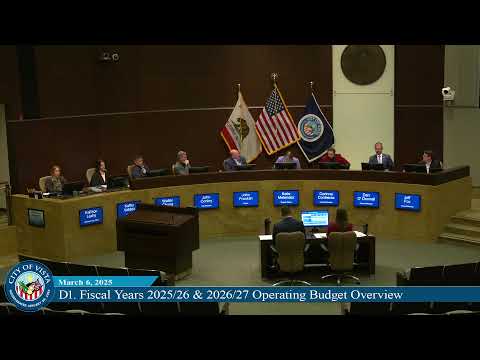
City finance staff told the Vista City Council on a March workshop that preliminary estimates show projected deficits in the general fund for both fiscal years 2025–26 and 2026–27 and urged council to work with staff on options to balance the budget.
City finance staff told the Vista City Council on a March workshop that preliminary estimates show projected deficits in the general fund for both fiscal years 2025–26 and 2026–27 and urged council to work with staff on options to balance the budget.
Mike Silvia, the city’s finance director, told the council “it’s unlikely that the city's existing revenue sources are gonna be able to sustain the current level of services the city provides to its citizens in the long term without either exponential increases to existing revenues, or a new revenue source.” Sarah Taylor, the city’s finance manager, said total general fund revenues and other sources are estimated at $123,700,000 for fiscal year 2025–26 and $127,400,000 for fiscal year 2026–27 while staff currently estimate expenses at $107,700,000 and $114,000,000, respectively.
Why it matters: the gap between revenue and spending — coupled with uncertain economic forecasts, declining legal cannabis sales and growing pension obligations — led council members to press staff for additional analysis and short-term options such as a hiring freeze, re-examining the Wave Water Park subsidy, and targeted program changes.
Key revenue and reserve figures presented by staff include an estimated $6,000,000 in cannabis tax revenue for the current year (a decline from prior years), with staff recommending a $4,460,000 cap on ongoing operating uses and directing excess cannabis revenue at year end to designated accounts. Staff said approximately $1,500,000 could be available annually for council-designated uses under current assumptions. The city’s emergency reserves were reported at about $36,700,000 (roughly 32.5% of the 2024–25 midterm original general fund budget) and the city’s section 115 trust was listed at about $22,600,000.
On debt and savings, staff said they are pursuing a refunding of the 2015 lease revenue bonds and expect to present preliminary numbers at the council’s April 8 public hearing; Silvia estimated that refinancing could show nearly $11,000,000 in savings. The council was also shown the Propel/Prop L revenue schedule: Propel revenue receipts of about $12.1 million (FY25–26) and $12.5 million (FY26–27) were noted, with only roughly $1.2 million used annually in the operating budget and the remainder funding debt service and a reserve projected to grow to about $28.8 million by the end of FY26–27.
Council members raised multiple program- and service-specific concerns. Council member Contreras pressed staff about business and labor indicators, park rangers and the Wave subsidy: “I really want us to reassess the park rangers and see if that function that we currently have is worth the expense,” Contreras said, and urged examining whether staffing shortages or scheduling affect the Wave Water Park’s subsidy. Staff noted the current Wave subsidy is about $1,000,000 annually and that a follow-up workshop on the Wave assessment is scheduled for June, after a February presentation and with the intent-to-form action scheduled March 25 for the lighting and landscape maintenance district work.
Public safety funding and personnel requests were discussed in detail. Council members reiterated a request for more information about a sheriff gang detective position first raised on Feb. 25. Staff said the estimated cost for that single position, including vehicle acquisition and startup, is $445,000 for FY25–26 and $366,000 for FY26–27, and that ongoing annual costs are projected thereafter. Council member Fox, who had participated in a sheriff ride-along, said the single detective currently proposed would frequently operate without a partner and emphasized the operational importance of staffing decisions.
Economic trends and commercial vacancy were another focus. Staff and council discussed business-park vacancy metrics: an economic development staff member reported an industrial vacancy around 6% (about 6.4% as of last quarter) and office vacancy near 16%. Council members connected those trends to declining taxable sales and cannabis revenue and urged staff to present dashboards and trend plots for council review.
Pension liabilities were raised as a longer-term budget pressure. Silvia and Taylor described CalPERS-related costs as a driver of staffing expenditures and noted a projected UAL (unfunded actuarial liability) peak under current assumptions around fiscal 2030–31. The council discussed using the city’s section 115 trust and other strategies to create capacity for future pension cost increases.
Several council members urged near-term fiscal controls. One council member proposed an immediate hiring freeze except for essential public safety positions; the suggestion was framed as an action the council should direct the city manager to consider, and several members requested staff bring back a list of potential budget reductions and vacant positions for council review. Deputy Mayor Katie Melendez and others said they favored a careful, citywide review of recurring subsidies and expenditures rather than abrupt cuts.
No formal votes or ordinance actions on the budget were taken at the workshop. Staff repeatedly emphasized that the numbers presented were preliminary and based on department estimates and that a balanced draft budget will be presented to council and the community in May with subsequent quarterly updates.
What’s next: staff said they will continue refining revenue and expenditure estimates, present preliminary refunding savings at an April 8 public hearing, deliver a draft budget in May, and hold a June workshop on the Wave Water Park assessment. Council members asked for additional data including business park vacancy trend charts, U-6 unemployment metrics, and a detailed list of proposed cuts or holdbacks for consideration.