Get Full Government Meeting Transcripts, Videos, & Alerts Forever!
Get email alerts on the Procurement topic
No spam. Unsubscribe anytime.
Oxnard staff propose comprehensive overhaul of city purchasing code
Summary
Assistant City Attorney Elle McCarron presented a proposed ordinance to repeal and replace Chapter 4, Articles 1–5 of the Oxnard City Code, updating procurement procedures, increasing bidding thresholds under recent state changes, and adding tools such as on-call agreements and a streamlined local business preference.
Elle McCarron, assistant city attorney for the City of Oxnard, presented a proposed ordinance to repeal and replace Chapter 4, Articles 1–5 of the Oxnard City Code covering purchasing, contracting and public projects and asked that the finance and governance committee review the measure and recommend that the city council introduce and waive first reading.
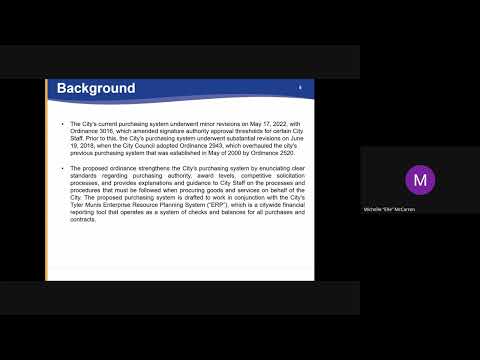
McCarron told the council the rewrite is intended to provide clear, detailed guidance to city staff on procuring goods, services, professional services and public projects and to align local code with recent state changes. “Iwould like to present to you an ordinance repealing and replacing chapter 4, articles 1 through 5 of the Oxnard City Code for purchasing, contracting, and public projects,” McCarron said.
The draft ordinance reorganizes the purchasing system into five articles: citywide provisions; public projects; professional services; general goods, supplies and services (including IT); and miscellaneous procedures. The proposal replaces language that directed staff to look up multiple state code provisions with expanded local text designed to be used alongside the cityTyler Munis enterprise resource planning (ERP) system for tracking solicitations, contracts and approvals.
Among substantive changes, the ordinance would: adopt an "aggregate value" basis for authority thresholds (measuring the total value over a contract's life rather than "per vendor per fiscal year"); codify use of on-call (as-needed) agreements and multiple-award schedules; add a prohibition on project splitting and potential misdemeanor enforcement for noncompliance; codify emergency contracting procedures; and provide guidance on design-build public projects and delegation of design approval to support a design-immunity defense.
The proposal incorporates statutory updates McCarron cited as having taken effect January 1, 2025 (referred to in the presentation as AB 2912) that increase public-project bidding thresholds. Under the changes described, negotiated or force-account work that previously fit under a $60,000 threshold would now be allowed up to $75,000; informal public-project solicitations would apply for projects between $75,000 and $220,000; and formal solicitations would be required for projects above $220,000.
McCarron said the proposed on-call contracting approach and aggregate-value thresholds are intended to shorten procurement timelines. She reported that professional-service solicitations currently take about six to nine months from scope development through contract execution and estimated that using on-call task orders could reduce that to roughly six to eight weeks for individual tasks. The draft also sets typical on-call contract terms at three to five years and proposes per-task limits of $200,000 for capital-improvement task orders and $100,000 for other task orders.
The presentation included operational context: Oxnard manages substantial infrastructure and service portfolios, including more than 1,037 miles of streets, roughly 504 miles of water lines and over 43,000 water service connections, a wastewater system that processes about 27,000,000 gallons per day and 415 miles of sewer lines, and municipal solid-waste and recycling operations referenced by the presenter. McCarron said the city had 646 contracts in fiscal year 2025 (about 619 then open) and cited purchase-order counts of 914 in fiscal year 2023, 1,161 in fiscal year 2024 and 827 so far in fiscal year 2025.
Other notable local provisions in the draft include a simplified small-local-business purchasing preference modeled on the state definition of small local business (allowing a 5% or $5,000 preference in some solicitations), explicit acceptance of electronic and digital signatures (with the mayorrequired to sign certain documents with a wet signature), updated surplus property disposal rules, and a reserved section for the city's living-wage policy.
McCarron emphasized that the proposed ordinance provides staff-friendly, consolidated text of state bidding and procurement rules (including public-contract-code provisions cited in the presentation) so employees need not repeatedly search the California codes for procedural requirements. She also noted the proposed code includes specific sections on prevailing-wage application, change-order authority, bonding and bid recheck procedures for public projects.
The presentation did not record a council vote. McCarron asked the finance and governance committee to review the draft and recommend that the council introduce the ordinance and waive the first reading; no formal action by the council was taken during the presentation. The staff report and proposed ordinance were presented as the next materials for committee and council consideration.