Get Full Government Meeting Transcripts, Videos, & Alerts Forever!
Get email alerts on the Land Use Gatekeeper topic
No spam. Unsubscribe anytime.
Committee advances rewrite of gatekeeper policy, narrows streamlined exemptions
Summary
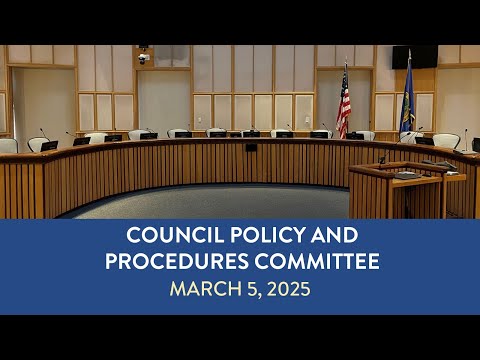
The Council Policies and Procedures Committee on March 5 reviewed and approved forwarding to the City Council an updated gatekeeper authorization policy that narrows streamlined exemptions for projects seeking to bypass a council authorization hearing.
The Council Policies and Procedures Committee on March 5 reviewed a staff proposal to update the city's gatekeeper authorization process, the procedure the city uses to screen projects that require legislative actions such as rezoning or general-plan amendments, and voted to forward a revised policy to the City Council.
The committee's action asks the council to adopt a written gatekeeper policy that keeps the draft staff content but changes certain suggested criteria into required criteria for projects seeking to bypass a separate council authorization hearing. Under the committee's recommendation, the first-phase streamlined exemptions would be limited in parcel size and, for residential projects, require a minimum density and other conditions before a project qualifies to move directly into formal processing.
Christian Murdoch, the city's Community Development Director, told the committee the update responds to a council priority placed on the gatekeeper process in 2023 and that the city's housing element (program 1.3 and 1.3.1G) requires the city to hold at least one authorization hearing per year and identify exemptions so the gatekeeper process does not unnecessarily impede housing production. "A gatekeeper application is a project that requires a legislative amendment, such as a rezoning or general plan amendment or zoning text change," Murdoch said, describing the distinction between a legislative gatekeeper action and ordinary permit review.
Staff outlined a three-part approach: (1) formalize written procedures, (2) define a streamlined gatekeeper route that bypasses the authorization hearing only when projects meet clear criteria, and (3) preserve standards and study-session requirements during formal review. Key items in the draft policy include an ongoing application period with a 90-day cutoff before an authorization hearing, a requirement that applicants submit their formal application within one year of council authorization, and reapplication limits (a two-year wait if a proposal is denied).
The committee's compromise recommendation converts several suggested application criteria into required criteria for the streamlined exemption and adds objective thresholds staff said would narrow previously broad exemptions. Those thresholds include a 2-acre parcel-size ceiling for streamlined eligibility, a minimum density of 30 dwelling units per acre for residential streamlined projects, and required public benefits such as on-site or secured public open space and a community facility where the city manager concurs there is a city need. Staff also proposed objective design principles and sustainability measures to encourage higher-quality proposals.
Committee members emphasized competing goals. Some members urged objective, performance-based criteria to reduce politicization and to make the streamlined path attractive to applicants; others urged care so the city can still prioritize staff capacity and comply with California housing-element obligations. Murdoch and staff said they expect staff-review timelines to target roughly a 30-to-45-day turnaround for initial responses when feasible, but that the gatekeeper process remains subject to standard routing and departmental review.
The committee voted to forward the recommended policy to the City Council. Committee members recorded the motion as approving the staff draft with the change that the streamlined criteria become required exemptions limited to the first-phase parameters described above. The motion passed with recorded votes in the meeting minutes (two ayes, one absent). The City Council will receive the committee recommendation for consideration, with staff aiming to place the item on council early in 2026 if the council acts before the summer recess.
The committee also asked staff to treat the updated gatekeeper policy as a living document and to return for periodic review so the city can adjust objective thresholds based on market response and council priorities. Staff said if the council adopts the policy, the city will announce the updated application window on a rolling basis but will require applications at least 90 days prior to an authorized hearing and will hold at least one authorization hearing per year for residential projects as required by the housing element.
Votes at a glance
- Motion (agenda item 5.1): Approve staff draft gatekeeper policy with revision to make certain streamlined criteria required and to limit the first-phase streamlined exemption to parcels no larger than 2 acres, residential projects proposing at least 30 dwelling units per acre, and additional public-benefit requirements. Mover: not specified. Second: not specified. Outcome: approved (2 yes, 0 no, 1 absent).