Get Full Government Meeting Transcripts, Videos, & Alerts Forever!
Get email alerts on the Instructional Budget topic
No spam. Unsubscribe anytime.
Fairport board reviews draft instructional budget, flags athletic supervision costs for reduction
Summary
At a Fairport Central School District board workshop meeting, district staff presented the draft instructional budget and reviewed major function codes, funding sources and program costs but did not take formal action on the budget.
At a Fairport Central School District board workshop meeting, district staff presented the draft instructional budget and reviewed major function codes, funding sources and program costs but did not take formal action on the budget.
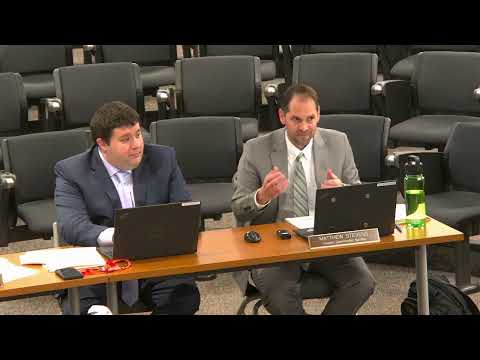
The draft shows roughly a $1.97 million increase in instructional spending, about a 2.43% rise from the prior year, driven primarily by contractual salary changes and the cost of services purchased through BOCES, staff said. Matt Stevens, who led the presentation, described the draft as a work in progress and repeatedly emphasized that the document remains a draft ahead of the March 18 review and the later revenue snapshot to balance the budget.
The draft allocates spending across traditional instructional categories such as curriculum development and supervision, teaching regular school, special programs including special education, summer school, technology instruction, and interscholastic athletics. Stevens said much of the year-over-year change reflects salary recoding between function codes and normal contractual increases: “overall, as we looked at developing, the instructional portion of the budget, really just involves for the most part, contractual salary increases,” Stevens said.
Why it matters: the instructional budget funds classroom staffing, special-education placements, universal prekindergarten (UPK) classes and district-run summer academics. Changes in these accounts will affect how many classes the district runs, how much it pays for out-of-district special-education tuition and which extracurricular programs it can sustain without offsetting revenue.
Universal prekindergarten and early-childhood funding Stevens said the district currently runs six UPK classes, two of which are covered by a statewide full-day pre-K grant at roughly $10,000 per pupil; the remaining four classes are funded at the standard $5,400 per pupil allocation. “It’s actually 4 classes because 2 of our classes are funded by the statewide universal full day pre k grant award that we received in 1415,” Stevens said. He described the general-fund cost to add another UPK class as “Roughly, it could it could depend on, the provider,” and estimated earlier in the discussion that adding a class would require roughly $70,000 from the general fund, depending on provider costs and staffing.
BOCES, Title I and special education placements The memo and presentation note that many services and some staff costs are run through Wayne-Finger Lakes BOCES, and the district expects aid for certain BOCES-provided services in the following year. Stevens said Title I grant funding helps support reading and math specialists and that the district’s special-education account includes in-district staffing, BOCES projections and any private placements. He identified Mary Cariola and Norman Howard as two examples of outside placements currently used by the district.
Career and occupational programs Stevens summarized the district’s occupational-education programming, which combines in-district offerings and slots at regional BOCES centers. He said the program currently serves about 85 students and that capacity constraints generally reflect regional BOCES availability rather than local district limits.
Summer school, technology and health services Summer programs include K-STAR, reading and math camps and music offerings; the budget captures staff, aides, supervision and materials for those programs. Instructional-technology costs (function code 2630) cover instructional technology coaches, hardware and software purchases and some BOCES-provided services; Stevens said some expenses previously budgeted to 2630 were reallocated to a non-instructional account to better reflect actual purchases.
The health services function reflects the district’s obligation to pay for health services provided to Fairport residents attending nonpublic schools outside the district; Stevens explained that when another public district provides such services, Fairport is invoiced for its residents’ share.
Athletics and event supervision District staff highlighted interscholastic athletics as a line item under review, calling out increases in costs for event supervision, officials, supplies and equipment. Stevens said the district has been “continuing to analyze, evaluate, the costs related to both security as well as our athletic supervisors” and intends to pursue “a considerable reduction” in the athletic supervision line to help close a projected budget gap. He described efforts to better match staffing to expected crowd sizes at events.
No budget decision taken; next steps Board members did not vote on the instructional budget at the workshop. The board was told that the first draft of the full budget and a revenue snapshot to balance the budget will be shared on Tuesday, March 18, and staff will return with updated figures and recommendations.
Votes and other formal actions taken at the meeting The board approved a set of field trip requests and approved entry into an executive session later in the meeting; the draft instructional budget itself was presented for discussion only and was not adopted.
Ending: Board members said they will continue reviewing the instructional budget line by line as revenue projections are finalized and staff return with a balanced budget for formal consideration.