Get Full Government Meeting Transcripts, Videos, & Alerts Forever!
Get email alerts on the Education Programs topic
No spam. Unsubscribe anytime.
Elementary robotics and high-school alternative pathways highlighted at Timberlane school board meeting
Summary
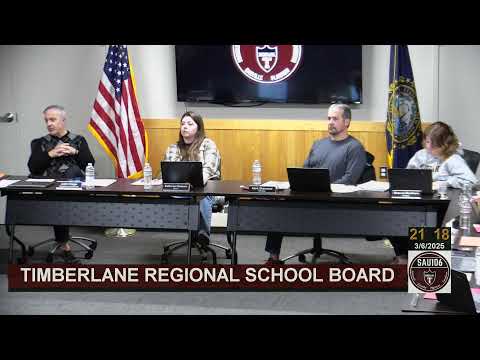
Atkinson Academy students demonstrated Bear Robotics and Timberlane Regional High School staff outlined alternative education pathways — extended learning opportunities, evening division and HiSET preparation — during the March 3 Timberlane Regional School District school board meeting.
Atkinson Academy students presented the school—s Bear Robotics team and demonstrated how robotics instruction and new Spike Prime kits, funded by a New Hampshire Department of Education grant, have expanded hands-on STEM learning for fourth- and fifth-graders.
Principal Harris introduced the students, who explained they moved from older Mindstorms NXT kits to Spike Prime kits and learned block coding and attachment construction to complete themed missions. A student said the team learned from mistakes in their November competition and improved problem-solving and presentation skills.
At the high school, Danielle Foley, assistant principal for alternative educational pathways at Timberlane Regional High School, described three major options: extended learning opportunities (ELOs), an evening-division program and a HiSET preparation program for students seeking a high-school equivalency. She said ELOs let students earn elective credit through internships, private instruction and worksite experiences such as internships at Pollard Elementary or local daycares.
Foley said 41 students were enrolled in ELOs this year and 19 had already expressed interest for next year; evening-division ran 25 classes with 168 students and allows students to take Timberlane classes Monday–Thursday from 4 to 7 p.m. HiSET classes prepare learners to take the five‑test high‑school equivalency battery (math, science, social studies, reading and writing).
Students shared individual projects and outcomes: Sean Violette described a condensed BioTrek boot camp and a tissue‑engineering pitch his team won; Joey described pursuing a private pilot—s license and using school time for flight training; and Riley described using evening division to combine full‑time work, CTE welding at Pinkerton and night classes to regain academic standing and pursue apprenticeships.
Board members and administrators praised the presentations as examples of the district—s work to expand student choice and provide alternate pathways to graduation, especially for students for whom traditional schedules or settings are not a good fit.
Board members and staff encouraged families to contact Foley with questions about alternative pathways and noted that many ELOs complement existing CTE programs by placing students in off-site clinical and workplace settings.
Proper names and program sponsors mentioned included Atkinson Academy, Pollard Elementary, Pinkerton CTE, BioTrek and the New Hampshire Department of Education grant program.
The presentations occurred during the student "staff and family share" portion of the March 3 meeting and prompted informal discussion but no formal board action.