Get Full Government Meeting Transcripts, Videos, & Alerts Forever!
Get email alerts on the State Legislation topic
No spam. Unsubscribe anytime.
Georgia House approves dozens of bills in marathon session; repeal of COVID testing for long‑term care draws opposition
Summary
The Georgia House on March 7 passed a broad package of bills on taxes, health care, education and public safety, including a measure repealing a COVID‑19 testing requirement for long‑term care staff that drew vocal opposition from Democrats.
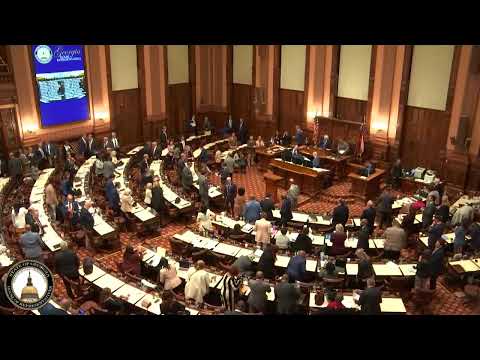
ATLANTA — The Georgia House of Representatives passed a large set of bills on March 7, approving measures that range from tax changes and consumer protections to health‑care and public‑safety rules. Lawmakers approved changes to vehicle ad valorem taxation, new consumer protections for automatic renewals, amendments affecting municipal liability, and alterations to public‑health and criminal‑justice procedures during a late session that stretched into the evening.
Why it matters: The package includes bills that affect taxes and fees, health coverage and disclosure rules, protections for workers and inspectors, and criminal‑justice procedures. One of the highest‑profile moments came when the chamber voted to repeal a rule requiring COVID‑19 testing of staff in long‑term‑care facilities — a move that prompted an extended floor exchange and an outspoken floor objection from Representative Lisa Campbell.
The House opened with a series of presentations of bills by their sponsors and committee reports. Many measures proceeded under the rule requiring adoption of a committee substitute and were then put to an immediate vote.
Health and safety debates Representative Joe Campbell (presenting HB 618) said the bill would require sellers of real property to disclose flood‑damage history, putting buyers on the same footing as renters. “Georgia homebuyers deserve the same right,” Campbell said, describing the measure as restoring parity between renters and buyers on flood disclosures.
The chamber also debated House Bill 6 45, which repeals a statutory requirement that staff in long‑term‑care facilities be tested for COVID‑19 as part of admissions and hiring rules established during the pandemic. Representative LaHood, the bill’s sponsor, described HB 6 45 as a measure to “return to normalcy” and said infection control practices would remain in place.
Representative Lisa Campbell opposed that bill on the House floor, citing recent case and death data and arguing testing remains an inexpensive and effective protective tool for vulnerable residents. “COVID‑19 continues to be a highly communicable virus that still leads to illness and death,” Campbell said, noting higher recent case rates in nursing homes and low staff vaccination coverage cited from CDC sources. Her remarks were recorded on the floor before the chamber voted to approve the repeal.
Domestic violence and criminal‑justice measure House Bill 5 82, carried by Representative Stan Gunther, allows defendants to offer evidence of having been subjected to family or dating violence as a justification or as mitigating evidence in sentencing proceedings, and it creates a procedure for resentencing petitions by people already serving sentences. During presentation, Representative Gunther said the bill creates avenues for victims of domestic violence who later commit offenses to present evidence of abuse as justification or mitigation.
Representative Santos — who identified herself in debate as a survivor — rose on the floor to thank the sponsor and said the bill would give survivors “more avenues for justice and healing.”
Coverage for orthotics and prosthetics House Bill 87, presented by Representative Clark, would require state‑regulated health plans to cover medically necessary orthotic and prosthetic devices and materials. Clark cited examples from advocates and families, including a child who uses a prosthetic limb, to illustrate the bill’s aim of expanding access to devices for daily living.
Other notable measures and questions - House Bill 291 (Community Health Worker Certification Act) creates a certification pathway overseen by the Department of Public Health for community health workers and was presented as a tool for expanding care in rural and underserved areas. - House Bill 351 revises the Solid Waste Act to resolve inconsistencies and clarify local and state roles in permitting for solid‑waste facilities; sponsors said the revisions respond to recurring litigation and jurisdictional disputes. - House Bill 270 responded to a court of appeals ruling and clarified who may serve eviction notices; sponsor Representative Matt Reeves said it restores longstanding practice allowing private process servers to serve eviction cases.
Votes at a glance (bill — short description — sponsor — recorded result) - HB 627 — Juvenile code: include aggravated assault with a firearm as a Class A designated felony in the juvenile code — Rep. Persinger — Passed (yeas 156, nays 2). - HB 429 (listed as 4‑29) — Exempt motor vehicles titled before 03/01/2013 from ad valorem taxation — Rep. Wilkerson/Wilkinson — Passed (yeas 166, nays 0). - HB 618 — Require flood‑damage disclosures by sellers of real property — Rep. Joe Campbell — Passed (yeas 170, nays 2). - HB 291 — Community Health Worker Certification Act; Dept. of Public Health oversight — Rep. Darlene Taylor — Passed (yeas 169, nays 4). - HB 87 — Require insurance coverage for medically necessary orthotic and prosthetic devices — Rep. Clark — Passed (yeas 171, nays 2). - HB 384 — Establish uniform oath for peace officers — Rep. Seabaugh — Passed (yeas 171, nays 0). - HB 646 — Minimum salaries/compensation and benefits for coroners and deputies; remove certain death investigation fees — Rep. Patty Stinson — Passed (yeas 127, nays 4). - HB 430 — Venue for certain petitions to the sex‑offender registry — Rep. Sainz — Passed (yeas 168, nays 0). - HB 531 — Municipal sovereign immunity adjustment (sets municipal liability threshold) — Rep. Matt Reeves — Passed (yeas 161, nays 13). - HB 127 — Increase allowable personal leave days for teachers (from 3 to 5) — Rep. Brent Cox — Passed (yeas 172, nays 3). - HB 483 — Provide assault/penalty protections for code enforcement inspectors — Rep. Prince — Passed (yeas 168, nays 5). - HB 323 — Allow Medigap coverage for certain individuals under 65 with ALS or ESRD — Rep. Matheak — Passed (yeas 174, nays 2). - HB 351 — Amend Solid Waste Act to resolve jurisdictional/permitting issues — Rep. John Corbett — Passed (yeas 175, nays 0). - HB 677 — Placement procedures for children discharged from hospitals/residential treatment; create a coordinating team and reporting — Rep. Dempsey — Passed (yeas 173, nays 1). - HB 652 — Clarify motor‑fuel tax treatment for electricity at certain EV charging stations (exemptions) — Rep. Todd Jones — Passed (yeas 167, nays 4). - HB 635 — Streamline licensing/registration for residential/commercial contractors — Rep. Weidauer/Wedower — Passed (yeas 171, nays 2). - HB 567 — Authorize and regulate teledentistry; allow specified hygienist functions under general supervision — Rep. Katie Dempsey — Passed (yeas 174, nays 2). - HB 582 — Allow evidence of family/dating/child abuse in justification/mitigation and petition for resentencing — Rep. Stan Gunther — Passed (yeas 166, nays 2). - HB 577 — Georgia Nicotine Vapor Product Directory Act; create state registry/enforcement mechanism for vape products — Rep. Houston Gaines — Passed (yeas 159, nays 12). - HB 586 — Extend exemption on intangible recording tax from 3 years to 7 years — Rep. Bruce Williamson — Passed (ayes 170, nay 1). - HB 630 — Reorganize registration/board structure for used motor vehicle and used motor vehicle parts dealers — Rep. Wedower — Passed (yeas 165, nays 3). - HB 471 — Require hospitals/birth centers to make water‑safety education video available to parents of newborns (video prepared by DPH and Every Child A Swimmer Foundation) — Rep. Chokas — Passed (yeas 169, nays 0). - HB 270 — Restore practice allowing private process servers to serve evictions after a court decision altered past practice — Rep. Matt Reeves — Passed (yeas 172, nays 0). - HB 266 — Increase annual military retirement income exemption (from $17,500 to $35,000) — Rep. Sainz — Passed (yeas 171, nays 0). - HB 529 — Georgia Online Automatic Renewal Transparency Act (consumer opt‑out protection) — Rep. Barrett — Passed (yeas 169, nays 2). - HB 397 — Allow municipalities to opt into Saturday early voting for municipal elections (rules committee substitute) — Rep. Fleming — Passed (yeas 159, nays 13). - HB 328 — Increase cap and technical changes to student scholarship organization tax credits (QEE tax credit adjustments) — Rep. Carpenter — Passed (yeas 98, nays 75). - HB 506 — Medicaid coverage for tobacco‑cessation treatments — Rep. Hilton — Passed (yeas 142, nays 31). - HB 645 (listed as HB 6 45 earlier) — Repeal staff COVID‑19 testing requirement in long‑term care settings — Rep. LaHood — Passed (yeas 123, nays 45). - HR 128 — Compensation resolution for Joseph Samuel Watkins and related matters — Adopted (yays 151, nays 12).
Floor dynamics and next steps Several bills were debated with questions from members; other measures passed with no recorded floor debate. Representatives repeatedly used committee substitutes and rules committee substitutes; many measures were framed by sponsors as clarifications or technical cleanups of existing law. Sponsors and committee chairs said several bills respond to court decisions, litigation trends, or perceived gaps in current statute.
Representative Matt Reeves framed HB 270 as responding to a court of appeals decision affecting service of evictions; Representative John Corbett and others said HB 351 seeks to reduce litigation and clarify permitting processes for solid‑waste facilities. On HB 582, sponsors and supporters described the change as adding avenues for survivors of domestic abuse to present evidence in mitigation or justification.
The House adjourned until 1 p.m. Monday, March 10, 2025.
Ending note: The session approved a large number of measures with a range of policy impacts; several bills will now move to the Senate or to implementation steps identified in their text and committee reports.