Get Full Government Meeting Transcripts, Videos, & Alerts Forever!
Get email alerts on the State Tax Policy topic
No spam. Unsubscribe anytime.
Georgia House approves bill to accelerate individual income tax cut to 5.19% after heated debate
Summary
The Georgia House passed House Bill 111, accelerating a scheduled individual income-tax rate cut from 5.39% to 5.19% effective July 1, 2025. Supporters said it returns money to taxpayers; opponents said it circumvents fiscal guardrails and disproportionately benefits high earners. Vote: 110–60.
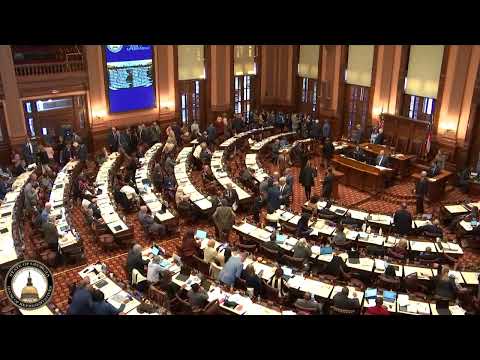
The Georgia House of Representatives on the floor approved House Bill 111, a measure to accelerate the state's individual income tax rate from 5.39% to 5.19% effective July 1, 2025, by a 110'to'60 roll-call vote.
Supporters, led on the floor by Representative Hong as the governor's floor leader, said the cut is possible because of conservative budgeting and state surpluses and will return money to Georgia taxpayers. "This bill and this year's proposal will further accelerate the rate by an additional 20 basis points to bring the rate from 5.39% to 5.19% effective 07/01/2025," Hong said during her presentation.
Opponents said the measure improperly bypasses financial benchmarks set in prior legislation and that the savings are concentrated at the top of the income scale. Representative Draper, who had supported last year's structured schedule for cuts, argued HB 111 "basically asks us to ignore our vote last year on HB 1015. It asks us to ignore the wisdom in that bill of not reducing tax rates further if the financial health of the state cannot support it. That is not fiscal responsibility." Representative Sanchez said the bill "overwhelmingly benefits the wealthiest Georgians while offering minimal relief to working and middle class families." Representative Ramon called it "a scam for most Georgians," saying the average household would receive only modest annual savings while essential services could be underfunded.
Proponents described the change as an acceleration of a multi'year plan that began in prior sessions. Hong noted that earlier measures already lowered the rate from earlier levels and that this action would further the step-down schedule started in previous legislation. "This acceleration and the reduction will save the taxpayers $860,000,000 Overall," Hong said on the floor.
Lawmakers debating the bill also disputed whether the state had met fiscal triggers set in last year's legislation. Draper said one statutory benchmark required a 3% revenue increase in the next fiscal-year estimate, which she said was not met; she told colleagues she had asked the Office of Planning and Budget for a required report and the office had none to produce because the benchmarks were not achieved. Supporters countered that conservative budgeting and economic performance permitted acceleration nonetheless.
During the debate, multiple members urged alternatives targeted to lower-income households. Several speakers referenced the earlier package of tax changes that expanded the standard deduction and dependent exemptions; proponents said those changes had already eliminated liability for many low-income filers.
The final recorded vote on the passage of House Bill 111 was 110 yeas and 60 nays, and the House declared the bill passed. The bill will move next through the legislative process as prescribed by House rules.