Get Full Government Meeting Transcripts, Videos, & Alerts Forever!
Get email alerts on the Municipal Budget topic
No spam. Unsubscribe anytime.
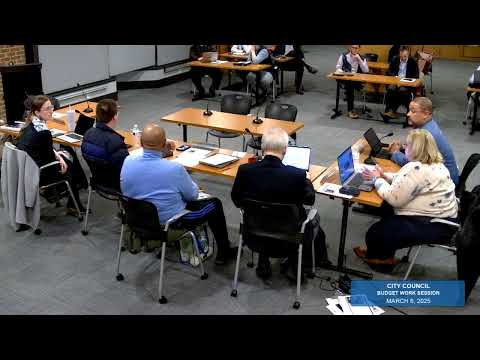
Charlottesville staff present FY‑26 proposed $264 million budget; City Manager and finance staff flag slowing revenue, priority spending
Summary
City staff outlined a roughly $264 million fiscal 2026 spending plan that holds tax rates steady, adds funding for schools and sidewalks, increases reserves and vacancy-savings targets, and allocates one‑time dollars for homelessness and capital needs while warning that some revenue streams have softened.
Sam (city staff) introduced the proposed fiscal year 2026 budget on the council’s budget work session, describing it as “roughly $264,000,000” and saying the plan is meant to reflect council priorities.
Finance staff member Chrissy Hamill told council that some local tax revenues “for the first time in a long time…are actually, seeing some of our revenues, not performing as well as they have” and that the city is revising near‑term revenue projections while proposing a FY‑26 general fund that increases locally generated tax revenue by about $8.7 million compared with the adopted FY‑25 budget.
The proposal holds tax rates steady, including a real‑estate tax at $0.98 per $100 of assessed value, a meals tax of 7 percent, a transient lodging tax of 9 percent and a personal‑property tax rate of $4.40 per $100. Hamill said the city’s revised FY‑25 results imply a year‑end revenue surplus of about $2.5 million but cautioned that final surplus size depends on the expenditure side.
Why the budget matters: the plan directs new ongoing money to schools and public services while also using one‑time or near‑term funds to shore up reserves and prepare for rising debt costs. Highlights in the proposed operating and designated budgets include:
- A $4.9 million increase in the city’s contribution to Charlottesville City Schools, which Hamill said “fully fund[s] their ask.”
- $7.8 million for new sidewalks and sidewalk repair and $52.9 million for affordable housing projects, a number Hamill said includes the Carlton Mobile Home Park and a Salvation Army commitment.
- $8.7 million allocated for an Americans with Disabilities Act transition plan.
- Additions to public safety and labor costs tied to collective‑bargaining agreements. Hamill said implementation of multiple bargaining outcomes and a step plus 1 percent pay‑scale adjustment for non‑represented employees increases personnel costs by roughly $1.3 million; she listed second‑year police contract costs at about $434,000, fire at $826,000 and a labor‑and‑trades contract impact of about $1.8 million.
- An increase in planned vacancy savings: the FY‑26 budget increases the assumed vacancy savings from $2 million (level in the current base) to $5 million to reduce reliance on unanticipated vacancies to produce year‑end surpluses.
Service, staffing and operations
Hamill and Sam described several staffing and operational changes built into the budget. New or reclassified positions shown in the proposal include a zoning inspector, an urban forester for Neighborhood Development Services, two human‑resources positions, a civilian FOIA/public‑records officer for the police department, a reclassification in communications, an administrative assistant in the city manager’s office and a five‑person city concrete crew. Most of the additions were funded by eliminating or reclassifying other vacant posts, Hamill said.
Hamill said the police FOIA workload has grown and that a sworn officer currently spends roughly 83 percent of his time managing police public‑records requests; creating a civilian FOIA officer is intended to return that sworn sergeant to internal‑affairs and other duties. On speed‑camera enforcement, the police chief (not named in the session) told council the state code requires every ticket be reviewed and signed by a sworn officer, which drives workload and is a reason the city plans a pilot before expanding the program.
Short‑term rentals and compliance software
The FY‑26 proposal includes a purchase of short‑term rental compliance software in order to help identify short‑term rental units that may not be registered, to ensure lodging‑tax remittance and to improve collection of business licenses and tangible‑personal‑property taxes from operators. Hamill said the software will assist Neighborhood Development Services staff, who currently rely largely on complaints, to be more proactive in finding short‑term rentals; she noted a home‑stay permit in residential zones costs $100 per year.
Transit and public works
The proposed budget increases the city’s contribution to Charlottesville Area Transit (CAT) by about $606,000, reflecting the first full year of the ATU contract and reduced federal support. Hamill said the budget shows CAT FTEs increasing by eight drivers that were funded as a lump sum in FY‑25 and will appear as personnel in FY‑26, plus a new transit mechanic. Councilors and staff discussed persistent challenges recruiting drivers and the risk of budgeting capacity that cannot be filled immediately.
Public works staff argued for an in‑house concrete crew to accelerate small‑scale sidewalk and repair work and reduce reliance on external contractors. Steven Hicks, director of public works (introduced in the session), told council he could complete smaller projects faster with five city crew members; the manager’s office said those five positions were created by converting three vacant roles rather than adding net new long‑term payroll.
Nonprofits, homelessness and one‑time uses
Hamill summarized proposed outside‑agency contributions, including a roughly $552,000 increase for the Virginia Community Foundation (VCF) main fund to $2.3 million overall and planned increases for the regional jail, library, health district and other partners tied to their operational cost pressures. The budget proposes $750,000 in ongoing funding for homeless interventions; staff also proposed $500,000 for low‑barrier shelter operational support and an additional $250,000 to BRAC for related services. Hamill said a new SPCA contract negotiated with the city will be brought to council for approval and will include board seats for city representation.
Fund balances, one‑time surplus options and risks
Hamill said the city is monitoring three housekeeping uses for any year‑end surplus before discretionary allocations: replenishing health‑care fund reserves (target discussed near $3.5 million), addressing debt‑service pressure and covering one‑time costs related to collective bargaining implementation. She warned that federal and state funding uncertainty could require the city to backfill reduced outside funding to local nonprofits and programs.
Hamill also noted the city’s fund‑balance policy target (about 17 percent) is a local policy that rating agencies review; she said the debt‑service transfer from the general fund will rise about $1.4 million in FY‑26 and the transfer to the capital projects fund will increase roughly $500,000.
Next steps
Hamill gave council a schedule of remaining budget meetings and public hearings: upcoming work sessions on contributions to nonprofits and the capital improvement program, public hearings on March 17 and April 7 (including the tax‑rate hearing), and final adoption at a special meeting on April 14. She pointed councilors and the public to the city’s online budget book (charlottesville.gov/budget) and the budget‑explorer tool for more detail.
Ending
Councilors thanked staff for the presentation and said they would continue weekly work on questions and prioritization. Staff emphasized the proposal contains no tax or fee increases and that conversations about using any year‑end surplus will continue in coming work sessions.