Get Full Government Meeting Transcripts, Videos, & Alerts Forever!
Get email alerts on the Planning Code Update topic
No spam. Unsubscribe anytime.
Jenks Planning Commission approves broad Chapter 16 UDO updates with conditions on event venues and roof structures
Summary
The Jenks Planning Commission approved updates to Chapter 16 of the Unified Development Ordinance, adding procedural and dimensional clarifications and attaching conditions to allow places of assembly in the riverfront commercial zone only via PUD and only on the second floor or higher.
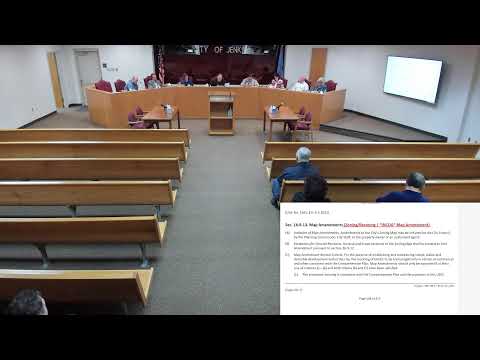
The Jenks Planning Commission voted unanimously to approve a package of updates to Chapter 16 of the City Unified Development Ordinance (UDO), adopting clarifications and new standards for setbacks, roof-mounted structures, places of assembly, parking and administrative procedures, while attaching specific conditions to how places of assembly and roof-mounted structures may be permitted in the riverfront commercial area.
The commission’s action (agenda item number 4) followed an extended staff presentation by Planning Director Ms. Hilton and public comment from Oklahoma Aquarium Foundation representatives who urged caution about loosening assembly-use rules in the Riverfront Tourist Commercial (RTC) district because of parking impacts.
What the commission approved - Places of assembly in the RTC: The commission agreed to allow "place of assembly" (a category that includes event venues, museums and other recurring congregation-type uses) to be permitted in the RTC only through a planned unit development (PUD) process and only if located on the second floor or higher. The motion attaches that condition to table 16-3-4 in the UDO. - Roof-mounted structures: The update creates a review framework for approved roof-mounted structures (non-sign building features) and requires Planning Commission review/approval rather than purely administrative sign rules. Staff described draft limits: structures limited to 15 feet above the roof including supports; no portion extending more than 75 feet above ground; width limited to 33% of roof width or 20 feet, whichever is less; internal (non-blinking) illumination preferred; and a conditional-use-permit–style review circulated through planning, engineering and public safety. - Parking rules and driveway/parking-pad clarifications: The UDO language was clarified to prohibit parking outside of a dedicated drive aisle in residential districts (staff said the language will be aligned with a City policy that provides enforcement guidance). The commission also directed staff to permit exceptions for older homes (staff cited 1985 as a working cutoff) to allow nonconcrete parking pads under specified conditions rather than forcing impervious paving in older neighborhoods. - Setbacks and nonconforming structures: Staff proposed language clarifying that minimum setback standards apply to new construction; existing structures in platted subdivisions or PUDs may continue to rely on setbacks that applied at their time of construction to avoid creating widespread nonconformities and a flood of variance requests.
Why it matters: assembly uses, parking and roof-mounted structures Commissioners and staff framed the RTC changes as a way to balance riverfront activation with protecting existing uses, notably the Oklahoma Aquarium. Keith Montgomery, representing the Oklahoma Aquarium Foundation, opposed allowing places of assembly in the RTC without conditions, saying the aquarium and its campus have shared parking arrangements and that allowing new event venues without negotiated parking agreements could reduce parking available to aquarium patrons. "By adding this change, it basically loses some of our control over our own parking ... it introduces additional risk to us," Montgomery said.
Planning Director Ms. Hilton and other commissioners described the aquarium campus as governed by its own SUPs, plats and deed restrictions that require coordination; staff said PUD review would still allow the aquarium and other campus stakeholders to review and sign off on proposed projects. "If they provided all their parking ... we would not have any objections," Montgomery said, while Ms. Hilton described the multi-layered review PUDs receive and the longstanding practice of negotiating shared parking agreements.
Staff rationale and technical limits Ms. Hilton said staff originally disallowed assembly uses entirely in the RTC because many proposed projects could not meet off-street parking requirements (assembly uses require one parking space per 40 sq. ft. of floor area under the current table). The revised approach permits project-specific consideration through PUDs, including conditions such as requiring the assembly use to be above the first floor and specifying parking provisions as part of the PUD approval. On roof-mounted structures, staff proposed a conditional internal review and specific size and illumination limits intended to prevent flashing or beacon lights and to require review by planning, public safety and engineering.
Commission action and vote A motion to approve the UDO edits, with the conditions that place-of-assembly uses in the RTC be allowed by PUD and only on the second floor or higher, that roof-mounted structures be subject to Planning Commission approval, and that parking in residential areas be prohibited outside dedicated drive aisles, passed unanimously. Recorded votes were: Commissioner Wilson — yes; Commissioner Boers — yes; Commissioner Bowman — yes; Commissioner Nixon — yes; Commissioner Stevens — yes; Chair West — yes.
Public input and commission concerns The Oklahoma Aquarium Foundation (Keith Montgomery) and Charlotte Montgomery, a long-time Jenks resident and aquarium trustee, urged caution. Keith Montgomery said the aquarium already rents its facility for events and works out parking arrangements, and he opposed a change that might allow outside venues to access aquarium parking without negotiated agreements. Charlotte Montgomery said she initially opposed the change but came to see potential uses of upper-floor spaces (museums, cultural exhibits, small event venues) that could activate underused second-floor areas, provided appropriate parking and floor restrictions are applied.
The commission and staff discussed alternatives and enforcement. Commissioners favored keeping the ability to consider assembly uses through the PUD process rather than a blanket prohibition, while adding conditions that aim to protect existing businesses and the aquarium’s operations.
Next steps Staff will forward the UDO amendments to the City Council with the Planning Commission’s recommended conditions. The changes will be incorporated into Chapter 16 text and related code tables; several items discussed were phrased to allow more detailed city policy documents to set enforcement mechanics (for example, defining acceptable drive-aisle dimensions and parking-pad materials in a policy rather than the UDO text).
The commission also received progress updates on other planning work (a parking study and the downtown master plan) and asked staff to continue refining the proposed language before Council consideration.